Global
Industry
SaaS
Services Provided
Search Engine Optimisation
Content Marketing


Publishing more articles feels like progress. But sometimes, it's actually the problem.
A leading print-on-demand platform in India had built an impressive content library. Hundreds of blog posts. Strong domain authority. A solid reputation in the eCommerce space. Their platform helped D2C brands, online sellers, and entrepreneurs launch custom product businesses without dealing with inventory, printing, or fulfillment headaches.
They'd done the hard work of creating educational content. Guides on starting a print-on-demand business. Tutorials on dropshipping. Articles about growing an eCommerce store. The kind of helpful content that should attract customers.
But something wasn't working. Despite all that content, organic traffic had plateaued. Growth had stalled. And here's the worst part: they had no way to know if any of that content was actually driving signups or just attracting visitors who read and left.
When they came to Tenet, we didn't recommend publishing more articles. Instead, we focused on fixing what already existed: reorganizing their content architecture, eliminating internal competition between pages, optimizing high-performers, and building systems to track what actually mattered.
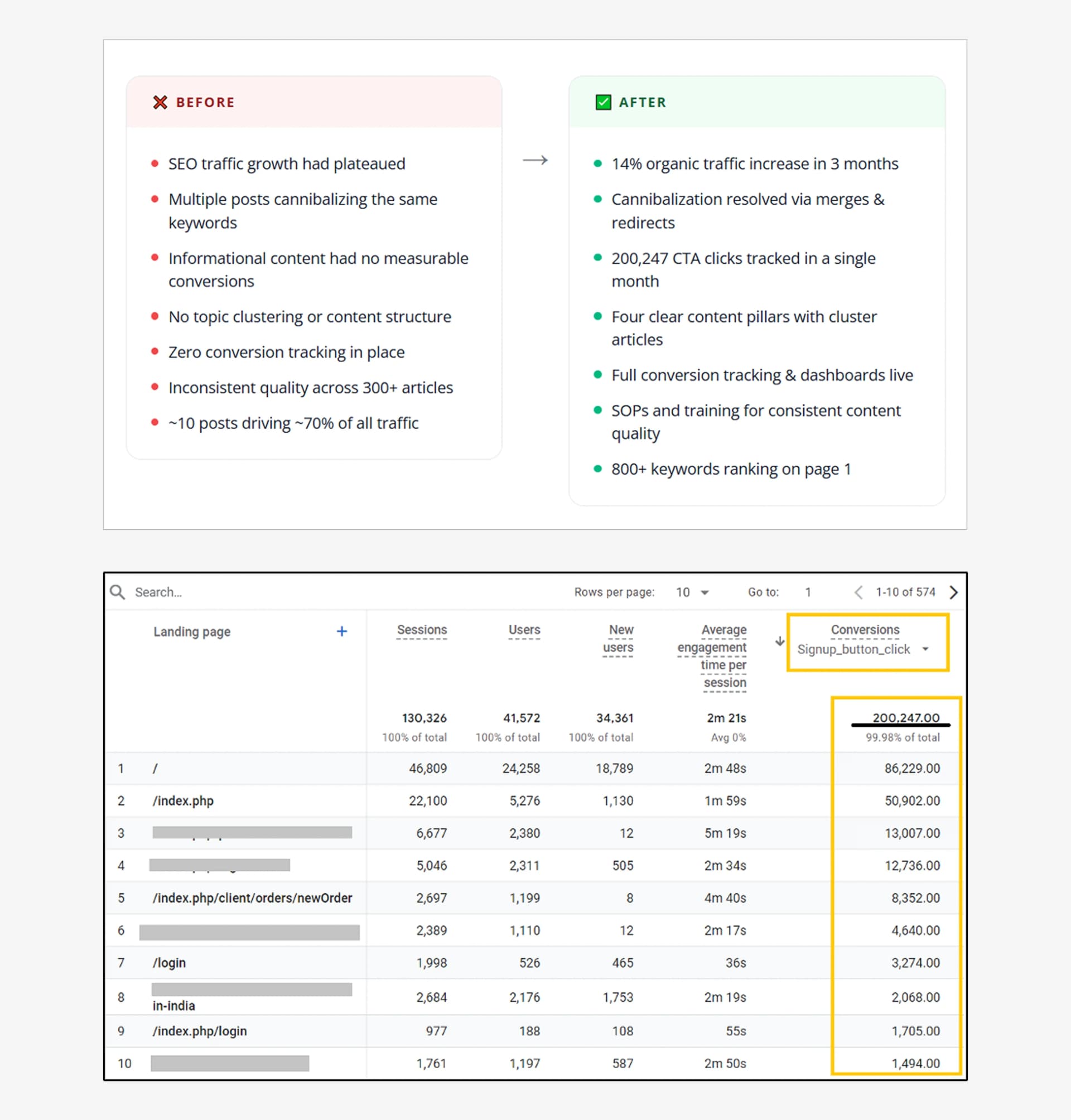
Within three months, organic traffic increased by 14%. Over 800 keywords reached page one positions. The website generated more than 200,000 CTA clicks in a single month. And most importantly, more than 6,000 users signed up for the platform, directly attributable to SEO-driven content.
Our work included comprehensive SEO auditing, keyword cannibalization resolution, content optimization and consolidation, writer training and SOP development, topic cluster architecture, schema markup implementation, and full conversion tracking setup.
Note: The original name of the client has been withheld to comply with NDA obligations. A placeholder name has been used where required for documentation purposes only.
The platform had all the ingredients for SEO success. Strong domain authority built over years. A large library of educational content. Real expertise in the print-on-demand and eCommerce space. Integrations with major platforms that made them genuinely useful to their target audience.But under the surface, several structural problems were limiting their growth.
When you publish hundreds of articles over several years, it's easy to accidentally target the same keywords multiple times. That's exactly what happened here. Multiple blog posts competed for the same search queries, confusing Google about which page should rank. Instead of one strong page, they had several weak ones fighting each other.
This is one of the most common SEO mistakes for content-heavy websites, and one of the most damaging. Every new article on a similar topic diluted the authority of existing pages rather than building on it.
We analyzed the entire blog and found a stark reality: out of more than 300 published articles, roughly 10 posts generated about 70% of all traffic. The rest? Barely contributing anything.
That's not unusual, but it reveals a clear opportunity. Instead of spreading effort across new content, focusing on those high-performers could deliver much faster results.
Perhaps the biggest problem: the team had no idea which content actually drove business results. There was no tracking system connecting blog visits to platform signups. Content felt productive because it generated traffic, but whether that traffic converted into users remained a mystery.
This meant every content decision was essentially a guess. Which topics deserved more investment? Which pages needed improvement? Which calls-to-action worked? Nobody knew.
Multiple writers contributed to the blog over time, and it showed. Some articles were well-optimized with clear structure and strong SEO fundamentals. Others lacked basic elements like proper headings, internal links, or keyword focus. This inconsistency made it hard to scale content production reliably.
The blog had grown organically, article by article, without a clear organizational structure. There were no topic clusters, no pillar pages, no logical hierarchy connecting related content. Users couldn't easily navigate from one helpful article to related resources. Search engines couldn't understand the topical relationships between pages.
The platform had built a valuable content asset, but it wasn't organized or optimized to deliver its full potential. They needed a strategic overhaul, not more volume.
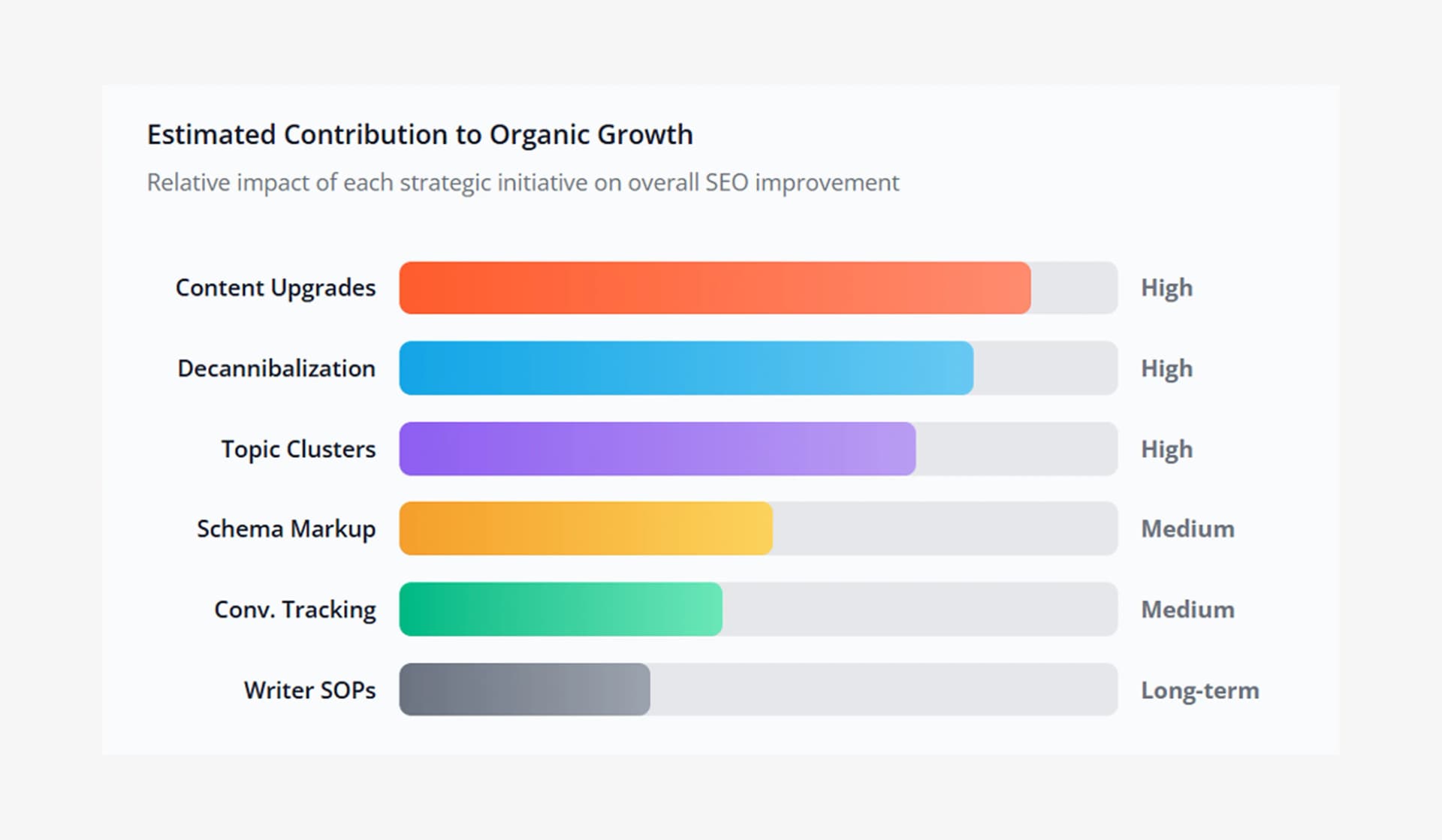
We approached this project with a clear philosophy: fix the foundation before adding anything new. Every optimization focused on making existing content work harder and ensuring we could measure results accurately.
The first priority was stopping pages from competing against each other. We conducted a detailed audit mapping every article to its target keywords, then identified where multiple pages targeted the same or closely related terms.
The solution involved strategic consolidation. We merged overlapping articles into single, comprehensive pages that combined the best content from each source. Thin or outdated content that couldn't be improved was redirected to stronger pages, passing link equity rather than wasting it.
For major keyword topics, we created clear pillar pages that would serve as the definitive resource. Supporting articles linked to these pillars, creating a hub-and-spoke structure that signaled topical authority to search engines. We also rebuilt internal linking throughout the blog. Every article now connected logically to related content, helping both users and search engines navigate the site more effectively.
Since a small number of articles drove most of the traffic, these became immediate optimization priorities. Rather than hoping new content would eventually rank, we improved pages that were already working
The optimization process was comprehensive. We expanded thin sections with additional insights, examples, and practical guidance. We improved formatting with better headings, bullet points, and visual breaks that made content easier to scan. We added relevant images and graphics that increased engagement.
On the technical side, we strengthened internal linking, added semantic keyword variations throughout the content, updated metadata for better click-through rates, and implemented schema markup where appropriate. After completing updates, we resubmitted each URL to Google Search Console to accelerate reindexing.
These updates delivered results quickly. Within weeks, we saw improved impressions, higher keyword rankings, and increased traffic to optimized pages.
Sustainable SEO requires consistent content quality. With multiple writers contributing to the blog, we needed systems that ensured every article met the same standards.
We developed detailed content guidelines and standard operating procedures covering everything from keyword research to final formatting. These SOPs became the blueprint for all future content.
We trained the writing team on search intent mapping, teaching them to understand not just what keywords to target but what users actually wanted when they searched those terms. We covered semantic SEO principles, helping writers naturally incorporate related terms and concepts. We introduced formatting best practices that improved both readability and search performance.
Most importantly, we provided frameworks for making every article conversion-focused. Writers learned to include clear calls-to-action, relevant product mentions, and logical pathways from educational content to platform signup. These investments ensured that content quality would remain consistent regardless of who wrote each article.
To transform the blog from a collection of random articles into a strategic content asset, we organized everything around clear topic clusters.
We conducted deep keyword research to identify the four primary content pillars most valuable to the platform: Print on Demand, Dropshipping, Custom Printing, and eCommerce Growth. These represented the core topics their target audience searched for and the areas where the platform provided the most value.
Under each pillar, we mapped supporting keywords and subtopics. Every existing article was assigned to a cluster, and content gaps were identified for future publishing priorities.
We structured internal links to reinforce these relationships. Pillar pages linked out to cluster articles. Cluster articles linked back to pillars and to related content within the same topic area. This architecture helped search engines understand the site's topical depth and authority.
We also created a centralized learning hub that organized all educational content in one accessible location. This improved user experience by giving visitors a clear path through related resources, keeping them engaged longer and moving them closer to signup.
Technical SEO improvements strengthened how search engines interpreted the website. We implemented structured data markup across key pages, including the homepage, about page, and important product-related pages.
Schema markup helps search engines understand page content more precisely and increases eligibility for enhanced search results like rich snippets. These technical improvements required minimal effort but contributed to overall search visibility.
This was perhaps the most important change. Before our engagement, the team had no way to connect content performance with business outcomes. We built a comprehensive tracking system that changed that entirely.
We implemented tracking on every call-to-action button across the website. We tagged key user events and interactions, from scroll depth to time on page to button clicks. We set up goal tracking specifically for signups and conversions. We created dashboards that connected these metrics to individual pages and content types.
For the first time, the team could see exactly which articles drove user actions. They could identify which topics generated the most signups, which CTAs performed best, and where visitors dropped off without converting. This data transformed content strategy from guesswork into informed decision-making.
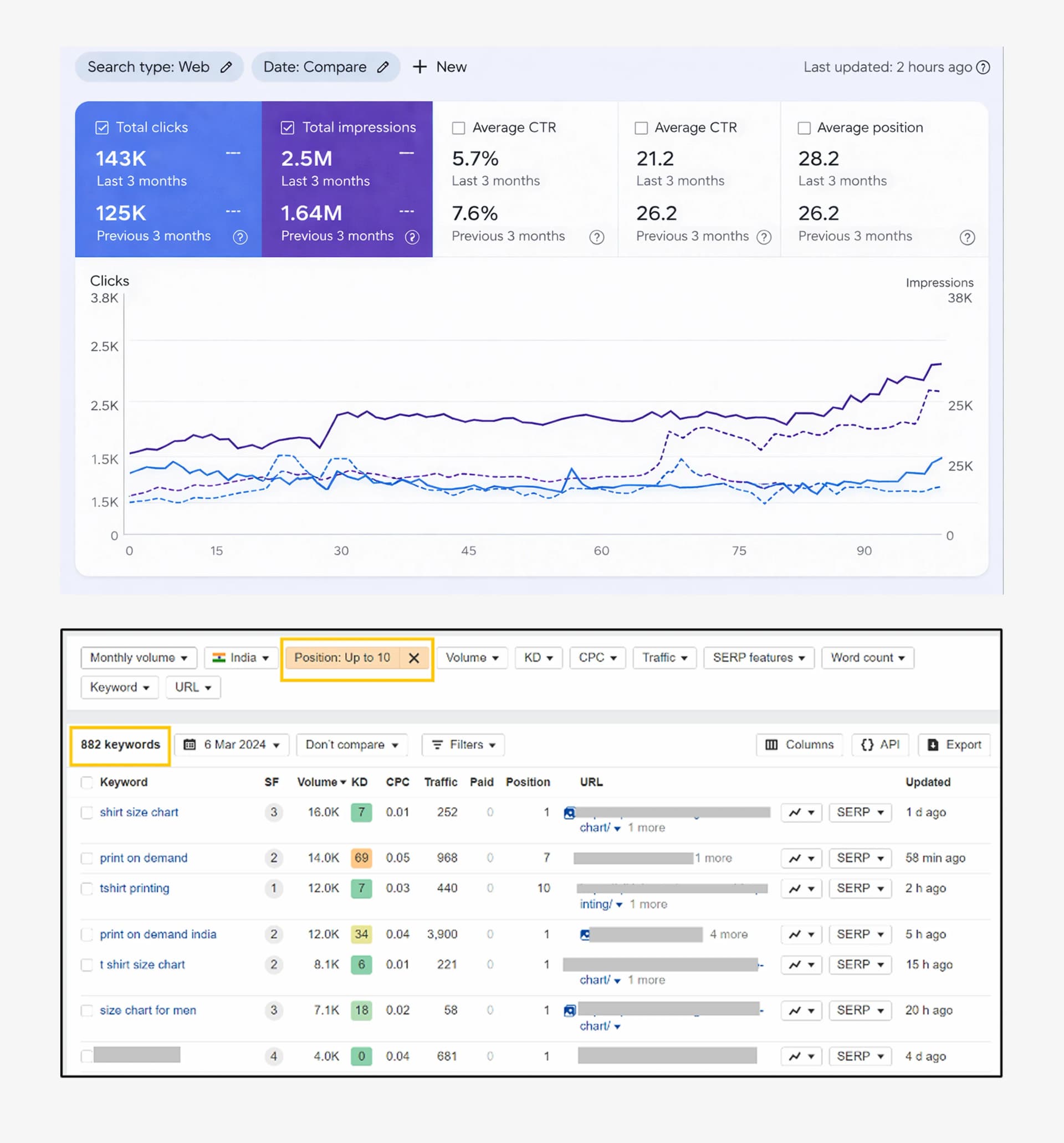
Organic traffic increased 14% within the first three months. This growth came primarily from optimizing existing content and resolving cannibalization issues, not from publishing dozens of new articles.
The traffic increase was also higher quality. By focusing on conversion-oriented content and proper intent mapping, we attracted visitors who were actually interested in using the platform, not just reading about print-on-demand concepts abstractly.
The restructured content architecture and optimization work pushed more than 800 keywords into positions 1 through 10. This represented a significant expansion in search visibility across all four topic pillars.
Importantly, these weren't just random long-tail keywords. The improvements included competitive terms directly related to the platform's core business: print-on-demand tutorials, dropshipping guides, eCommerce growth strategies. The kind of searches that indicate real purchase intent.
With better content structure, clearer calls-to-action, and improved user experience throughout the learning hub, engagement metrics improved dramatically.
In a single month, the website generated more than 200,000 CTA clicks. Visitors weren't just reading and leaving, they were taking action. They clicked through to product pages, explored platform features, and initiated signup flows.
This engagement spike reflected the combined impact of all our improvements: better content quality, clearer navigation, strategic CTA placement, and content that actually addressed user needs rather than just targeting keywords.
The most important metric: more than 6,000 users signed up for the platform through SEO-driven content. At approximately 3.5% conversion rate from button clicks to signups, this demonstrated that the content was attracting the right audience and effectively moving them toward action.
For the first time, the team could directly attribute platform growth to specific content investments. They knew which articles drove signups, which topics performed best, and where to focus future efforts for maximum impact.
Beyond immediate metrics, the project established systems for long-term success. The topic cluster architecture provides a scalable framework for future content. Writer SOPs ensure consistent quality regardless of who creates new articles. Conversion tracking connects every piece of content to business outcomes.
The platform now has what they lacked before: a true SEO growth engine. Not just a blog that publishes articles, but a strategic content system designed to attract qualified visitors, educate them effectively, and convert them into platform users.
This project proved that content strategy isn't about volume. It's about architecture, optimization, and measurement. The platform had spent years building content. In three months, we made that content actually work.ions through accessible, trustworthy guidance exactly when they needed it.
Impact Delivered
450+
Solutions Delivered
for our clients & partners
20M+
People Impacted
through our solutions
15+
Countries Catered
for our global clientele
98%
Client Satisfaction
through verified reviews
Explore other works


We’d love to hear about your brand, your visions, current challenges, even if you’re not sure what your next step is.
Let’s talk