
Bing’s New AI Performance Data for Webmasters
 By
By Share

Share
Get a quick blog summary with



The search demand for the query “Bing Webmaster” has skyrocketed over the last few days. No, Bing did not beat Google at anything big this week.
But it did launch something many webmasters and SEOs have been asking for. Bing Webmaster Tools has rolled out AI performance data that shows how your content is being cited in AI answers.
With more people using AI search and Copilot-style results, site owners want to know one simple thing. Is my content being picked by AI or not.
Till now, there was no clear way to track this. That is why this update got so much attention. It helps you see how often your pages are used as sources, what type of queries trigger those citations, and which pages are getting picked.
As soon as this feature went live, people started checking how it works, what data it shows, and how useful it is for SEO and content planning. In this guide, we will break down what Bing has added, what the data means for your website, and how you can use it in a practical way.
What the AI Performance Report Shows
Source: https://x.com/colorvivo
Bing Webmaster Tools was earlier used mainly to track search performance like clicks, impressions, keywords, and indexing issues.
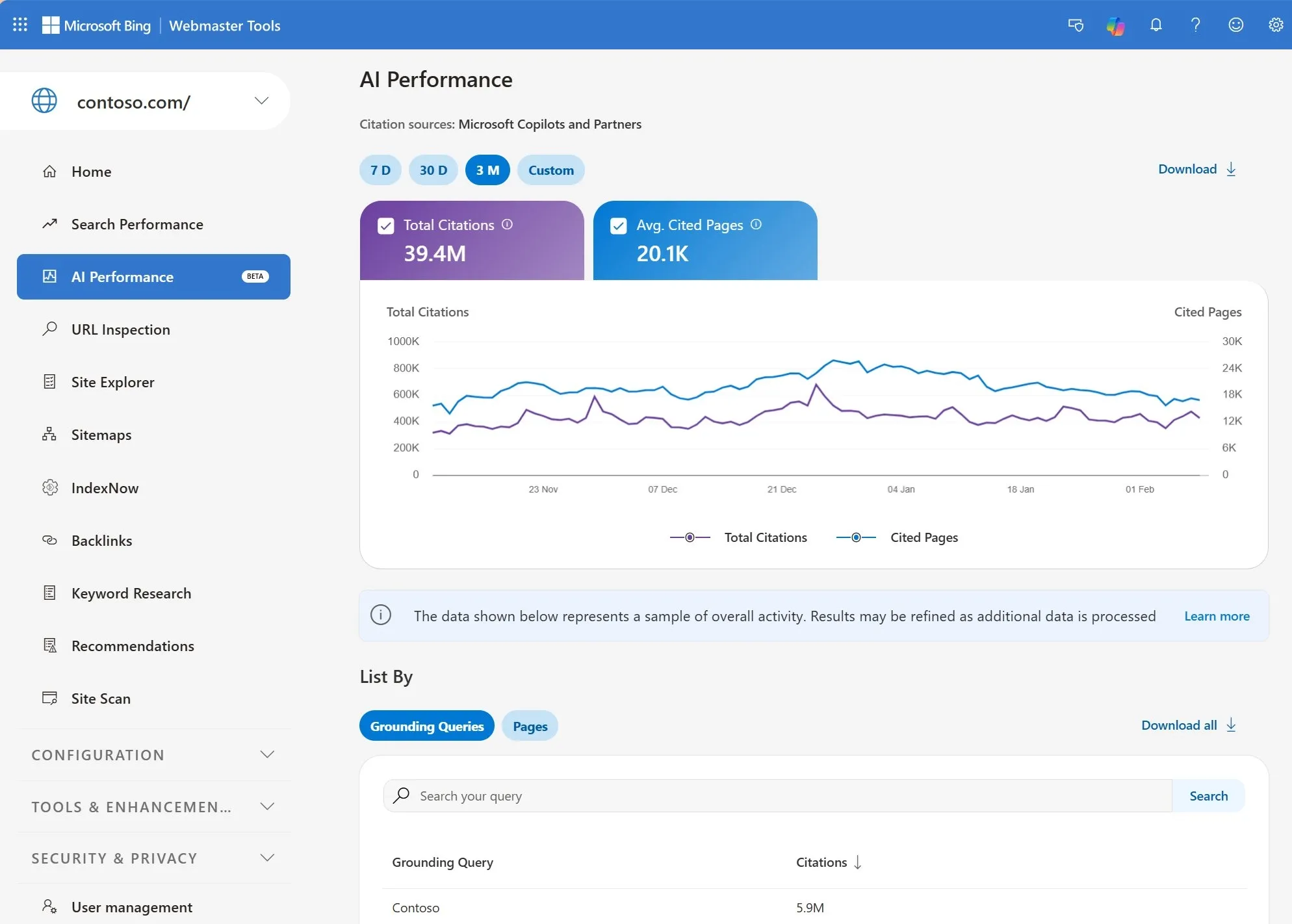
With the new AI Performance report, it now also helps you understand how your content is being used inside AI answers on Bing and Copilot.
Here is what each metric in the AI Performance report actually shows and how you can use it.
a. Total Citations
This shows how many times Bing’s AI has cited your website as a source in AI generated answers during a selected time period. In simple words, it tells you how often your content is being picked by AI.
If this number is growing, it means your content is becoming more visible in AI answers. If it is low or dropping, it may mean your content is not being considered relevant enough for AI responses.
b. Average Cited Pages
This shows the average number of unique pages from your website that get cited by AI per day. This helps you understand whether only one or two pages are getting all the visibility or if multiple pages across your site are being picked.
A higher number here means your content coverage is strong across different topics. A low number may mean only a few pages are useful for AI answers.
c. Grounding Queries
Grounding queries show the type of search queries or prompts that led Bing’s AI to pick your content as a source. This is very useful because it tells you what people are actually asking when your content gets cited. You can use this data to improve your existing pages, add missing details, and create new content around similar queries that AI already trusts your site for.
d. Page Level Citation Activity
This section shows which exact URLs from your site are being cited by AI and how often. It helps you identify your strongest pages for AI visibility.
You can analyze these pages to see what they have in common like structure, depth of content, clarity, or freshness. You can then apply the same approach to other important pages that you want AI to pick up more often.
e. Visibility Trends Over Time
This shows how your AI citations are changing over time. You can see if your visibility in AI answers is improving, staying flat, or declining. This is helpful to understand the impact of your content updates, SEO work, or new pages.
If you notice a sudden drop, it can be a signal to review recent changes on your site or check if competitors are publishing better content on the same topics.
Why Is This Update Important?
This is the first time a major search engine has clearly shared how websites are being cited inside AI answers. Till now, site owners had no direct way to see if their content was being picked by AI tools like Copilot.
People had to guess based on traffic changes or random mentions they spotted manually. That was not reliable and not scalable.
On the Google side, AI features are included within overall search performance reports. But there is no clear, separate view that shows how often your content is used in AI answers, which pages are picked, or what type of queries trigger those citations. That makes it hard for teams to understand what is working for AI visibility and what is not.
Bing’s AI Performance dashboard changes this. It shows how many times your site is cited, which pages are used, and what type of queries lead to those citations.
This level of detail helps SEO and content teams take real action. You can double down on pages that already work well for AI, fix gaps in content, and plan new pages based on actual AI driven demand. This is a big step towards making AI visibility measurable and practical for website owners.
What Does This Mean Going Forward?
While click level data from AI answers is still missing, this update is a strong first step. Microsoft has already mentioned that it will continue refining the AI Performance report and improve the depth and accuracy of the data over time. For now, this gives website owners at least some visibility into how their content is being picked and used by AI, which was completely missing earlier.
This also puts pressure on Google to offer more transparency around AI driven visibility. As AI answers become a bigger part of search results, businesses will need clear data to understand how they show up in these experiences and how that impacts their overall search presence.
We at Tenet work with businesses across industries and help them through our SEO services for both traditional SERP visibility and AI mentions. With this new data from Bing, our SEO and content efforts can become more detailed and insight driven. If you are looking to improve how your brand shows up in search and AI answers, get in touch with our team and we will help you plan the right approach.
Expertise Delivered Straight to Your Inbox
Expertise Delivered Straight to Your Inbox






Got an idea on your mind?
We’d love to hear about your brand, your visions, current challenges, even if you’re not sure what your next step is.
Let’s talk


