
Google Aluminum OS Explained: Features and Early Details
 By
By Share

Share
Get a quick blog summary with



What if your next laptop feels as smooth and intuitive as your phone?
Or imagine having the same operating system running on your mobile, tablet, and desktop, all with powerful AI support built in. That is the idea behind Google’s newly surfaced Aluminum OS.
According to the latest leaks and early details, Google is working on a new Android-based operating system designed to run across laptops, PCs, tablets, and other larger devices. It aims to unify the experience, add deeper AI features, and possibly replace or evolve beyond ChromeOS in the future.
In this article, let us take a look at everything we know about Aluminum OS for now and how it could shape the next generation of Google-powered devices.
What is Aluminium OS?
Aluminium OS is the name that has surfaced for Google’s new Android-based operating system designed for laptops, desktops, tablets, and other larger devices. While it has not been officially announced, the details became clearer after a recent Google job listing mentioned “Aluminium” as part of an upcoming platform for bigger-screen hardware.
From what we know, Aluminium OS is built with AI at its core. Google is planning deeper system-level AI features, better multitasking, and a more unified experience across devices. It also signals Google’s shift from simply maintaining ChromeOS to moving toward a single, more powerful operating system that brings Android and desktop computing closer together.
Why Google Needs Aluminium OS Right Now
Google has been trying to bridge the gap between ChromeOS and Android for many years. Both systems grew in different directions, and managing two separate platforms has always limited how smoothly Google’s ecosystem can work across phones, tablets, and laptops. With the market shifting fast, Google now needs a unified operating system that can run well on all types of devices.
The tech space has also evolved. Users want lightweight laptops, powerful tablets, smart displays, and even small PC boxes that can all stay connected. Other brands are already moving toward unified systems, so Google cannot afford to stay split between ChromeOS and Android anymore.
AI is another major reason. AI is now becoming a core expectation, not an extra feature. By building Aluminium OS with AI at its center, Google can integrate Gemini more deeply into the system and deliver better multitasking, smarter assistance, and more automation across devices.
On top of that, Google needs a stronger position against competitors like Windows and macOS, both of which are adding advanced AI features. Aluminium OS gives Google a fresh chance to compete in the desktop and laptop space with an AI-powered system that feels familiar to Android users but is capable enough for larger devices.
What We Know (So Far): Features, Hardware, and Strategy
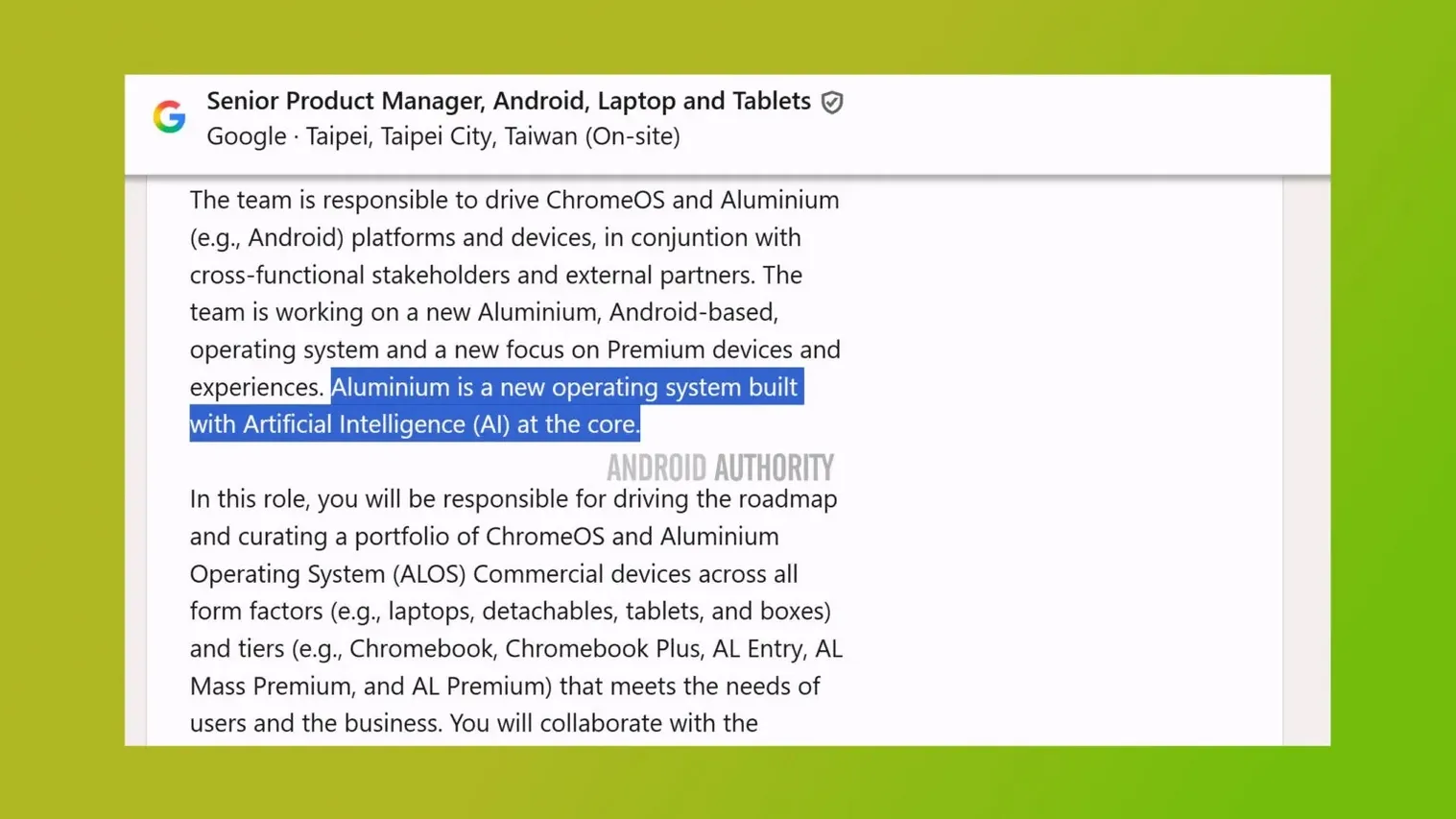
The first solid details about Aluminium OS surfaced after a Google job listing for a Senior Product Manager role mentioned “Aluminium” as part of Google’s plans for larger-screen devices. Since then, more information has come out from internal references and reports.
As shared by Mint, the OS is expected to work closely with ChromeOS during the initial phase. This means Google is not shutting down ChromeOS immediately. Instead, both systems will run in parallel for some time, followed by a gradual migration once Aluminium OS becomes stable.
On the hardware side, early testing reportedly includes Intel and MediaTek platforms. This suggests Google wants Aluminium OS to run across a wide range of devices, from entry-level machines to more premium laptops and tablets. The goal is to cover multiple device categories instead of focusing on one type of hardware.
AI is central to the strategy. Aluminium OS is expected to ship with deeper system-level AI tools, powered mainly by Gemini. That includes smarter multitasking, better real-time assistance, improved automation, and more intelligent device-to-device integration. In simple terms, Google wants this OS to feel like a natural extension of Android but built for bigger screens with AI doing the heavy lifting behind the scenes.
The Road Ahead With Aluminium OS
Changes like Aluminium OS do not just update an operating system. They shift the direction of the entire device ecosystem. When Google introduces a new platform at this scale, it influences how people use their phones, laptops, and everyday digital tools. It also changes how companies build products for these platforms.
At Tenet, we are always exploring how these shifts impact the future of design and development. Our tech team studies upcoming platforms early so we can adapt our workflows and continue delivering modern solutions. Aluminium OS will also influence how we plan and build mobile apps, large-screen experiences, and custom desktop applications for global clients. It will bring new opportunities along with new challenges, and this is exactly what drives innovation at our agency.
If you want to understand how Aluminium OS could impact your product or if you are planning to build a new digital experience, we are here to help. Tenet offers design, research, development, and marketing services to support businesses at every stage. Get in touch with our team and let us help you build what’s next.
Expertise Delivered Straight to Your Inbox
Expertise Delivered Straight to Your Inbox




Got an idea on your mind?
We’d love to hear about your brand, your visions, current challenges, even if you’re not sure what your next step is.
Let’s talk


