
30+ Global Entrepreneurship Statistics and Trends in 2026
 By
By Share

Share
Get a quick blog summary with



Entrepreneurship is growing across the world, but the reality behind the numbers is not simple. More people are starting businesses than ever before, yet many struggle to survive, scale, or build long-term companies.
This research article is based on the Global Entrepreneurship Report, one of the largest and most reliable studies on entrepreneurship worldwide. The report covers 53 economies and tracks how people start, run, and grow businesses across different environments.
Our team at Teney spent weeks studying and analyzing this data to extract what actually matters for founders. Instead of presenting raw statistics, we focused only on insights that directly impact:
- how founders start
- how they survive
- and how they scale
This guide breaks down the most important findings in a simple way, so you can understand what is really happening in global entrepreneurship and how it affects your decisions as a founder.
Here are the key global entrepreneurship statistics from our study:
- In 6 economies, more than 25% of adults are starting or running a business
- In 4 economies, less than 4% of adults participate
- In 8 economies, there are more than 4 startups for every 1 established business
- In some countries, 60% say starting a business is easy, but only 10% plan to start
- In 41 of 48 economies, more than 40% of people avoid starting due to fear
- Economies where fear stops the majority increased from 16% in 2019 to 29% in 2025
- In 34 of 48 economies, most exited founders plan to start again
- In 9 of 23 middle income economies, startups show near gender parity, but none in established businesses
- In 39 of 48 economies, most people start businesses due to lack of jobs
- 84% of entrepreneurs consider sustainability in business decisions
💡 Founder’s Note
“Most founders focus too much on starting and too little on surviving. The data clearly shows that launching a business is no longer the hard part. Staying alive and scaling is where most fail.
If you are building today, focus on three things early:
- Solve a real problem people will pay for
- Keep your costs low until you find traction
- Build distribution as early as possible
“Growth is not something you add later. It needs to be part of your product from day one.” — Shantanu Pandey.
If you are an early-stage startup and need help with product, UX, or growth, the team at Tenet works closely with founders to build and scale digital products.
Where are the most people starting businesses today?
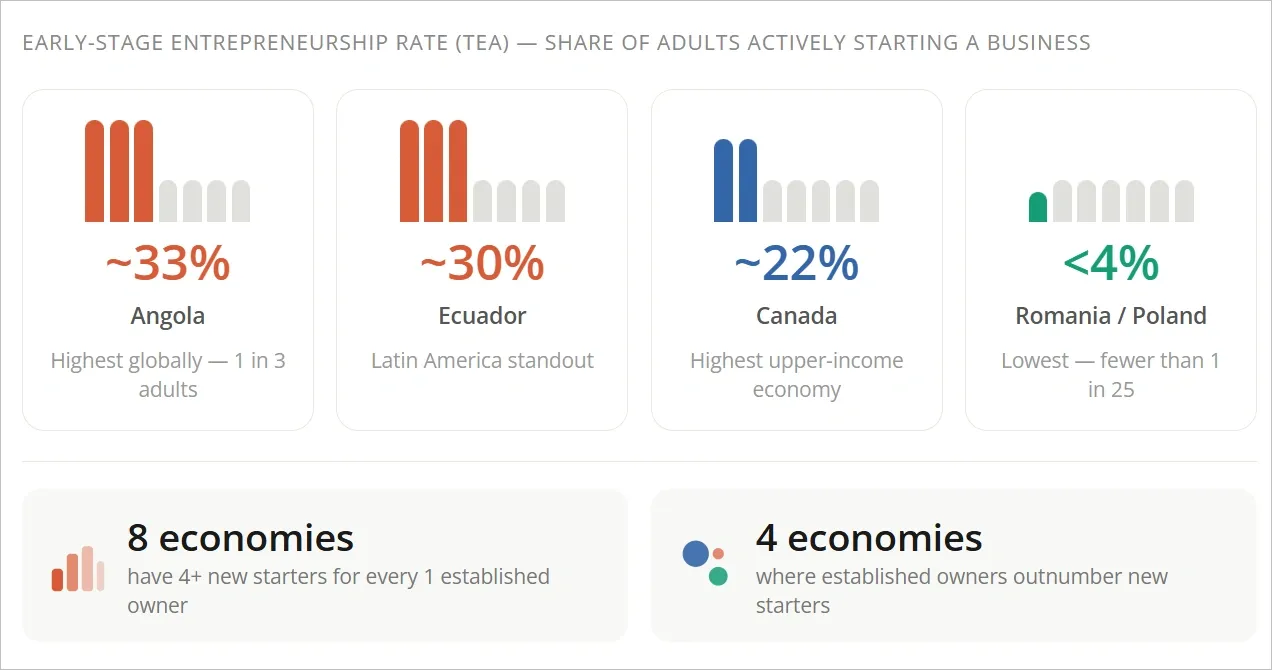
Six economies report that more than one in four adults is actively starting or running a new business: Angola, Ecuador, Chile, Saudi Arabia, Canada, and Guatemala. At the other extreme, four economies have fewer than one in 25 adults engaged in early-stage activity: Qatar, Egypt, Poland, and Romania.
Within the upper-income group, Saudi Arabia, Canada, the United Kingdom, and the UAE each record more than one in five adults starting new businesses. Eight economies have four or more adults starting or running a new business for every one who owns an established one:
- Venezuela
- Argentina
- Chile
- Ecuador
- Angola
- Bahrain
- UAE
- Canada
The pattern flips sharply when looking at established business ownership. Only five economies have one in eight or more adults owning an established business. Seven report established ownership below one in 25. In only four economies does the share of established owners actually exceed the share of early-stage entrepreneurs:
What this means for founders:
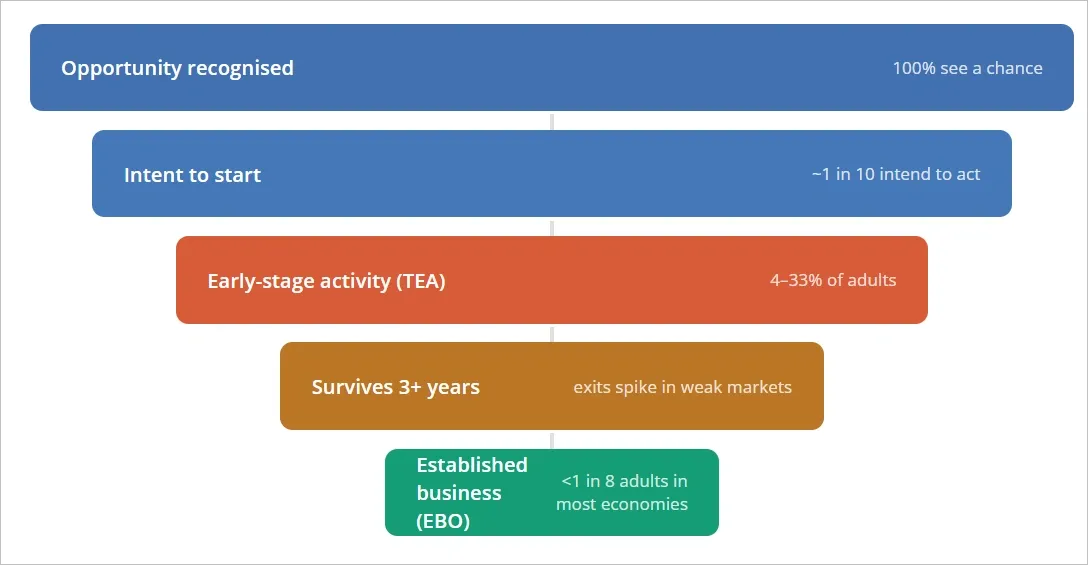
High TEA rates signal a society where starting a business is culturally and economically normalised, which lowers the social risk of founding. But the more operationally important number is the TEA-to-EBO ratio. Where new businesses vastly outnumber established ones, the environment tends to reward entry but not survival.
Founders operating in high-TEA, low-EBO markets face structural headwinds beyond their own execution: weak finance systems, limited market access, and regulatory environments that do not support the transition from startup to scale. In these contexts, survival strategy matters more than growth strategy in the early years.
Does thinking it is easy to start a business actually make people start one?
The relationship is weak. The line of best fit across all 48 APS economies shows a gently positive slope between perceived ease and entrepreneurial intent, but with very low explanatory power. In Poland, Sweden, Norway, and Finland, roughly three in five adults agree that starting a business is straightforward, yet only about one in ten intend to launch one within the next three years. These are some of the widest gaps in the dataset.
The reverse pattern exists in Guatemala, Jordan, Brazil, Angola, and Oman, where the proportion of adults intending to start a business approaches or outpaces the share who consider it easy, largely driven by necessity rather than confidence in the system.
The factors that operate independently of perceived ease include:
- Cultural norms around risk and failure
- Income insecurity and household financial pressure
- Personal risk tolerance
- Fear that the business might fail
- Underlying motivation to start in the first place
What this means for founders:
The practical implication is that a favourable regulatory environment or a simple registration process does not by itself create founder readiness. If you are operating in a market where the process is easy but intent is low, the competitive landscape may be less crowded than the TEA rate suggests, because few of those who could start actually will.
Conversely, if you are in a high-intent, low-ease market, the friction you experience is not unique to you. Navigating bureaucratic complexity while competitors face the same barriers is a leveller, not just a cost.
How often does fear stop people from starting a business?
In 7 of the 34 economies where a majority of adults see good opportunities to start a business, over half of those opportunity-seers say fear would prevent them from acting.
Across the full dataset, in 41 of 48 APS economies, at least 2 in 5 adults who recognise good opportunities would not act on them because they fear failure. In 27 of those 48 economies, the figure sits between 40% and 50% of opportunity-recognisers.
By 2025, the share of economies where fear deters a majority of opportunity-recognisers is nearly double the 2019 level. The only interruption was the first year of COVID-19, where fear briefly declined, likely because necessity-driven activity temporarily overrode psychological risk aversion.
What this means for founders: Fear of failure is not irrational, but GEM data suggests it is often miscalibrated. Non-entrepreneurs tend to overestimate either the probability of failure or its lasting personal and financial cost compared to those who have already started.
The 29% figure means that in nearly one in three economies globally, the dominant psychological response to a recognised opportunity is to walk away from it.
For active founders, this is actually a structural advantage: the population of people who will convert opportunity recognition into action is much smaller than the population who see the opportunity. The barrier is psychological, not informational, which means founders who act despite fear are already filtering out the majority of potential competition.
Do founders start again after a business fails or shuts down?
In 34 of the 48 economies, a majority of adults who exited a business in the past 12 months intend to start another. In 14 of 24 middle-income economies and 20 of 24 upper-income ones, those who have exited are at least twice as likely as non-exiters to plan to start again.
Only 3 economies have over half of non-exiters intending to start, meaning the gap between exiters and everyone else is consistent and substantial across the dataset.
Exit rates and the reasons behind them vary considerably:
The reasons for exit skew negative in most economies:
- Saudi Arabia is the only economy where positive exits outnumber negative ones
- 6 upper-income economies (Sweden, Spain, Netherlands, Germany, Canada, Lithuania) have at least 2 in 5 exits for positive reasons such as selling the business, pursuing other opportunities, or retirement
- 18 economies, split between 13 middle-income and 5 upper-income, have three in four or more exits driven by negative causes including financial losses, excessive taxation, and regulatory burden
What this means for founders:
The data directly challenge the assumption that failure ends entrepreneurial careers. Exited entrepreneurs are significantly more likely to start again than those who have never started, and they carry experience, networks, and a recalibrated understanding of risk.
Are women starting businesses at the same rate as men?
Nine of 23 middle-income economies have reached or are extremely close to gender parity for early-stage entrepreneurial activity (TEA). A further 4 have a ratio of more than four women for every five men. Seven middle-income economies actually record higher female TEA than male TEA:
- India
- Peru
- El Salvador
- Ecuador
- Oman
- Costa Rica
- Chile
Six economies have a gender gap of one percentage point or less: Republic of Korea, Israel, and Poland in the upper-income group, and South Africa, Hungary, and Venezuela in the middle-income group.
At the other end, four economies have at least two men starting a business for every woman: Egypt, Sweden, Norway, and Finland. The northern European cluster is notable given that these are otherwise high-income, institutionally advanced economies, pointing to cultural factors operating independently of systemic resources.
The gap deepens sharply at the established business ownership (EBO) level:
Not a single one of the 48 APS economies records higher female EBO than male. Seven economies are exceptional in that male dominance actually decreases as businesses mature: Luxembourg, Angola, Slovenia, Norway, Romania, Thailand, and Poland.
In the remaining economies, the gender gap widens as ventures grow older.
What this means for founders:
The gap is narrowing at the startup stage but widening at the established business stage identifies where the real structural barriers sit. Women are entering entrepreneurship at increasingly comparable rates to men in many middle-income markets. The problem is survival and scale, not entry.
For women founders specifically, the data points to finance access and network depth as the critical leverage points, not founding confidence.
Are younger people more likely to start businesses than older people?
In 33 of 48 economies, younger adults (18 to 34) are more likely to be starting or running a business than older adults (35 to 64). Germany, Cyprus, and Slovenia stand out as the most extreme cases, where younger adults are twice as likely as older ones to be in early-stage entrepreneurship.
The 15 economies where older adults show higher TEA rates are concentrated in Asia (8 economies) and Latin America and the Caribbean (5 economies), with Switzerland and Egypt completing the group.
In 10 economies, over half of all entrepreneurs are under 35:
- Middle-income: Angola, Jordan, Mexico, India, Ecuador, Guatemala
- Upper-income: Cyprus, Germany, Bahrain, United Kingdom
Five economies have two thirds or more of entrepreneurs in the 35 to 64 bracket: Switzerland, Taiwan, Republic of Korea, Thailand, and Romania.
Age intersects significantly with sustainability priorities, and the results challenge common assumptions:
The largest differences in favour of older entrepreneurs:
- Romania: 61% of younger entrepreneurs prioritise sustainability vs. 86% of older
- Cyprus: 43% younger vs. 63% older
- Norway: 38% younger vs. 58% older
What this means for founders:
The age data matters most for understanding your customer and your competition, rather than just your own position. In markets dominated by younger entrepreneurs, business models tend to be more digitally native, faster-moving, and more willing to operate at a loss in early stages.
Why are people starting businesses today?
An average of 51% of new entrepreneurs across 48 economies agree with the motivation to make a difference in the world. This means a slight majority of new entrepreneurs globally endorse social purpose as a motivating factor alongside economic necessity.
All four GEM-tracked motivations show substantial agreement. The full picture across motivations is as follows:
- "To earn a living because jobs are scarce."
In 39 of 48 economies, over half of new entrepreneurs agree. Six upper high-income economies record agreement from two in three or more new entrepreneurs:
"To build great wealth or very high income"
Majority agreement in 35 of 48 economies. Highest proportions in lower-middle-income economies, with three in four or more agreeing in 8 of them. European economies consistently show the lowest agreement.
"To make a difference in the world"
Average of 51% across 48 economies. Highest in Angola, India, South Africa, Guatemala, and Brazil. Lowest in Republic of Korea, Poland, Argentina, France, and Oman. Has recovered post-pandemic to exceed its pre-2020 level in 2025.
"To continue a family tradition"
Majority agreement in only 5 economies: India, Thailand, Angola, South Africa, and the UAE. Fewer than one in four new entrepreneurs agree in 14 economies. No consistent trend over time.
Correlation between motivations:
- "Make a difference" and "family tradition" have a significant positive correlation (coefficient: 0.61), suggesting purpose-driven and tradition-driven motivations are not as distinct as they appear
- "Build wealth" and "earn a living" have a weak positive correlation (0.26), indicating that material motivations often coexist
What this means for founders:
The 51% figure for "make a difference" is significant because it tells you that purpose-based positioning resonates with the majority of early-stage entrepreneurs globally, not a niche. If you are building tools, platforms, or services for entrepreneurs, leading with impact and purpose framing is not idealistic, it is demographically accurate.
The motivation data also explains why necessity and purpose coexist so commonly in the same founder: the correlation between material and purpose motivations is weak enough that they are genuinely independent drivers, meaning most entrepreneurs are not choosing between them but holding both at once.
Are founders actually focusing on sustainability?
In 35 of 48 economies, a majority of new entrepreneurs report having taken specific steps in the past year to minimise environmental impact or maximise social impact.
An average of 84% across 48 economies report always considering social or environmental implications when making decisions about the future of their business.
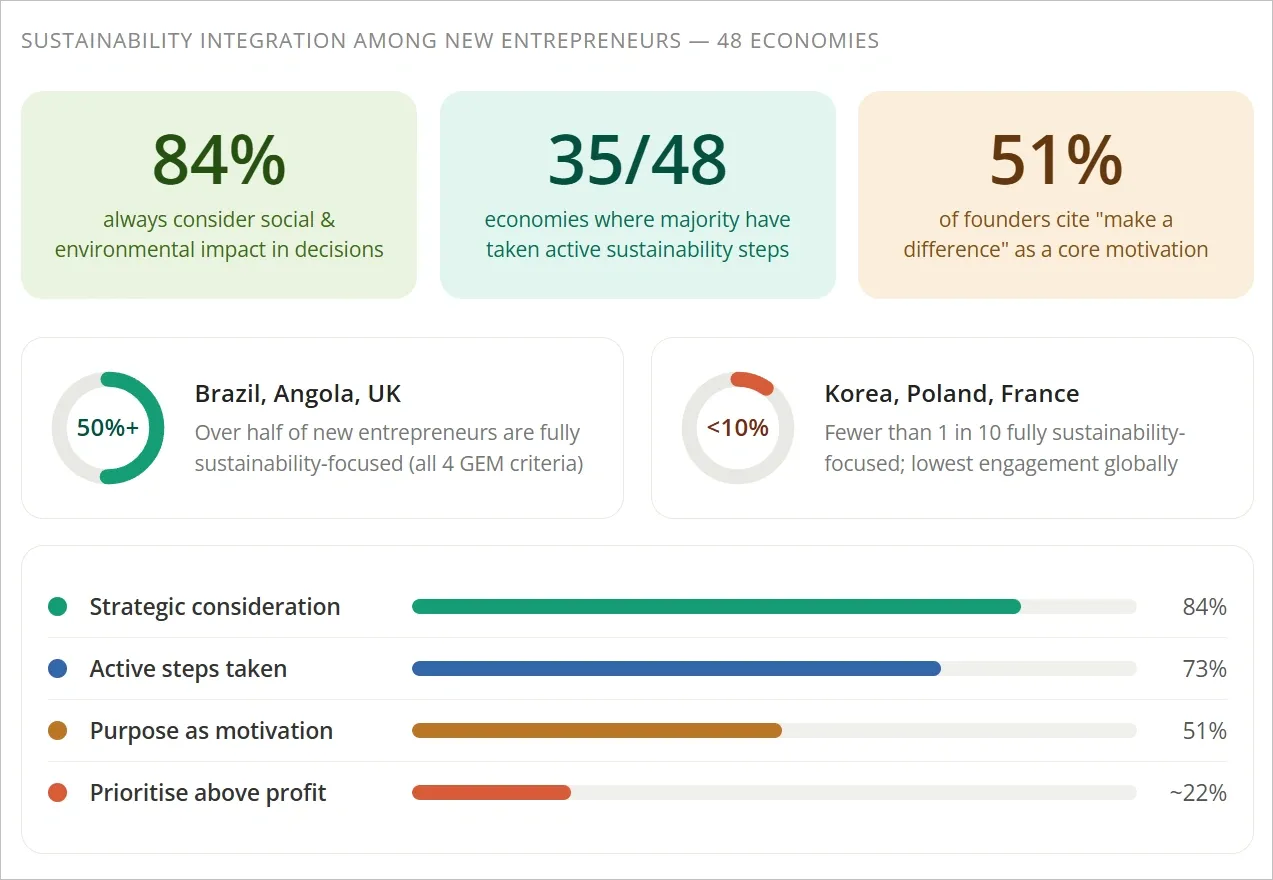
Full breakdown of sustainability integration across three levels:
Level 1: Actions taken in the past year
- Highest action rates: Brazil, Thailand, Romania, Argentina, Poland
- Lowest: Peru at 39%, Sweden at 44%
- Notable shift: India moved from the lowest action rate in 2024 (under one in five entrepreneurs) to 45% in 2025
Level 2: Strategic consideration of sustainability
84% average across 48 economies always consider social or environmental implications in future decisions. Even in the lowest-scoring economies, at least three in five entrepreneurs affirm this: Sweden, Netherlands, and Israel all sit above 60%.
Level 3: Sustainability-focused entrepreneurship (all 4 GEM criteria met)
GEM defines this as new entrepreneurs who simultaneously agree with the "make a difference" motivation, have taken sustainability actions in the past year, always consider sustainability in long-term strategy, and explicitly prioritise social or environmental impact above profit or growth.
In 31 of the 48 economies, older entrepreneurs (35 to 64) are more likely to prioritise sustainability above profitability or growth than younger ones. Agreement with sustainability prioritisation also declines with income level, with the most consistent agreement in lower and upper-middle-income economies.
What this means for founders:
The 84% strategic consideration figure is the most operationally relevant number here. It means that across virtually every market GEM tracks, the large majority of new entrepreneurs say they factor social and environmental outcomes into their forward-looking business decisions.
This has direct implications for B2B founders targeting early-stage companies: sustainability is not a premium add-on feature in your pitch; it is a baseline expectation. The harder distinction to make is between founders who always consider sustainability strategically versus the much smaller group who prioritise it above profit.
Are founders selling to global customers or staying local?
The share of early-stage entrepreneurs with international customers ranges widely by income level. The five lowest shares are all in Latin America and the Caribbean: Costa Rica, Guatemala, Brazil, Venezuela, and Chile. The five highest are all in Europe or the Gulf: the UAE, Lithuania, Estonia, Latvia, and the United Kingdom.
In 8 lower and upper-middle-income economies, fewer than one in ten new entrepreneurs report foreign customers. Among high-income economies, only Poland and Saudi Arabia fall into that category.
Year-on-year change between 2024 and 2025, across 41 economies participating in both surveys:
Largest declines:
Largest increases:
Among the economies most cited in trade tariff debates, changes were modest:
What this means for founders:
The modest changes in major trade economies like the USA, Canada, India, and Mexico suggest that early-stage entrepreneurs are not significantly redirecting their international activity in response to tariff friction, at least not yet. The bigger pattern in the data is structural: international reach is strongly correlated with income level and geography, not just founder ambition.
Which tools do founders rely on, and how important is AI?
Social media is rated very important by the majority of new entrepreneurs in 32 of 36 economies, making it the dominant digital tool globally. In 34 of 48 economies, more than half of entrepreneurs expect to increase their use of digital technologies for selling within the next 6 months.
Full ranking of digital tools by share of new entrepreneurs rating them "very important":
Social media ranks highest in 16 of 21 middle-income economies and 10 of 15 upper-income ones. Email marketing consistently places last across both income groups, being the least important tool in 18 of 21 middle-income economies and all 15 upper-income ones. Digital tools overall matter more to entrepreneurs in middle-income economies (average 57%) than in upper-income ones (average 51%).
Expectations of increased digital technology use in the next 6 months:
- Highest: Angola (93%), Costa Rica (80%), Saudi Arabia (79%), Guatemala (78%)
- Lowest: Sweden (36%), Netherlands (39%), Israel (42%), Venezuela (43%)
AI importance expectations over the next 3 years:
What this means for founders:
The social media dominance finding is not surprising, but the email marketing result is. Despite being one of the most measurable and cost-efficient channels available, email marketing is rated very important by a majority of entrepreneurs in only 4 of 36 economies. This likely reflects both a skills gap and a maturity gap in how founders approach digital channels.
For founders selling to other entrepreneurs, this represents a genuine opening: email marketing capability is undersupplied in the market while demand for customer acquisition efficiency is high. On AI, the divergence between new and established businesses is the most strategically useful data point. New businesses are significantly more likely to expect AI to be central to their operations.
That means AI-native founders are entering markets where their incumbent competitors are less likely to be building AI capability with the same urgency, giving early-stage ventures a window before established players close the awareness and adoption gap.
Which countries are actually good for starting and growing a business?
Only 16 of 53 economies have a NECI score at or above 5.0, meaning fewer than one in three participating economies offer a sufficiently supportive environment for entrepreneurship according to their own national experts.
Only 4 economies meet or exceed sufficiency on all 13 Entrepreneurial Framework Conditions simultaneously: India (middle-income), Lithuania, Saudi Arabia, and the UAE (all upper-income).
Here’s the full NECI rankings as per 2025:
The UAE is ranked first for the fifth consecutive year. Lithuania leads in Europe. Seven of the top ten positions are in Asia, with three in Europe. 9 of the top 10 are upper-income economies, with India the sole middle-income economy in the group.
Latin America and the Caribbean dominate the bottom ten (6 economies), Africa (2), and Europe (2), with 9 being middle-income and Puerto Rico the only upper-income economy in the group.
Several major developed economies sit well below the sufficiency threshold: Japan (4.9), USA (4.8), Norway (4.8), Germany (4.7), Spain (4.4), and the UK (4.2).
What this means for founders:
The NECI data is most useful as a calibration tool rather than a ranking to celebrate or lament. The fact that the USA, Germany, UK, and Japan all sit below the sufficiency threshold tells you that even the world's most prominent startup ecosystems have systematic weaknesses in their entrepreneurial infrastructure.
Explore our other research-based articles:
- https://www.wearetenet.com/blog/saas-pricing-page-design-best-practices
- LinkedIn Profile Optimization Best Practices (Data-Backed)
- What to Include in Your Ecommerce Product Page? (New Study)
Final words
Entrepreneurship today is not limited by opportunity. It is limited by execution, consistency, and the ability to survive long enough to grow.
The data makes one thing clear. More people are starting businesses, but very few are building companies that last. Fear stops many before they begin. Most who start struggle to scale. And only a small number turn early traction into long-term success.
For founders, this changes how you should think.
Do not focus only on launching. Focus on staying in the game. Build something people truly need. Keep your burn low. Learn fast. Adapt faster. And treat growth as a core part of your product, not something you add later.
If you can do that, you are already ahead of most.
And if you need support in building, improving, or scaling your product, teams like Tenet work closely with startups to turn early ideas into sustainable businesses.
Get expert guidance to turn your startup idea into a scalable business
Get expert guidance to turn your startup idea into a scalable business

















Got an idea on your mind?
We’d love to hear about your brand, your visions, current challenges, even if you’re not sure what your next step is.
Let’s talk


