
The True Website Redesign Cost in 2026 (Pricing Breakdown)
 By
By Share

Share
Get a quick blog summary with



Key Highlights
- Website redesigns in 2026 typically cost $3,000 to $160,000+, based on scope and complexity.
- Small business redesigns usually cost $3,000 to $15,000 with templates and basic features.
- Enterprise redesigns often exceed $80,000 due to custom architecture, integrations, and scalability needs.
- Page count, custom design, UX flows, and CMS migration are major cost drivers.
A website redesign can cost around $2,500 to $5,000 for a standard business website in 2026.
This usually covers a focused redesign with a limited number of pages, custom visual improvements, responsive design, and basic UX updates. The cost can increase significantly when the project involves advanced requirements.
Large websites, custom UX flows, complex integrations, ecommerce features, custom development, advanced SEO, AI powered features, or enterprise requirements can push the budget to $10,000, $15,000, or even $20,000+.
At Tenet, we have worked on website design and redesign projects across different industries and business sizes. You can explore some of our **web design case studies** to see how different business goals, UX requirements, and project scopes shape the final website.
In this guide, we break down the main factors that affect website redesign costs in 2026, along with the hidden expenses businesses often overlook when planning their budget.
How much does it cost to redesign a website in 2026?
In 2026, a professional website redesign will realistically cost between $3,000 and $160,000+ USD, depending on complexity, scope, and technical requirements.
Based on current industry data and projected trends for 2026, here is a realistic breakdown of what businesses can expect to pay for a professional redesign:
It is common to find freelancers offering significantly lower starting prices, while established agencies typically work with higher minimum project commitments. The gap between the two is often because of the differences in process depth, team structure, and long-term accountability.
But here's what I tell every client: don't fixate on the number until you understand what shapes it as the same budget can deliver very different outcomes depending on scope and execution.
👉 Explore our website design services by country:
- Web design agency in India
- Web design agency in London, UK
- Web design agency in the USA
- Web design agency in Dubai

What are the factors that will affect your website redesign in 2026?
1. Website Size and Page Count
The number of pages is one of the clearest indicators of cost. Each page requires design, development, and quality checks. Even when templates are reused, pages still need layout adjustments, content alignment, and testing on different devices.
As the website grows, complexity increases. A site with 20 pages moves quickly through planning and production. Once a website reaches 60 to 100 pages, teams must invest more time in UX architecture, structured content mapping, stakeholder reviews, and coordination across teams.
Because this work scales with page volume and internal alignment, larger websites demand more time, resources, and project management, directly increasing the overall redesign cost.
Impact on cost:
- Standard pages: $200 to $800 each
- Unique or complex templates: $1,000+ per layout
- Large sites with 50+ pages: $15,000 to $50,000
2. Design Complexity and Customization
The level of design complexity directly affects how long a redesign will take.
Simple layouts with standard UI elements are faster to design and build, whereas when a redesign includes custom visuals, unique layouts, or advanced animations, the effort increases across every stage of the project.
Modern websites rely heavily on motion-led storytelling, interactive components, and brand-specific visual systems. While these elements improve user experience, they require more design exploration, prototyping, revisions, and cross-device validation.
As a result customization increases, so does the number of iterations and specialist involvement, which extends timelines and raises the cost of design and development.
Impact on cost:
- Custom UI systems: $5,000 to $25,000
- Advanced designs with animations and visuals: $15,000 to $50,000
👉 Discover how to fix the most common web design mistakes that quietly push visitors away.
3. Custom UX Flow and Interactions
Custom UX flows involve more than visual updates. They require planning how users move through the website, what actions they take, and how each interaction supports conversions or product understanding.
Businesses increasingly expect Interactive demos, guided journeys, and micro-interactions which demands deeper UX strategy, detailed prototypes, and careful development to ensure consistent behavior across devices and use cases.
This also means testing interactive elements and custom user journeys across different environments, including the need to test website in different browsers to ensure they perform consistently.
Because these flows require additional planning, testing, and refinement beyond standard page design, they significantly increase both design and development effort.
Impact on cost:
- UX strategy and prototyping: $3,000 to $12,000
- Advanced flows and integrations: $20,000+
4. CMS Choice and Content Migration
Your choice of CMS directly affects the redesign effort. Some platforms are quicker to configure and easier for teams to manage, while others require custom component development, workflow setup, and deeper technical planning.
Content migration adds another layer of complexity. Pages must be moved, cleaned, restructured, and aligned with the new design system. When content is inconsistent or outdated, teams often need to rework layouts and formatting during the migration itself.
As the number of pages grows or the CMS becomes more advanced, the time required for setup, migration, and validation increases, directly raising development effort and total project cost.
Impact on cost:
- Manual migration or structured content work: $100 to $300 per page
- Larger or complex sites: $2,000–$15,000+
5. SEO and Technical Optimization
Strong SEO and technical foundations can make a redesign more time-intensive because they involve far more than just updating content. A redesign must preserve site structure, internal linking, metadata, redirects and more to avoid traffic loss after launch.
Technical performance adds further effort. Improving Core Web Vitals, image optimization, accessibility, and code quality requires careful development and testing, much of which happens behind the scenes.
Because SEO and technical performance issues can affect rankings, traffic, and revenue, teams must invest additional time in planning, validation, and quality checks, increasing the overall scope of the redesign.
Impact on cost:
- Technical SEO strategy and implementation: $2,500 to $8,000+
6. Integrations with Third-Party Tools
Most modern websites rely on external tools for marketing, analytics, lead management, and automation. Each integration requires configuration, testing, and troubleshooting to ensure data flows correctly.
Simple tools like basic forms or analytics are quick to set up. But more advanced tools or integrations, such as CRM systems, marketing automation platforms, customer data platforms, or payment gateways, require more technical alignment and custom logic.
As integrations become more complex, teams must spend more time on development, validation, and security checks, which adds to both timeline and cost.
Impact on cost:
- Basic integrations: $1,000 to $3,000
- Complex API-based integrations: $10,000 to $30,000+
7. Custom Development or Web App Features
Some redesigns involve more than standard marketing pages. Features such as dashboards, calculators, booking systems, or product configurators add significant development complexity.
These features require detailed UX planning, logic mapping, development, and testing. Each workflow must function correctly across devices, user roles, and edge cases, which increases both design and engineering effort.
Because custom functionality introduces additional layers of planning, development, and quality assurance, it substantially increases the scope and cost of a website redesign.
Impact on cost:
- Basic custom features: $2,000 to $10,000
- Advanced web-app functionality: $20,000 to $50,000+
8. AI-Driven Personalisation and Automation
AI-powered features such as personalized content, recommendation systems, chatbots, and automated workflows require deeper technical planning than static pages.
These systems rely on data inputs, integrations with analytics or CRM platforms, defined rules, and extensive testing to ensure consistent behavior across different user segments.
Since AI features add complexity to both user experience and backend infrastructure, they significantly expand development time and testing effort, driving up total redesign costs.
Impact on cost:
- AI-powered personalization and automation: $2,000 to $30,000+
9. Security, Compliance, and Infrastructure
Websites that handle sensitive data or serve large audiences must meet higher security and compliance standards. This includes secure authentication, data protection, encryption, and protection against common vulnerabilities.
Compliance requirements such as GDPR, ADA, or WCAG accessibility guidelines add additional layers of auditing, documentation, and technical remediation.
When security hardening, compliance checks, and infrastructure upgrades are included in a redesign, the technical workload increases and must be carefully validated, which adds to the overall cost.
Impact on cost:
- Security and compliance work: $2,000 to $15,000+, plus recurring costs for security and monitoring tools.
👉 See the latest web accessibility statistics and their real impact on daily user experience.
10. Team Expertise and Location
The experience level of the team working on your redesign has a direct influence on cost. Teams with strong expertise in UX, accessibility, modern frameworks, and performance optimization typically charge more because they follow structured processes and deliver higher-quality outcomes.
Location also affects pricing. Teams based in high-cost regions often have higher rates due to operating expenses and specialization. However, higher rates often reflect experience, reliability, and project management maturity rather than geography alone.
Because expertise and coordination reduce long-term issues and rework, the cost of skilled teams is reflected in higher upfront pricing but often results in better overall value.
Impact on cost:
- Freelancers: $500 to $2,500 (project equivalent for basic work)
- Agencies: $100–$250/hour (adding 20–50% premium for specialized teams in high-cost regions like the US/UK)
- In-house teams: $120,000 to $250,000 over six months
11. Timeline and Project Urgency
Standard redesign timelines allow teams to follow structured workflows with research, design, development, reviews, and quality assurance. This approach keeps effort predictable and costs stable.
When timelines are compressed, teams must reallocate resources, work in parallel, or increase senior involvement to meet deadlines. Faster delivery also reduces buffer time for iteration, increasing pressure on accuracy and coordination.
Because urgent timelines require more concentrated effort and tighter management, accelerated schedules typically increase total project cost.
12. Content Production and Creative Assets
Content creation is often one of the most underestimated parts of a redesign. New copy, updated messaging, images, illustrations, videos, and branded graphics all require planning, production, and review.
As the number of pages and asset types increases, coordination between writers, designers, and stakeholders becomes more complex. Visual consistency and messaging alignment add further review cycles. If the brand is undergoing a refresh, this process becomes even more detailed.
Because content and creative assets must align tightly with the new design system and brand direction, this work adds meaningful time and effort to the redesign process.
Impact on cost:
- New copy and creative assets: $3,000 to $15,000+, depending on scope
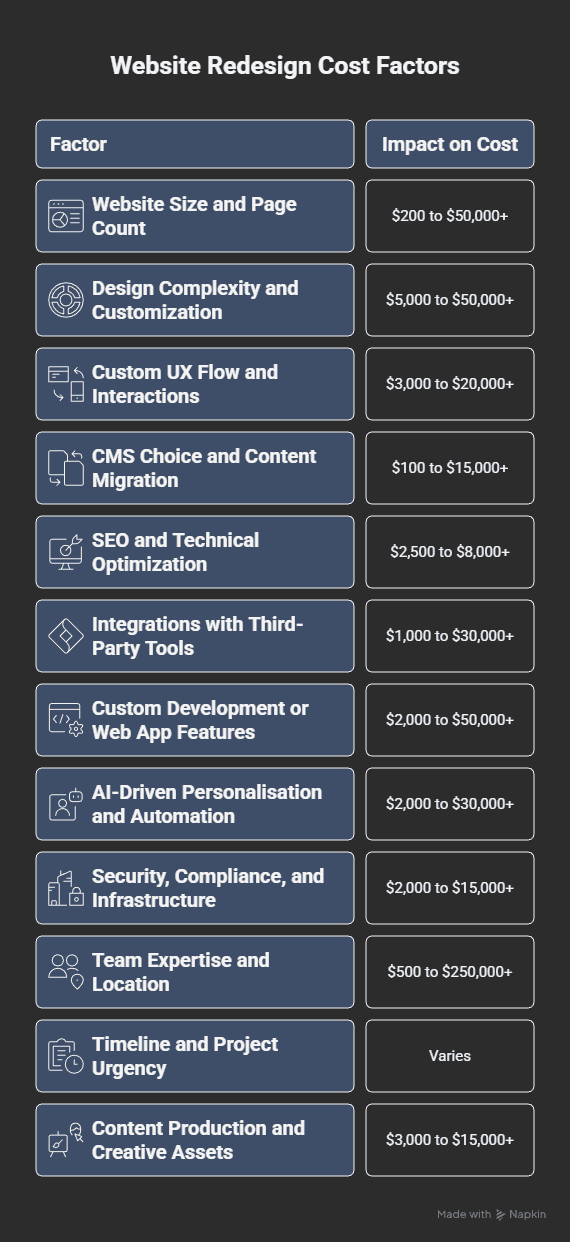
The image below gives a quick overview of the factors that influence website redesign costs.
What Are the Hidden Costs Businesses Usually Miss During a Website Redesign?
Redesign budgets often focus on visible work like design and development, but many operational and long-term costs are commonly overlooked. These hidden costs can add significantly to total expenditure if not planned for in advance.
1. Premium Images, Videos, and Icon Sets
High-quality visuals are essential, but they rarely come free. Stock photos typically cost $15–$50 each, and licensed video clips range from $30–$200. Custom icons or illustration packs can add another $50–$300.
For a mid-sized site, the visual cost can quickly reach $500–$2,000. Examples include:
- Hero images for each main page
- Product or service shots
- Custom icon sets or illustrations
2. Paid Plugins, SaaS Tools, and Security Add-ons
Modern websites rely on premium tools for SEO, analytics, forms, backups, and security.
Individual tools typically cost $20–$350 per year, and most sites require multiple integrations. Combined, subscriptions often total $200–$1,000 annually, a recurring expense that’s easy to overlook.
3. Maintenance and Support After Launch
Websites require ongoing care: CMS updates, security patches, backups, performance monitoring, and minor content changes.
Smaller websites may spend $50–$200 per month, while medium to enterprise sites can reach $200–$1,000 per month. Over a year, maintenance alone can total $600–$12,000+.
4. Content Cleanup, Rewriting, and Migration
A website redesign often exposes content that is outdated, misaligned, or poorly structured. Simply migrating old pages rarely works. Content needs to be reviewed, rewritten, and optimized to match the new design and support SEO and conversions.
Costs vary depending on the approach:
- Freelance writing: $100–$500 per homepage or landing page
- Freelance copywriter with industry expertise: $750–$3,000 per sales page
- Agency bundles (strategy + design + SEO optimization): $5,000–$15,000 for a complete website content package
Investing in professional content ensures that the redesigned site communicates effectively, engages visitors, and aligns with marketing goals, avoiding the hidden cost of low-performing pages.
5. Hosting Upgrades, CDN, and Performance Enhancements
Richer visuals or higher traffic expectations usually require stronger hosting and faster delivery. Typical costs include:
- Managed hosting: $25–$150/month
- CDN and security services: $100–$500/year
Total infrastructure upgrades can range from $300–$2,000 annually, depending on the type of web hosting.
6. Team Training for the New CMS
Switching to a new content management system or backend often requires training for internal teams. Editors, marketers, and administrators must learn new interfaces, workflows, or custom features.
Internal training time is a real cost in terms of labor hours, and external training or consultancy can add hundreds or even thousands of dollars, depending on duration and expertise required.
7. Analytics Setup and Event Tracking
Analytics is often underestimated during a website redesign because teams plan only for basic tracking. In reality, accurate measurement requires thoughtful configuration, governance, consent management, and validation across pages and devices.
As tracking sophistication increases, effort and cost rise quickly.
- Small businesses typically spend $5,000–$15,000 to establish reliable foundations and reporting.
- Mid-sized teams invest $15,000–$100,000 to support custom insights and deeper behavioral analysis.
- Large organizations often exceed $100,000 annually, especially when analytics feeds experimentation, BI tools, and continuous optimization.
When analytics is under-scoped, data breaks after launch, making performance decisions unreliable and costly to correct later.
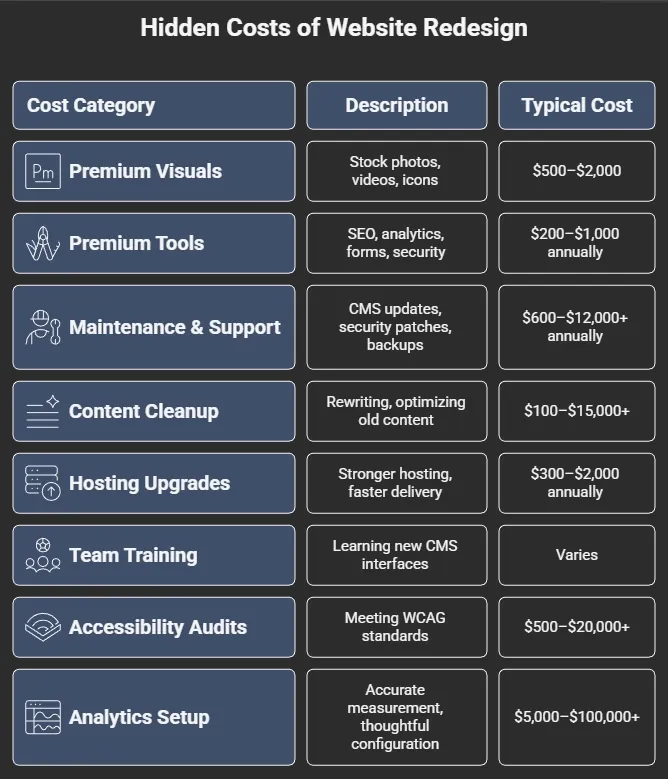
This image gives a quick rundown on the types of hidden costs that impact website redesign budget:
Get a free website redesign quotation from our design experts at Tenet
A website redesign is most effective when it begins with a structured, evidence-driven process. At Tenet, we focus on diagnosing core issues before recommending solutions. Our team evaluates your site’s architecture, content quality, performance metrics, conversion paths, and technical infrastructure to understand what should be preserved, improved, or rebuilt.
This ensures the redesign is not just visually stronger but operationally sound, easier to manage, and aligned with the way your business actually functions.
Our operational model prioritizes transparent pricing, human-centered design, and long-term strategic support. We initiate every engagement with a rigorous discovery phase to define business objectives, user requirements, and technical constraints before we ever discuss pixels or code.
We eliminate hidden fees and prevent scope creep through honest, data-backed conversations about what your website actually needs to perform.
If you want clarity on the real investment needed for your 2026 redesign, our team can prepare a detailed, no-obligation proposal tailored to your goals, platform, and complexity.
Get your free website redesign quotation from Tenet, and move forward with a clear, accurate understanding of scope, timelines, and cost.
Redesign your website for better results. Get a free consultation today.
Redesign your website for better results. Get a free consultation today.



















Got an idea on your mind?
We’d love to hear about your brand, your visions, current challenges, even if you’re not sure what your next step is.
Let’s talk


