
Sketch Creators Introduce Elyx, a New Design Tool Built for the AI Era
 By
By Share

Share

Get a quick blog summary with



AI coding agents have fundamentally changed how software can be built and modified. Developers can now work directly with local source files, Git repositories, version history, and AI agents to write, review, and update code.
Design still largely works differently. Product designs are commonly maintained as visual files inside dedicated design platforms. This can create a gap between what the designer intended, what exists in the design file, and what developers actually implement in the product.
That gap becomes more important as AI agents take on more of the development process. When an AI agent can modify production code, it also needs access to the design context behind that code.
This is the problem Elyx is trying to address. Created by Sketch co-founders Pieter Omvlee and Emanuel Sá, Elyx is built around a different approach to product design.
Its central idea is to make design structured, readable, versionable, and accessible to both humans and AI agents. Instead of keeping design separate from the development workflow, Elyx aims to make design files work alongside code, Git, and AI tools.
Sketch's Founders Are Building Elyx Around a Different Design Philosophy
Elyx comes from the same team behind Sketch. The product was created by Sketch co-founders Pieter Omvlee and Emanuel Sá, who have spent years building tools for digital product design and collaboration.
That experience is important because Elyx is not simply adding AI features to an existing design workflow. The team is taking a different approach to how design should work as AI becomes part of software development.
The traditional workflow treats design primarily as a visual artifact. Designers create screens, components, and prototypes in a design tool, and developers then use those designs as a reference during implementation.
Elyx is moving toward a different model:
Traditional visual design workflow → Design as structured development infrastructure
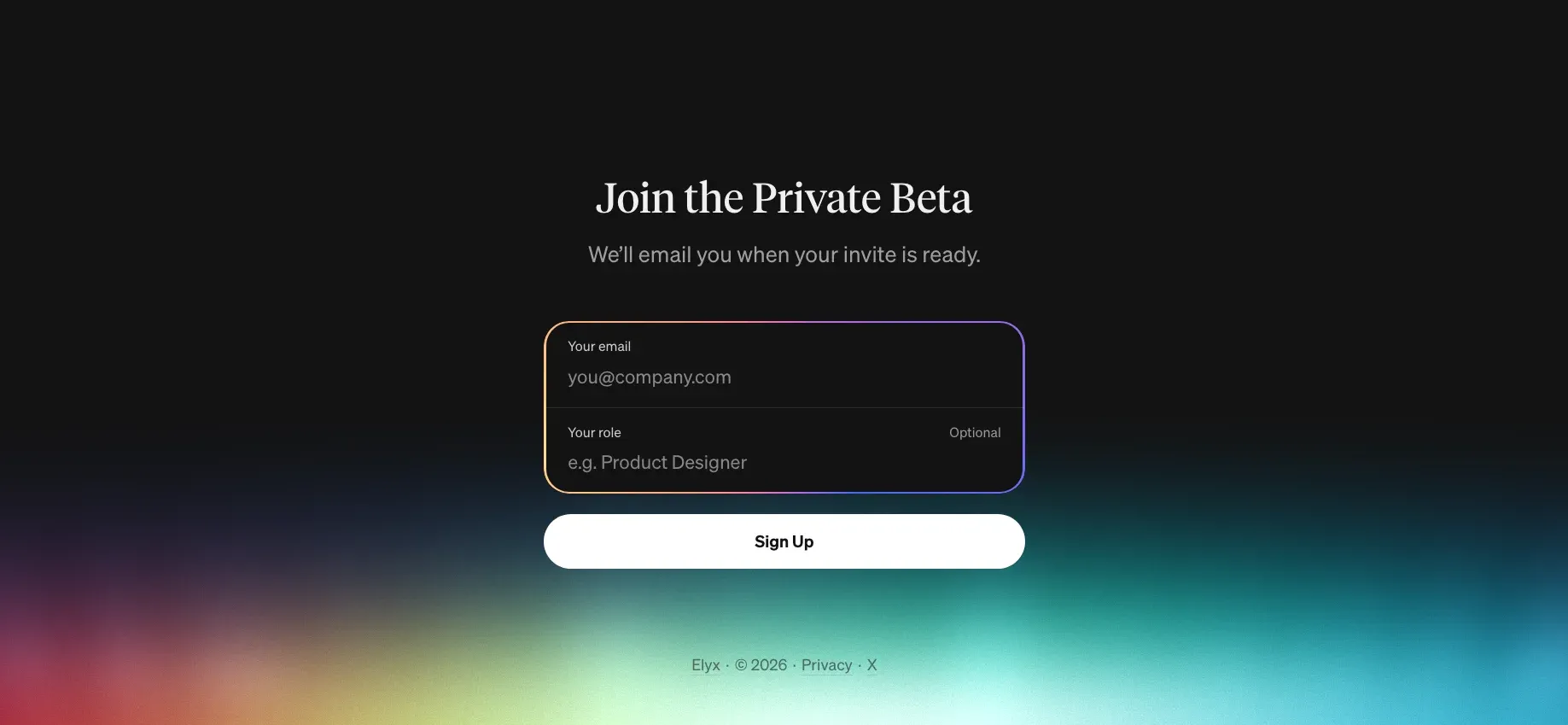
The idea is to make design files structured enough to be versioned, shared with developers, and understood by AI agents. Instead of design sitting separately from the codebase, Elyx is designed to make it part of the same development workflow.
What Exactly Is Elyx?
Let's break Elyx down into three components because the product is more than just another visual design editor. Elyx itself describes the platform around a design language, a visual design environment, and tools that allow AI agents to work with design files.
A. A New Design Language
At the centre of Elyx is its .elyx file format. These files are designed to store product designs as structured data rather than keeping them only as visual documents inside a design platform.
Elyx describes .elyx files as:
- Human-readable, so designers and developers can understand what they contain
- AI-readable, allowing AI agents to inspect and work with design information
- Versionable, making them suitable for Git-based workflows
- Reusable, so design elements and structures can be used across projects
- Local, allowing files to live on a user's computer or alongside source code
This is an important part of Elyx's approach. The goal is to make the underlying design representation useful outside the visual editor, including in development and AI workflows.
B. A Visual Design Environment
Elyx is not only a file format. It also provides a visual environment where designers can create and edit products.
The editor includes familiar design capabilities such as:
- Components
- Variants
- Themes
- Design tokens
- Stacks
- A freeform canvas
- Visual editing
This means designers can continue working visually rather than having to define every part of a product through code or prompts.
The difference is that the work created in the editor is represented through Elyx's structured file format, which can then be used outside the canvas.
C. CLI and Agent Tooling
The third part is the tooling that connects Elyx with development and AI agents.
Elyx provides a command-line interface and agent skills that allow tools such as AI coding agents to interact with .elyx files. This can include inspecting designs, checking files, formatting them, and rendering design output.
The approach is similar to how AI coding agents work with software repositories. Instead of asking an AI to interpret a screenshot of a design, the agent can work with the underlying structured design files.
That gives Elyx three connected layers:
.elyx files → Visual design environment → CLI and AI agent tooling
Together, these are what make Elyx different from a conventional design editor.
What This Means for Designers and Developers
One of the major changes Elyx is proposing is a closer connection between design and development. Instead of treating the design file as something that is handed over to developers after the design work is complete, Elyx is designed to make the design itself part of the development workflow.
For designers, this means they can continue working with a visual interface, components, variants, themes, tokens, and a freeform canvas. At the same time, their work is stored as structured .elyx files that can be versioned, reused, and accessed by AI agents. This could make design decisions easier to carry through as a product moves from early concepts to development.
For developers, the main change is that design files can live closer to the code and development workflow. .elyx files can be stored locally or alongside a Git repository, while CLI and agent tooling allows AI agents to inspect and work with the design.
This could give developers and coding agents more context about the intended interface instead of relying only on exported designs, screenshots, or handoff documents.
The larger idea is to reduce the distance between what is designed and what is built. Instead of design and development operating as separate stages, Elyx is trying to create a workflow where designers, developers, and AI agents can work from the same structured product context.
Expertise Delivered Straight to Your Inbox
Expertise Delivered Straight to Your Inbox






Got an idea on your mind?
We’d love to hear about your brand, your visions, current challenges, even if you’re not sure what your next step is.
Let’s talk


