
AI SEO Writing: 15 Tips to Create AI SEO Optimized Content
 By
By Share

Share
Get a quick blog summary with



Google no longer reads content the way it did 5 years ago.
In 2019, Google introduced BERT, a neural network that reads sentences in both directions and understands context, not just keywords. In 2021, it introduced MUM, which is far more advanced and can process text, images, and video across multiple languages.
This changed how content gets read, ranked, and cited. Google now evaluates content at the passage level. This means a single paragraph can rank even if the full page does not fully match the query.
At our agency, our SEO experts use these same SEO principles to create content that ranks and converts. We focus on how Google processes information and how users consume it.
These 15 principles explain the exact writing decisions that help Google understand, extract, and cite your content. Each one focuses on what works and why it works.
TL;DR (15 Principles for AI SEO Writing)
- Answer the query in the first paragraph
- Use clear definition format for key terms
- Align content with search intent before adding details
- Structure headings with clear hierarchy and purpose
- Write short, active voice sentences
- Use signal words to connect ideas clearly
- Include relevant entities to improve context
- Place keywords naturally in key sections
- Support claims with data and named sources
- Add trust signals and proof in high-intent content
- Use clear and descriptive anchor text
- Keep paragraphs short and focused
- Format content for easy extraction and scanning
- Write FAQs as complete and direct answers
- Use original research from diverse sources
👉 Want our experts to deliver growth in AI SEO? Check out our SEO services and get a free proposal.
Section 1: How Google Reads Your Content
Tip 01: Answer the query in the first paragraph of every section
Google's passage ranking system evaluates individual paragraphs independently of the rest of the page. When Google introduced passage ranking in 2020, it stated the goal was to find content where a single sentence answering a query might be buried deep in a page. The system scores that passage separately from the overall page.
Why it works:
The opening sentence of a section carries the highest scoring weight in passage evaluation. If the answer is in sentence three or four, Google scores that passage lower than a page where the answer is in sentence one.
For AI Overviews, CXL research found that 55% of citations come from the first 30% of the page. Burying the answer significantly reduces the extraction probability.
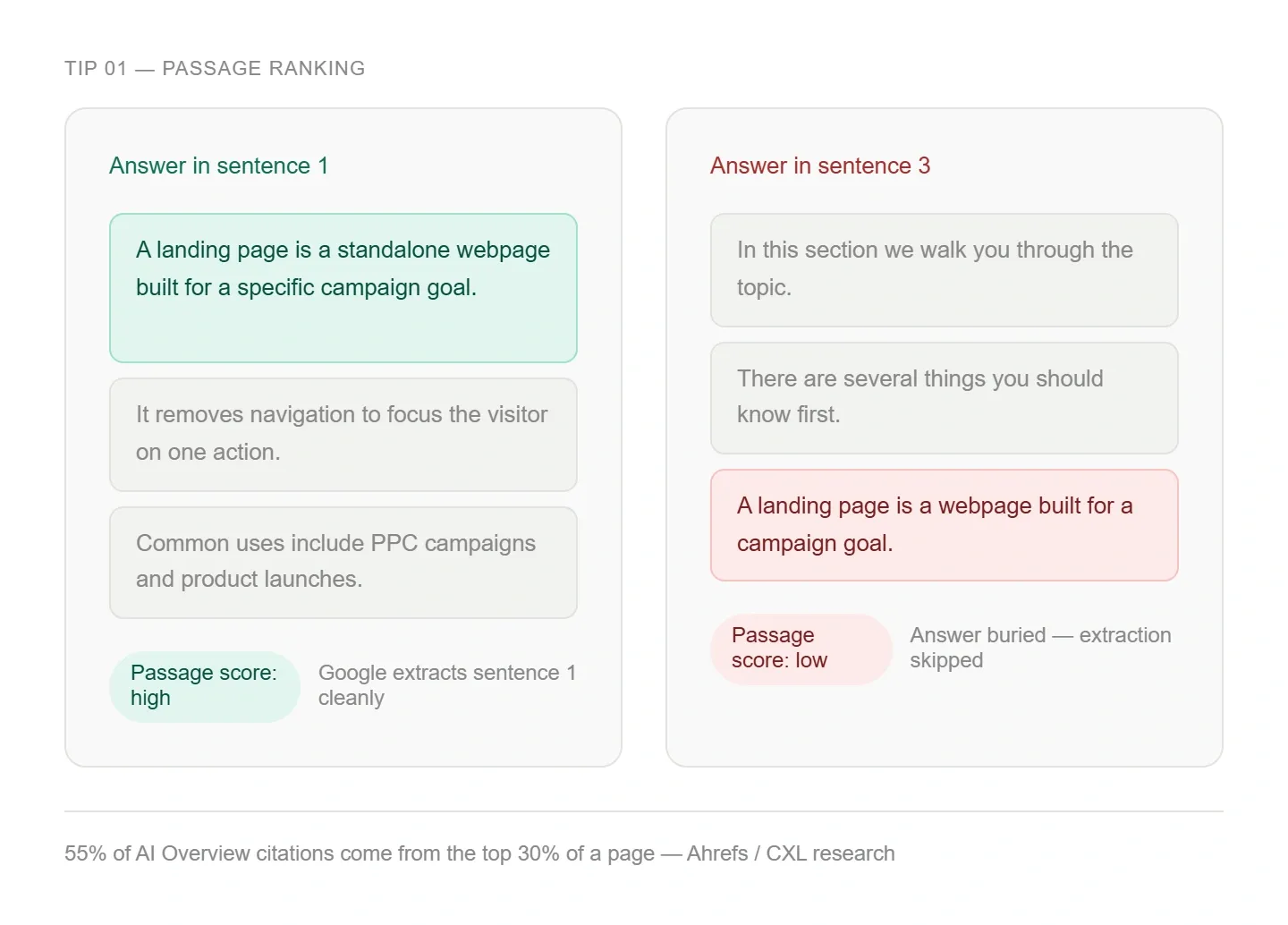
Good: A landing page is a standalone webpage built for a specific marketing campaign or goal. It removes navigation and distractions to focus the visitor on one action.
Avoid: In this section, we will walk you through what landing pages are, why they are used, and how they differ from regular web pages.
The second version scores poorly because it describes what will be answered rather than answering it. Google treats it as a preamble, not an answer.
Tip 02: Use the [Term] is [Definition] structure for every definition
BERT uses a process called dependency parsing, where it maps grammatical relationships between words to determine which words perform which role in a sentence. Subject, verb, and object relationships tell the model what is being defined, what is acting, and what is being acted upon.
Why it works:
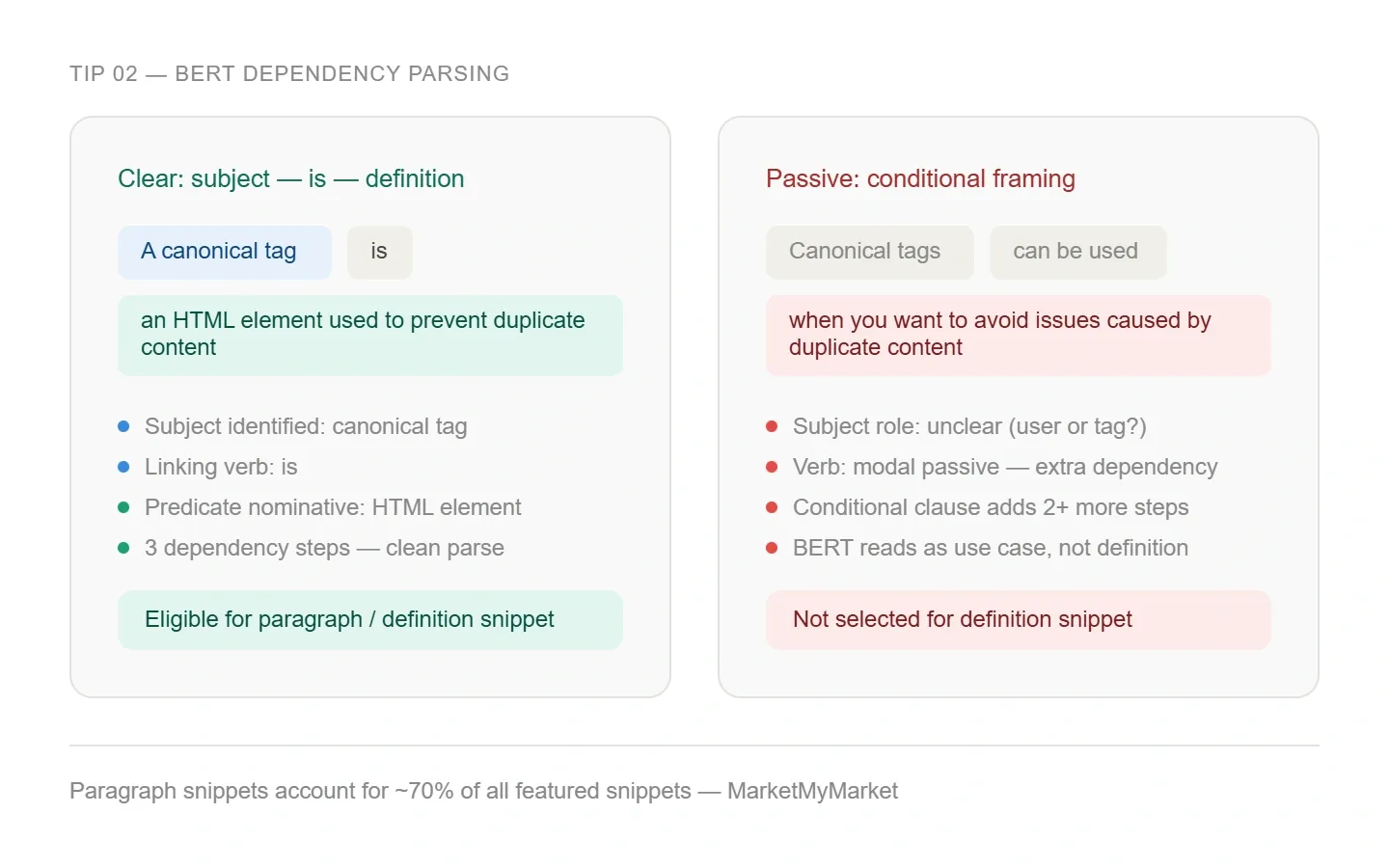
Declarative sentences in Subject Verb Object format create the clearest dependency parse for NLP systems. The structure '[Term] is [Definition]' produces a parse where the term is the subject, 'is' is the linking verb, and the definition is the predicate nominative.
This is the exact structure Google looks for when selecting paragraph snippets, which account for approximately 70% of all featured snippets according to research from MarketMyMarket.
Good: A canonical tag is an HTML element used to tell search engines which version of a duplicate or similar page should be indexed and ranked.
Avoid: Canonical tags can be used in situations where you want to avoid issues caused by duplicate content across multiple URLs on your site.
The second version uses passive construction and delays the definition with conditional framing. BERT reads it as a description of use rather than a definition, which reduces its eligibility for the definition snippet format.
Tip 03: Match the search intent type before adding context
Google classifies every query into one of four intent types: informational, navigational, transactional, or commercial. RankBrain, the machine learning system that handles intent classification, determines which intent applies and then scores pages based on how directly they serve that intent. BERT refines the semantic understanding once intent is identified.
Why it works:
If your content does not serve the classified intent in the opening of a section, RankBrain scores it as a weak match regardless of overall page quality. For informational queries, the intent is satisfied by a direct answer. For transactional queries, the intent is satisfied by an action or outcome. Both require that the relevant content appear at the top of the section, not after context or background explanation.
Query: Why is page speed important?
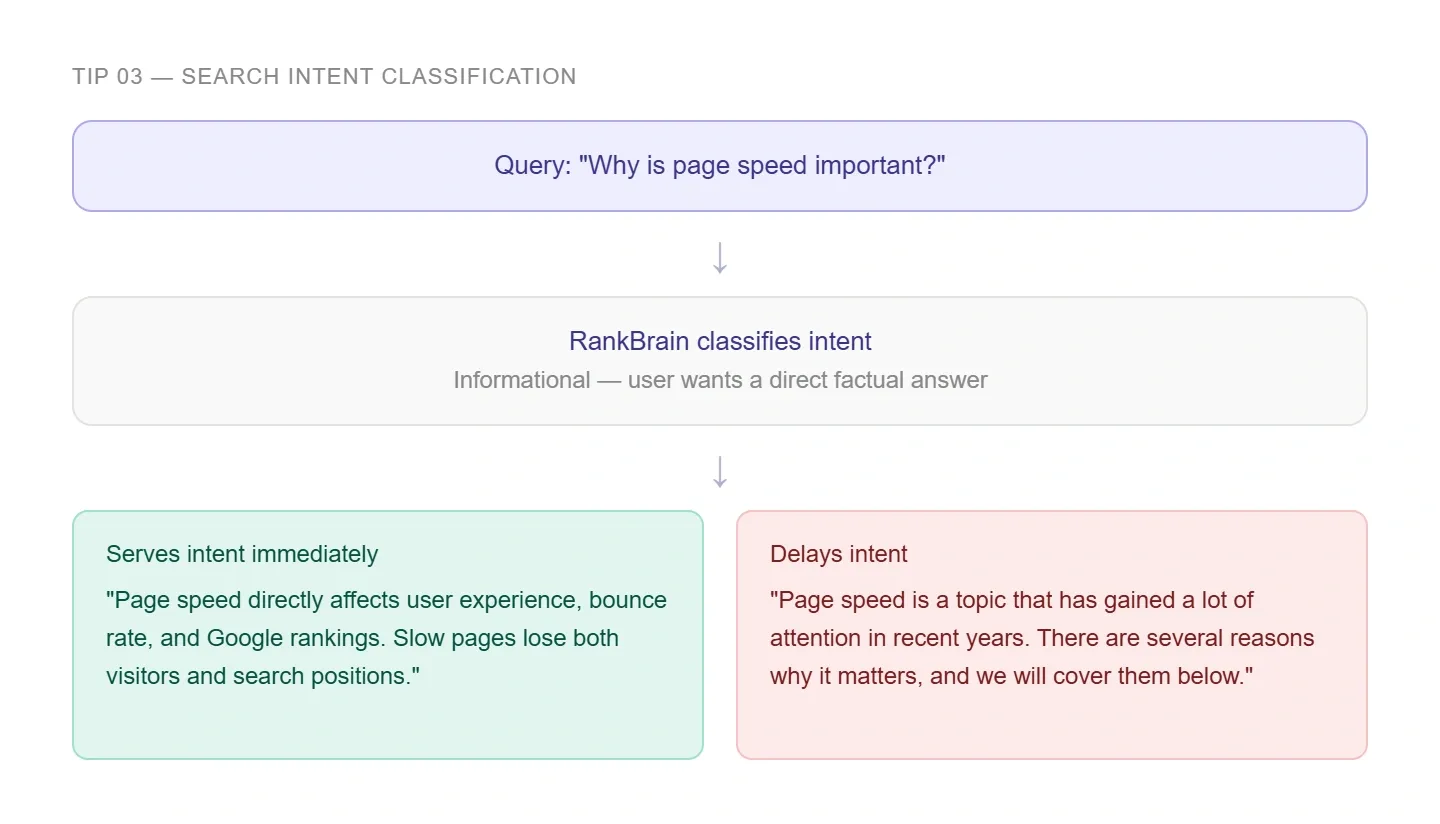
Good opening: Page speed directly affects user experience, bounce rate, and Google rankings. Slow pages lose both visitors and search positions simultaneously.
Avoid: Page speed is a topic that has gained a lot of attention in recent years.
There are several reasons why it matters for websites, and we will cover them below. The second version acknowledges the topic but does not serve the informational intent. RankBrain assigns a lower relevance score because the passage does not provide the answer the query is seeking.
Tip 04: Write H2 headings as questions, H3 headings as supporting detail labels
Google uses heading tags as structural signals to map topic hierarchy before it processes body content. A study of featured snippet selection patterns shows that H2-level question headings significantly increase snippet eligibility because they directly mirror how users phrase queries.
Why it works:
When BERT processes a page, it uses headings to identify where topics start and end before evaluating individual passages. Headings that match question formats align with how queries are submitted, which improves the passage score for the body content beneath them.
H3 headings under a main H2 section tell Google these are sub components of the same topic, improving topical coherence for that cluster of passages.
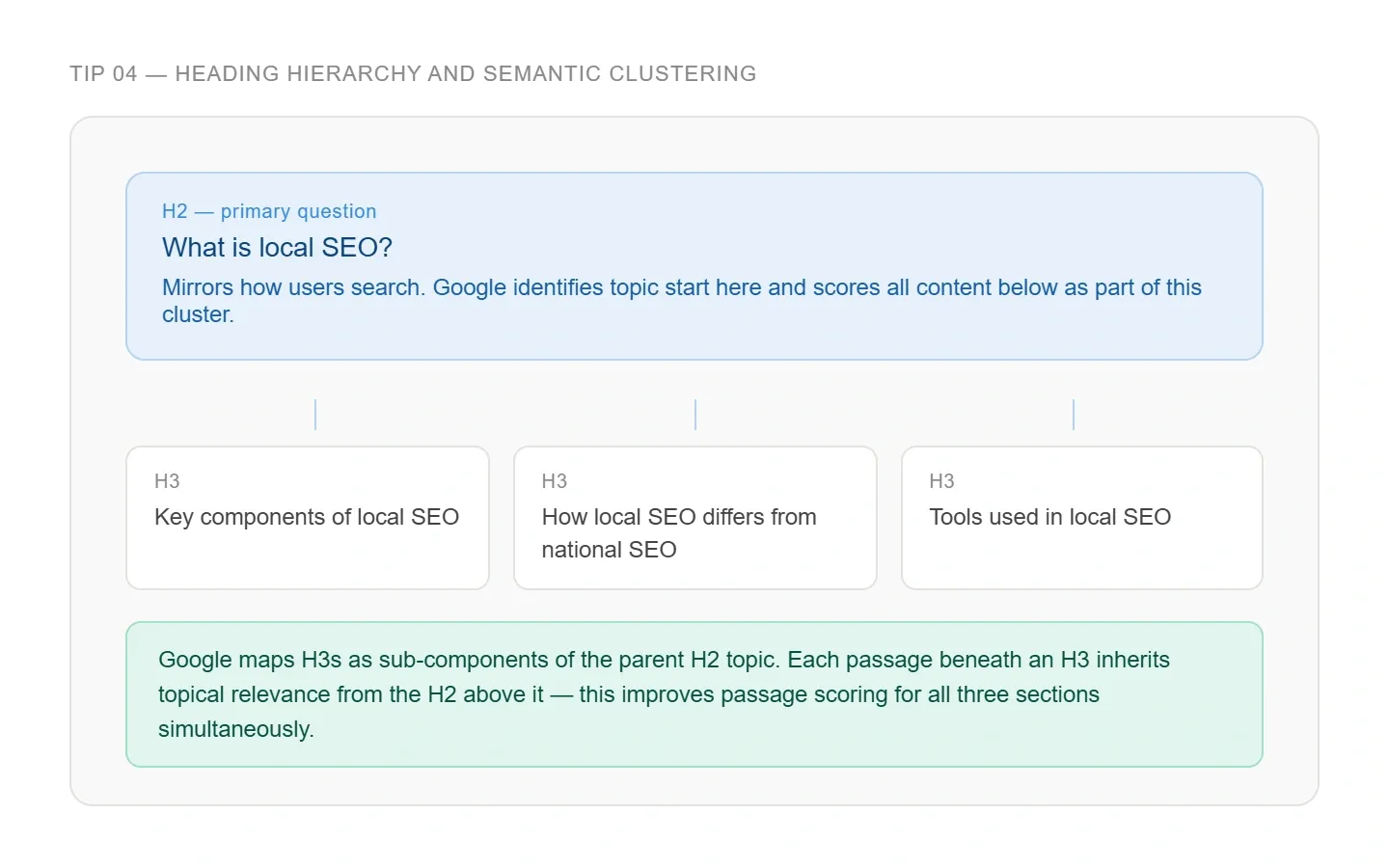
H2: What is local SEO?
H3: Key components of local SEO
H3: How local SEO differs from national SEO
This structure tells Google that the H2 is a primary question and the H3s are sub answers. Google maps this as a coherent semantic cluster rather than isolated content blocks.
Section 2: NLP Signals Google Reads in Your Writing
Tip 05: Write in active voice with sentences under 20 words
BERT reads sentences bidirectionally. It processes every word in context of all surrounding words simultaneously.
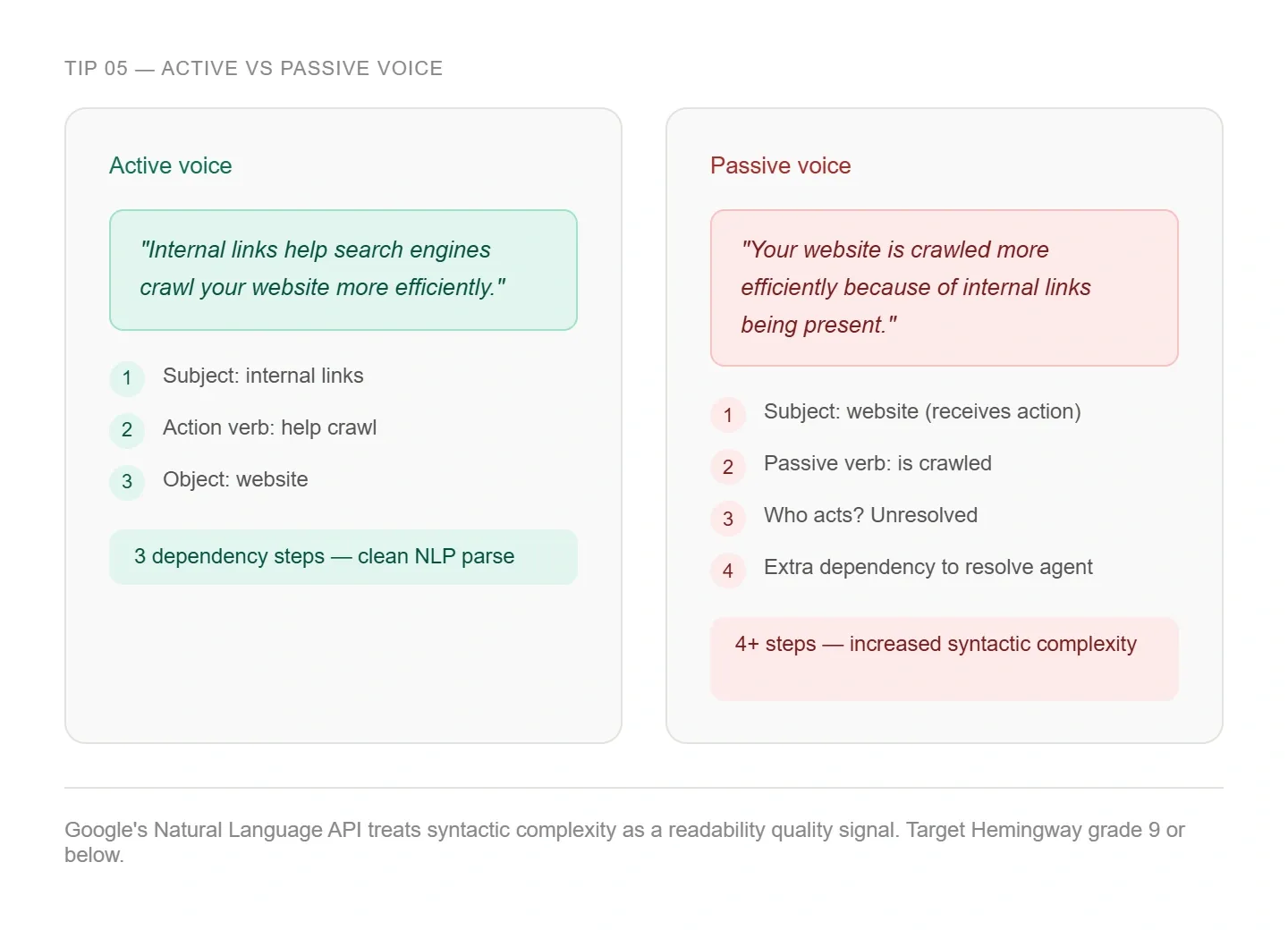
However, passive voice constructions and long sentences increase what is called syntactic complexity, which refers to the number of grammatical dependencies the model must resolve to extract meaning.
Why it works:
Google's NLP documentation from its Natural Language API describes readability analysis as a quality signal. High syntactic complexity is flagged as poor readability, which reduces content quality scores. Sentences where the subject performs the action directly produce fewer dependencies and generate a cleaner parse.
The Hemingway Editor tool measures this as grade level. Content at grade 9 or below consistently scores higher on NLP readability evaluations.
- Active: Internal links help search engines crawl your website more efficiently.
- Passive: Your website is crawled more efficiently because of internal links being present.
The passive version requires the NLP model to resolve an additional dependency to identify who or what performs the action. At scale across an entire article, this reduces overall content clarity scores.
Tip 06: Use NLP signal words to establish semantic relationships between sentences
Google's NLP systems use what are called relation extraction techniques. These identify how facts and claims within a page relate to one another.
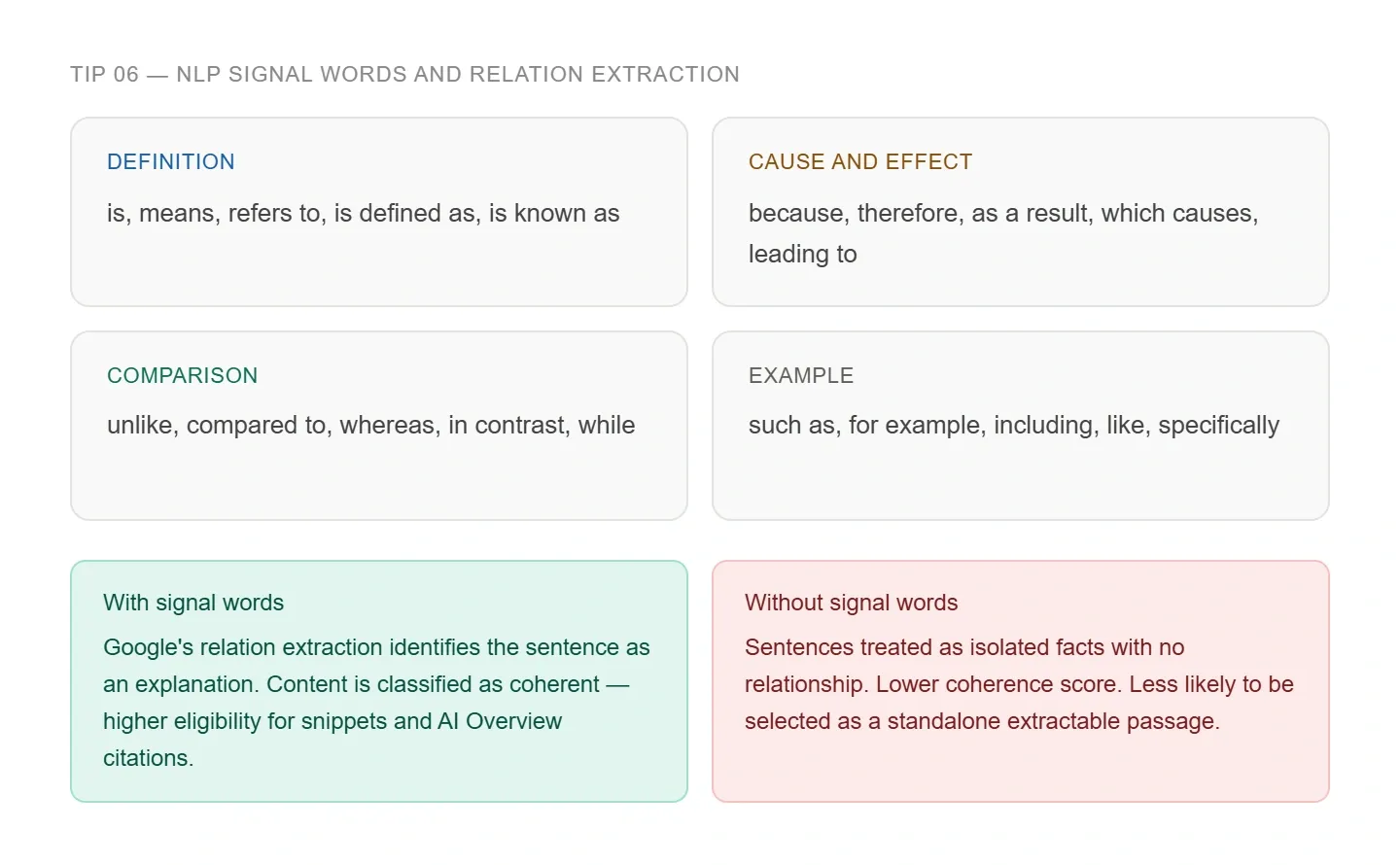
Signal words are the linguistic markers that allow relation extraction to categorize sentence relationships. Without them, the model treats sentences as isolated statements rather than a connected argument.
Why it works:
Relation extraction assigns categories like definition, cause effect, comparison, and example to the relationship between two statements. These categories determine how Google understands the coherence of your content and whether it constitutes a complete explanation rather than a list of disconnected facts. Pages with dense relational language score higher on coherence measures, which is a quality signal used in both ranking and AI Overview source selection.
Signal words by relationship type:
- Definition: is, refers to, means, is defined as, is known as
- Cause and effect: because, therefore, as a result, which causes, leading to
- Comparison: unlike, compared to, whereas, in contrast, while
- Example: such as, for example, including, like, specifically
- Sequence: first, then, next, finally, following this
Each section of your content should contain at least one signal word from the definition or cause category. These tell Google the passage is explanatory rather than descriptive, which increases its eligibility for both AI Overview and LLM platform citations.
👉 Read our complete guide to LLM SEO: How to Rank Your Website in AI Search Engines
Tip 07: Name specific entities in every section
Google's Knowledge Graph is a database of verified entities: named people, tools, platforms, organisations, places, and concepts.
When Google's NLP processes your content, it runs Named Entity Recognition (NER) to identify which entities are present and then cross-references them with the Knowledge Graph to establish topical context.
Why it works:
Vague language produces no entity signal. When you write 'various tools' or 'a popular platform', Google cannot link the reference to any Knowledge Graph entry. This means the surrounding content produces no topical context signal.
Naming specific entities like Google Search Console, Ahrefs, or Semrush gives Google three Knowledge Graph connections in a single sentence. Each one strengthens the topical relevance score for the entire passage.
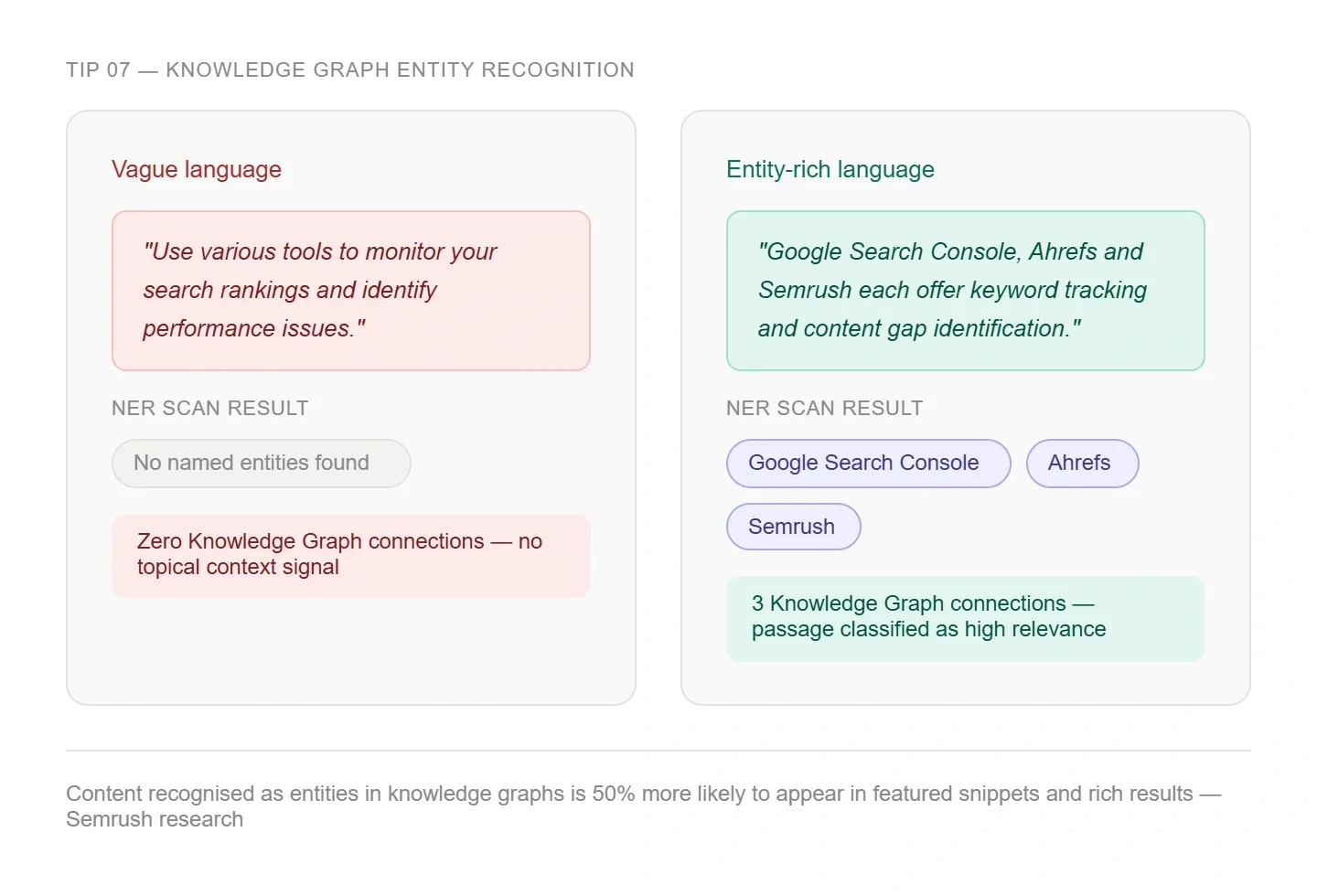
According to entity SEO research from Search Engine Land, Google increasingly uses entity clarity as the primary factor in determining whether a page represents a credible source on a subject.
- Weak: You can use various tools to monitor your search rankings and identify performance issues.
- Strong: Google Search Console shows impression and click data at the query level. Ahrefs and Semrush both offer keyword tracking, backlink analysis, and content gap identification.
The second version creates five Knowledge Graph entity references in two sentences. Google maps each one to its entity record and uses the cluster to classify the passage as highly relevant for search performance topics.
Tip 08: Place the target keyword in specific locations only
BERT does not rely on keyword density. It understands meaning from context and entity relationships.
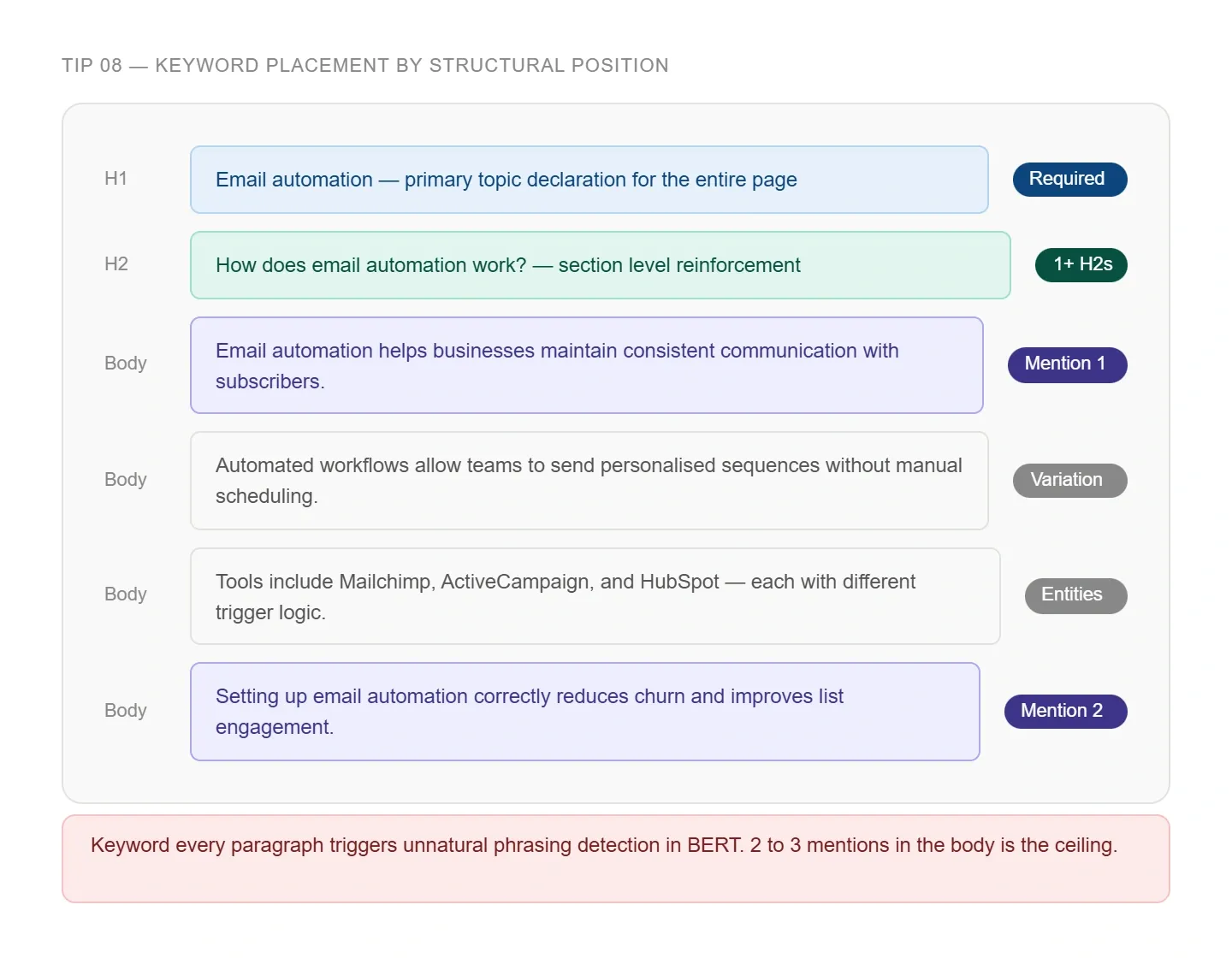
However, keyword placement in structural positions still functions as an explicit relevance signal because these locations are processed as primary topic indicators before NLP analysis begins.
Why it works:
Google uses the H1 heading as the primary topic declaration for a page. H2 headings containing the keyword reinforce topical relevance at the section level.
Two to three keyword mentions in the body confirm the topic without triggering the unnatural phrasing detection that BERT applies to keyword-stuffed content.
Using semantic variations and related terms throughout the body adds entity relationships without keyword repetition.
This approach satisfies both the structural keyword signals and the NLP coherence evaluation simultaneously.
- Place the exact keyword in the H1 heading
- Use the keyword in at least one H2 heading
- Include the keyword two to three times in the body with natural surrounding context
- Use keyword variations and related entity terms throughout the rest of the content
Exact: Email automation helps businesses maintain consistent communication with their subscriber lists.
Variation: Automated workflows allow marketing teams to deliver personalised sequences without manual scheduling.
Section 3: Credibility Signals That Affect Ranking and Citations
Tip 09: Support every factual claim with a named source and specific data
Google's E-E-A-T framework (Experience, Expertise, Authoritativeness, Trustworthiness) is assessed at both page and site level. One of the strongest page-level trust signals is the presence of verifiable, attributed claims. Google's Quality Rater Guidelines define high-quality content as content that makes claims backed by evidence from authoritative sources. Unverified claims are classified as low quality.
Why it works:
For AI Overviews, SearchIntel research shows that E-E-A-T signals, including author credentials, outbound links to authoritative sources, and references to original research all directly influence whether a page gets cited.
According to Google’s Search Quality Evaluator Guidelines, high-quality content should be supported by reliable sources and evidence. Google's NLP can identify statistical claims and check whether they are supported within the same passage.
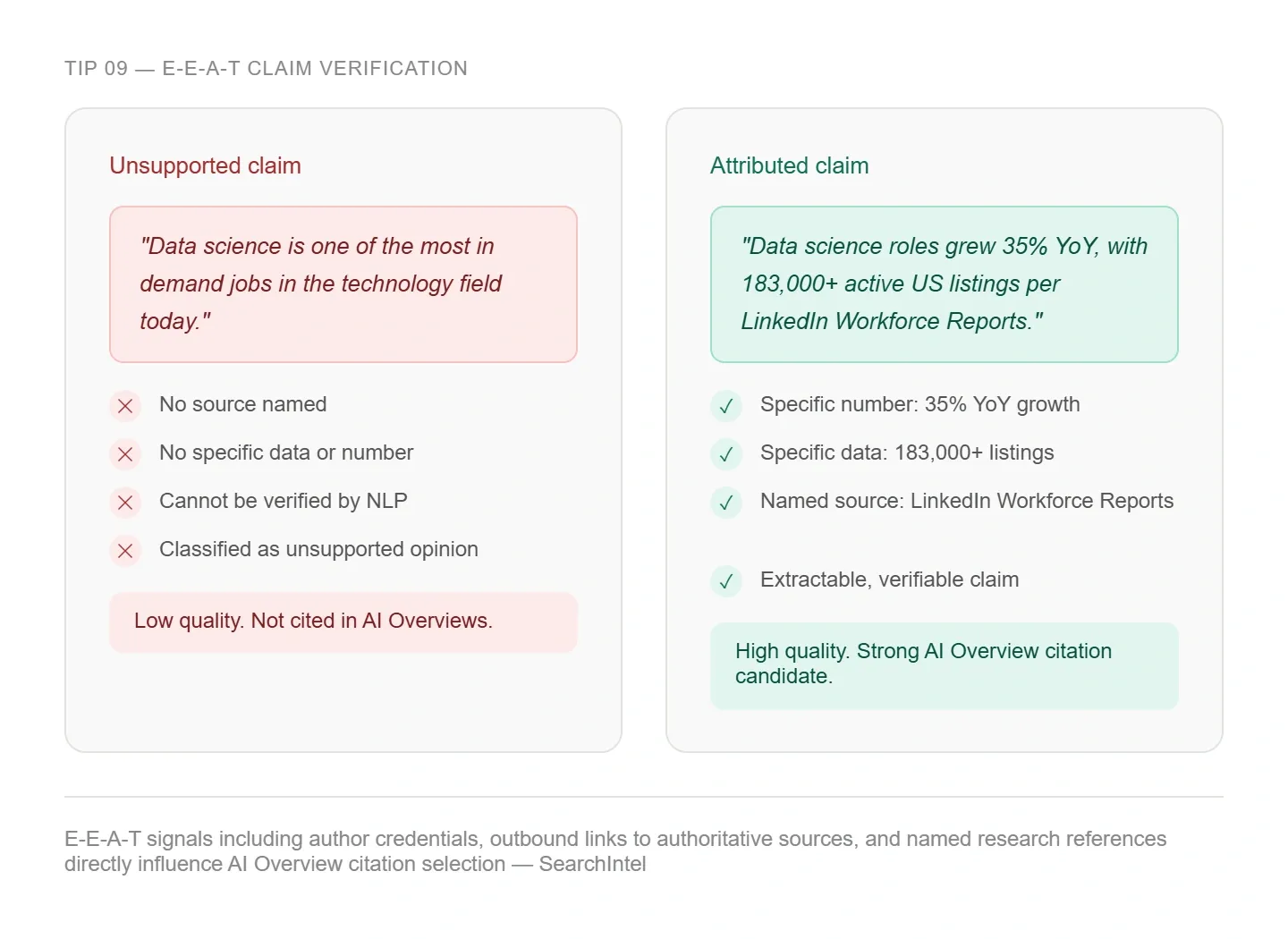
- Avoid: Data science is one of the most in-demand jobs in the technology field today.
- Better: Data science roles grew 35% year over year, with over 183,000 active US based listings on LinkedIn as of 2024, according to LinkedIn Workforce Reports.
The second version produces an extractable, verifiable claim. The first version produces an unverifiable opinion that Google's quality systems flag as unsupported.
Tip 10: Write BOFU introductions with social proof linked to the article topic
Bottom-of-funnel pages target users who are close to making a decision. These users are evaluating providers, not just learning. A generic introduction wastes the only moment where a business can establish credibility before the reader decides whether to continue.
Why it works:
Google's Search Quality Evaluator Guidelines assign higher page quality scores to pages that demonstrate the expertise and trustworthiness of the source. For commercial intent queries, social proof in the form of client results, case study references, or verifiable outcomes serves as a trust signal that generic editorial introductions cannot replicate.
For Tenet and similar service businesses, an introduction that names a specific result achieved for a client class ties the business claim directly to the content topic, producing both a credibility signal for the reader and an E-E-A-T signal for Google.
For an article titled 'How to choose an HR payroll system for GCC businesses':
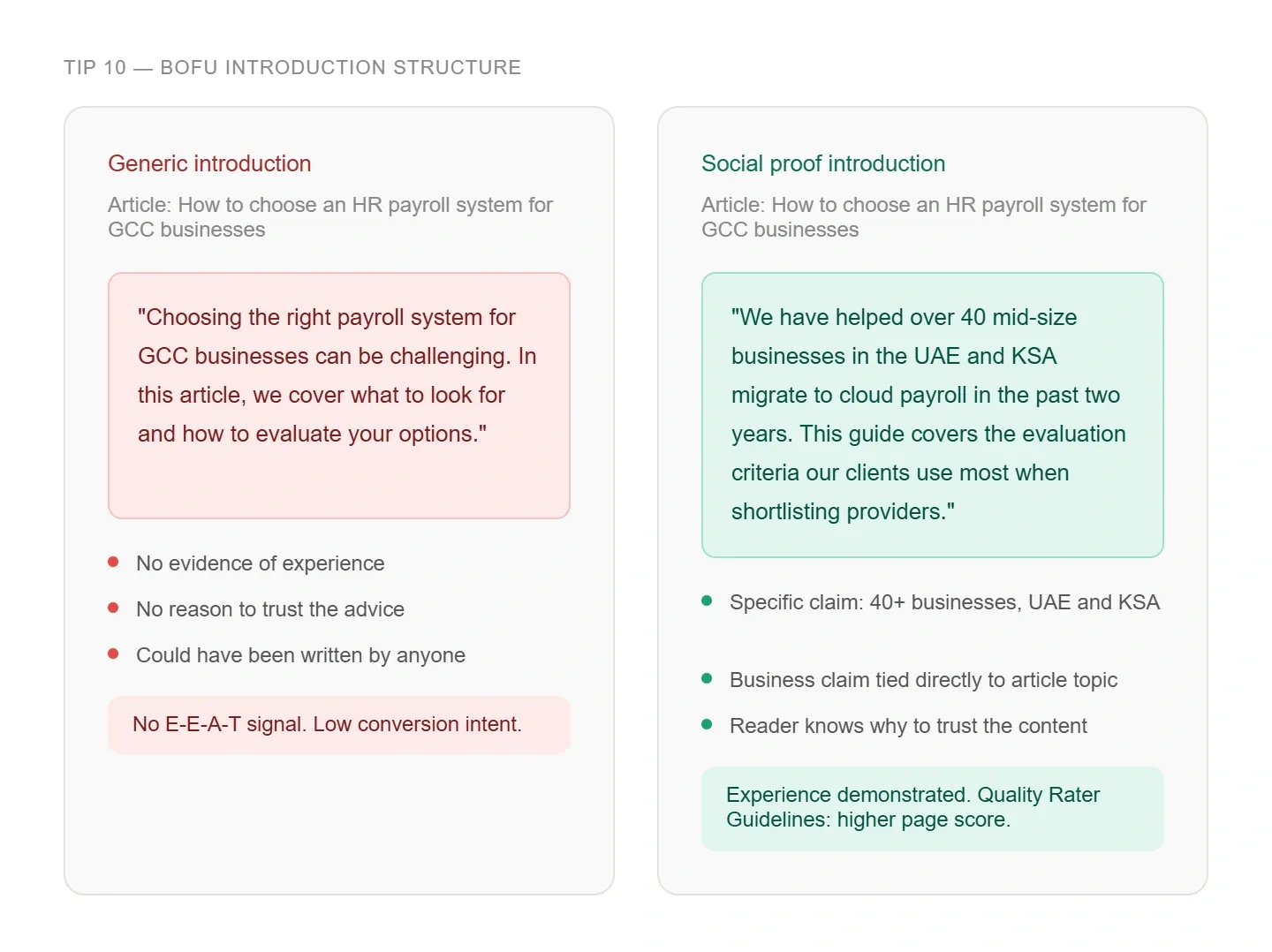
- Generic: Choosing the right payroll system for GCC businesses can be challenging. In this article, we cover what to look for and how to evaluate your options.
- Better: We have helped over 40 mid-sized businesses in the UAE and KSA migrate to cloud payroll systems in the past two years. This guide covers the evaluation criteria our clients use most when shortlisting providers.
The second version establishes the author's experience, links that experience to the article topic, and sets credibility before the reader reaches the first tip.
Tip 11: Write descriptive anchor text that states what the linked page covers
Google uses anchor text as a relevance signal for the destination URL. The text around an anchor also contributes context. Both are processed by BERT during page analysis. Anchor text that says 'click here' or 'read more' provides zero topical signal for the destination page and weakens the linking page's internal relevance structure.
Why it works:
Internal links with descriptive anchor text contribute to what Google describes as a crawlable, semantically coherent site structure. External links to authoritative sources with descriptive anchor text are treated as citation signals, similar to how academic papers use references.
Duke University's content guidelines state explicitly: link to relevant information and do not make readers search for something you mention if it already has a page.
Note: This applies equally to external links and internal navigation.
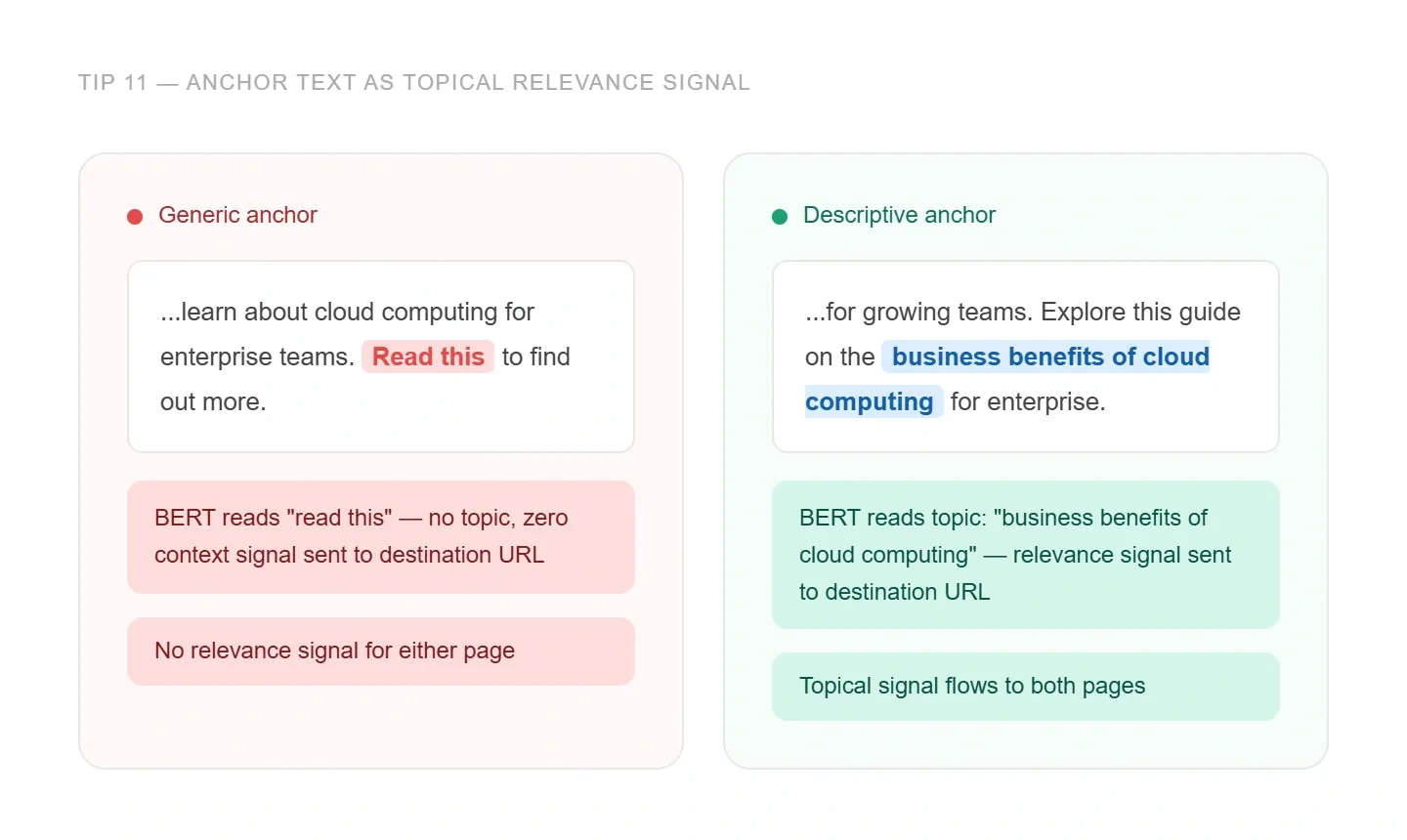
- Avoid: Read this to learn about cloud computing benefits.
- Better: Explore this guide on the business and cost benefits of cloud computing for growing enterprise teams.
Section 4: Readability and Structural Formatting
Tip 12: Keep paragraphs to three lines maximum, one idea per paragraph
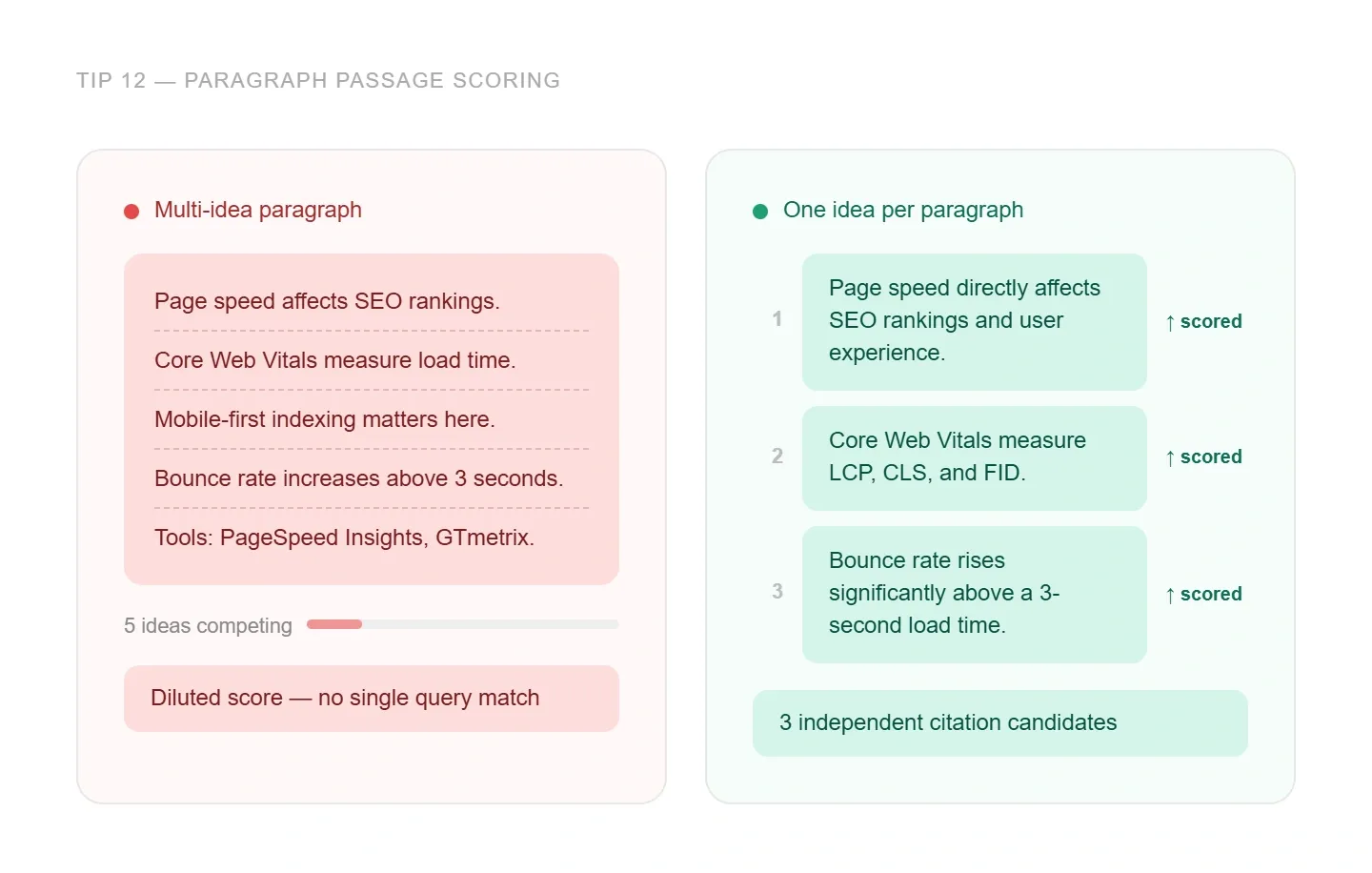
Google's passage ranking system scores paragraphs individually. A paragraph that contains multiple ideas produces a diluted passage score because the NLP model cannot identify a single dominant query match. Google's passage scoring works by identifying the strongest query signal in a passage.
Multiple ideas in one paragraph compete against each other, lowering the overall score for any single query.
Why it works:
Short paragraphs also reduce what is called cognitive load for readers. Pages with lower cognitive load produce stronger engagement signals: lower bounce rate, higher scroll depth, and longer time on page.
All three are behavioural signals that Google uses to assess content quality in its Helpful Content evaluation.
A paragraph with one clear idea is also more likely to be extracted as a standalone passage by both featured snippet and AI Overview selection systems.
One idea per paragraph is not just a readability preference. It is the structural requirement for passage level scoring to work in your favour.
Tip 13: Use the right format for the content type: lists, tables, and numbered steps each serve a different extraction pattern
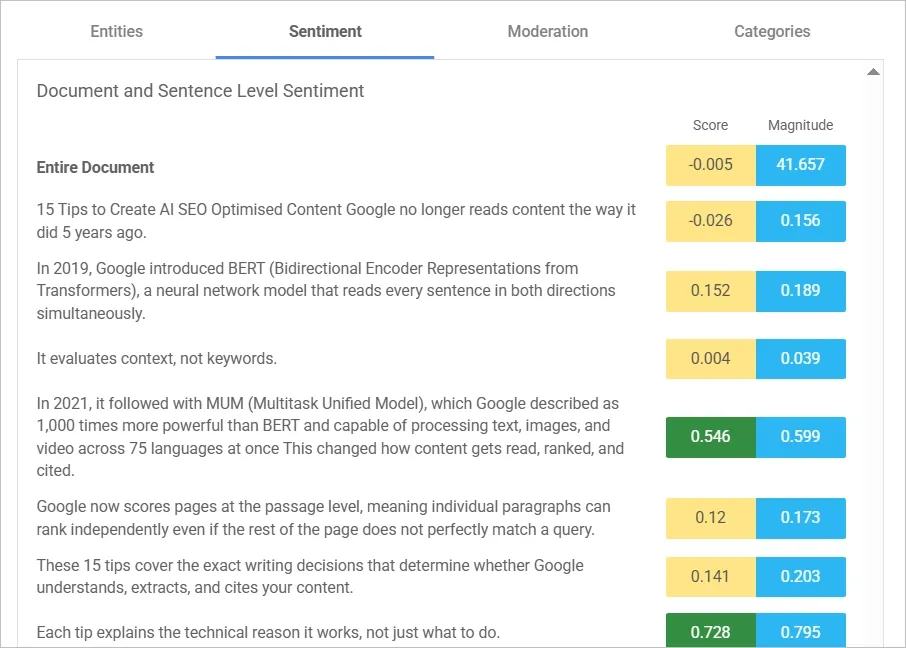
Google's NLP systems categorise content by sentiment and format type before evaluating relevance. Lists, tables, and numbered sequences produce different structured data signals.
You can also try Google’s NLP API demo here:
Using the wrong format for the content type reduces the probability of the content being extracted in the format the query requires.
Why it works:
According to Google's featured snippet documentation, listicle snippets appear for how and what queries requiring enumerated answers. Ordered list snippets appear for process and step queries. Table snippets appear for comparison and data queries.
If your steps are written as bullet points instead of numbered lists, Google cannot confidently classify the content as a procedural answer and it will not surface it as an ordered list snippet. Paragraph snippets average 40 to 60 words according to Semrush data. If a definition is longer than this, it is less likely to be pulled as a definition snippet.
- Steps and processes: use numbered lists so the sequence is machine-readable
- Feature lists and collections: use bullet points for unordered items
- Comparisons across two or more options: use tables with clear column headers
- Definitions and explanations: use short paragraphs of 40 to 60 words
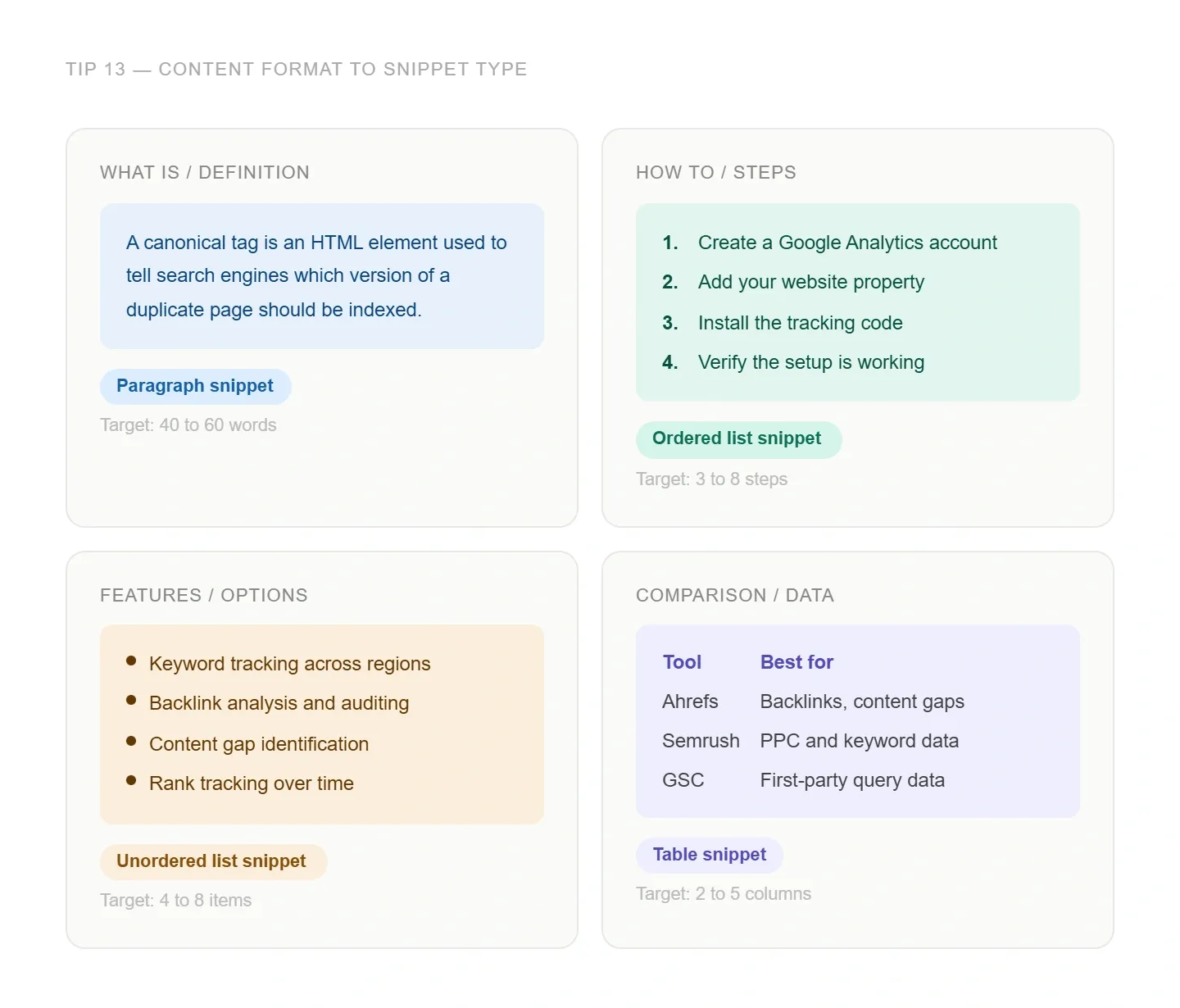
Matching the format to the query type is a direct factor in snippet eligibility. It is not a style choice.
Tip 14: Write FAQ answers as complete, standalone sentences that restate the question
Google's People Also Ask (PAA) boxes and AI Overviews both rely on passage extraction to populate answers. For an FAQ answer to be extracted, it needs to be self contained. An answer that begins with 'yes' or 'it depends' without a complete sentence following it cannot be pulled as a standalone passage because it has no subject.
Why it works:
AI Overview citation research from CXL found that self-contained paragraphs, defined as paragraphs that make complete sense when read in isolation without needing surrounding content for context, are significantly more likely to be cited than paragraphs that depend on adjacent text for meaning.
FAQ sections with full sentence answers that restate the question are the highest density source of self contained passages on any page.
Each properly formatted FAQ answer is an independent citation candidate. FAQPage schema markup, which explicitly marks the question and answer relationship for Google's crawler, further increases extraction eligibility.
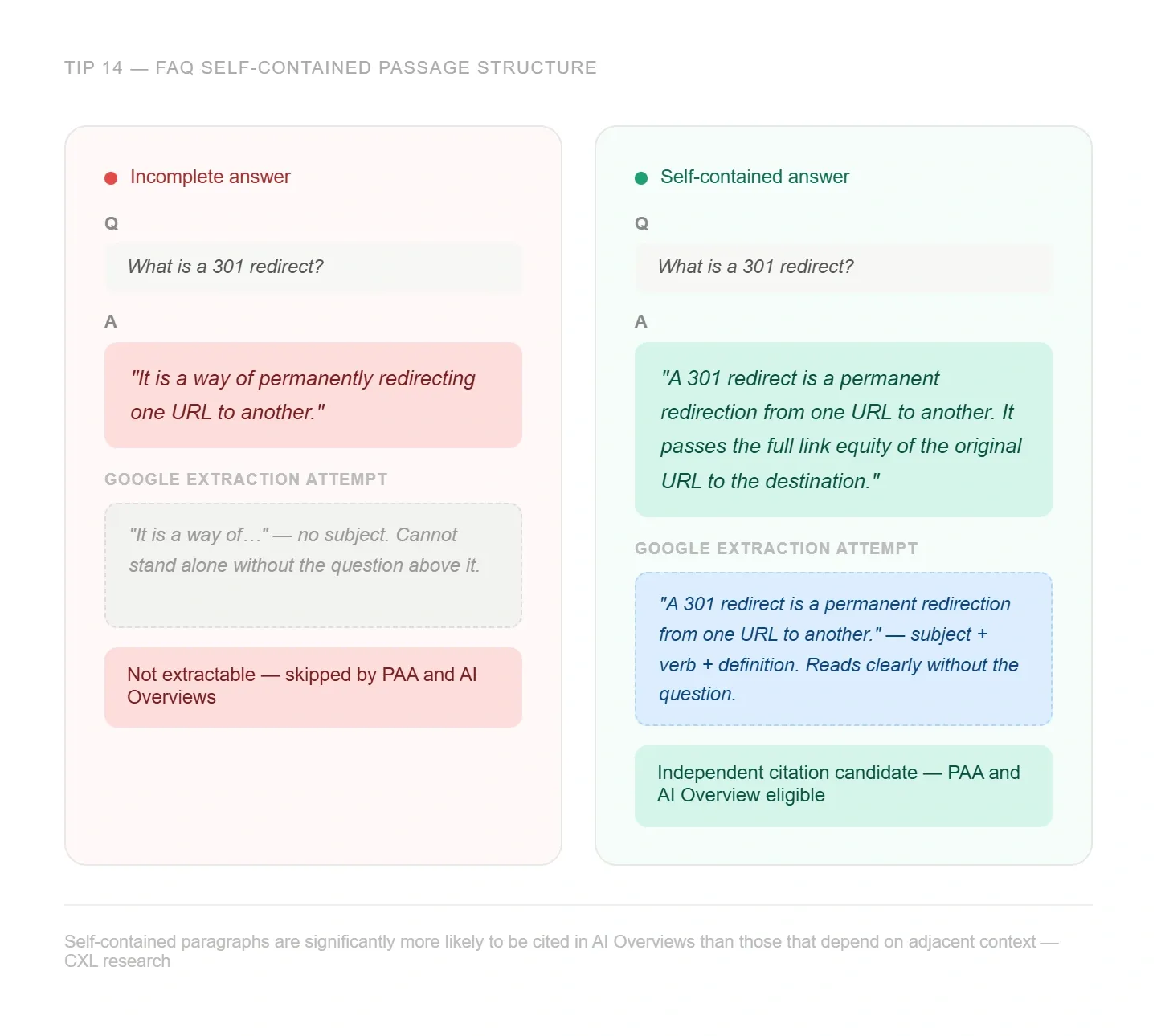
Q: What is a 301 redirect?
- Avoid: It is a way of permanently redirecting one URL to another.
- Better: A 301 redirect is a permanent redirection from one URL to another. It passes the full link equity of the original URL to the destination, making it the correct redirect type for site migrations and permanent URL changes.
The first answer cannot be extracted without context. The second answer is a complete, standalone passage with two self-contained sentences.
Section 5: Research
Tip 15: Research on niche communities and primary sources, not competing articles
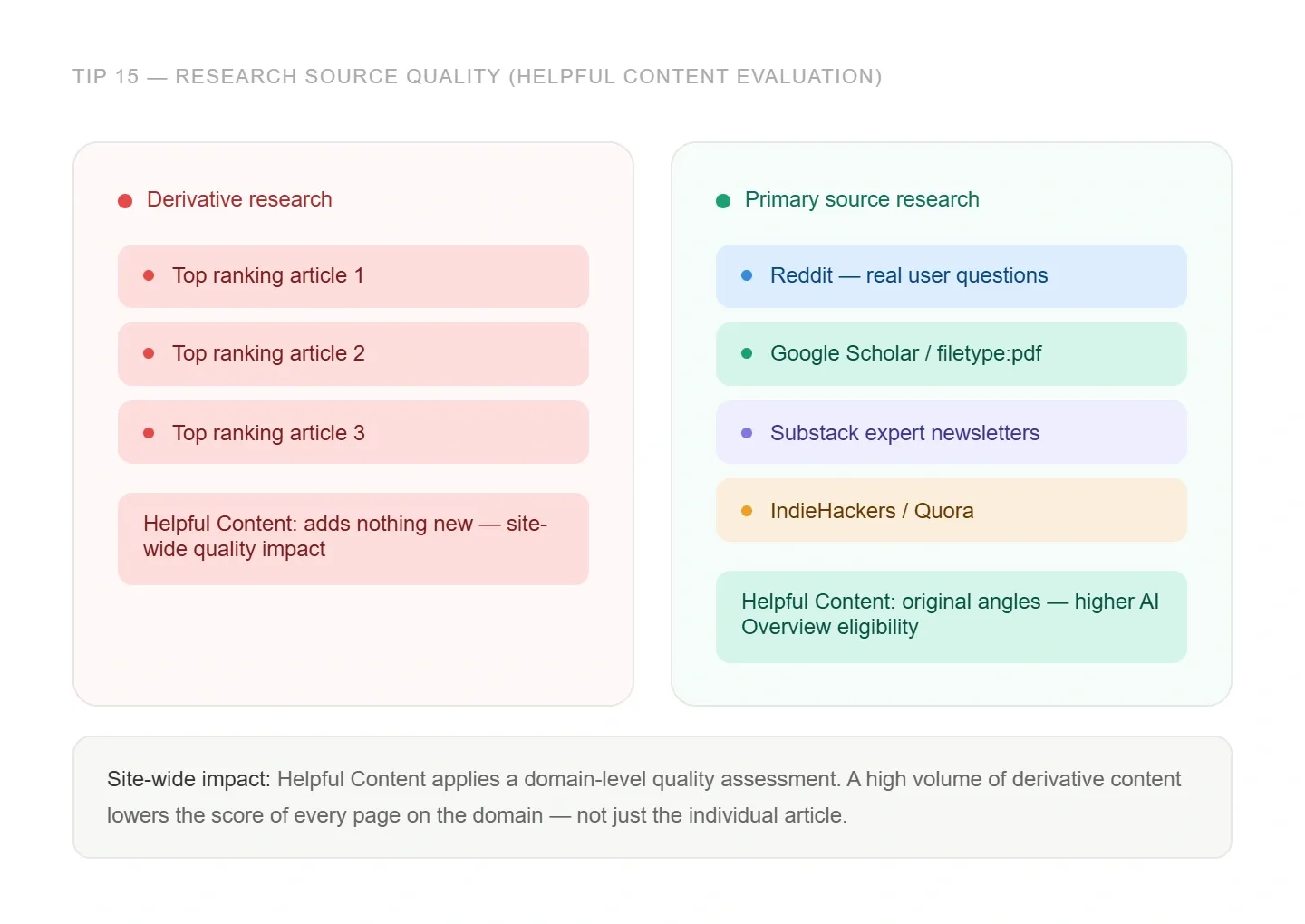
The standard content research process involves searching for a keyword on Google and summarising what top-ranking pages have already written. This produces what is sometimes called derivative content: a page that repeats existing claims without adding new information.
Google's Helpful Content system, introduced in 2022 and updated multiple times since, specifically evaluates whether content adds information beyond what is already available on the topic.
Why it works:
Google's Helpful Content guidance asks content creators to consider whether their page provides original analysis, research, or perspective.
Pages that synthesise publicly available summaries without adding unique data, specific examples, or original insight are classified as low quality under this evaluation.
The Helpful Content system applies a site-wide quality assessment, meaning a high volume of derivative content on a site can lower the quality score of every page on that domain, not just the individual articles.
Where to find primary and non-derivative research:
- Reddit: real user questions, unfiltered pain points, and language patterns your audience actually uses
- Quora: topic-specific questions that reveal what existing content has not answered well
- IndieHackers: search your topic followed by site:IndieHackers.com for practitioner-level insights
- Substack: search your topic followed by site:substack.com inurl:/p/ to find expert newsletters on the subject
- Google PDF search: search your topic followed by filetype:pdf to find academic papers, government reports, and industry white papers that top-ranked blog posts rarely cite
- Google Scholar: find peer-reviewed research on your topic that adds verifiable data most content does not reference
The goal is not the volume of sources. It is finding data points, examples, and angles that competing pages have not used.
In fact, one unique statistic from a credible PDF or a specific case shared on a practitioner forum is more valuable than rephrasing five well-ranked blog posts.
💡 Explore our list of tools to help you with SEO and content creation:
- Schema Markup Generator: Create & Validate JSON-LD Schema
- GEO Readiness Checker for AI Search
- AI Case Study Generator
- SEO Cost Calculator | Get a Monthly SEO Pricing Estimation
- Article/Blog Schema Generator for YMYL Pages
Final words
AI SEO content is not about adding more keywords. It is about making content easy to understand, easy to extract, and easy to trust.
Search engines now read content as users do. They look for clear answers, strong structure, and real proof. If your content is simple, well-organized, and backed by data, it is more likely to rank and get cited.
At our agency, we use these principles to create content that drives both rankings and conversions. We focus on clarity, intent, and credibility in every piece we publish.
If you follow these principles, your content will not just rank. It will become a reliable source that search engines and AI systems choose to reference.
Using our AI SEO approach, we have generated results for our clients. Here are some of them:
- SEO Led Growth for Print on Demand Platform - Tenet Case Study
- Scaling Organic Traffic and Enterprise Leads for Yomly's HR & Payroll SaaS Platform
👉 Want to get similar results for your brand? Check out our AI SEO Services and get a free proposal in the next 48 hours.
Get Expert Help to Scale Your AI SEO Content
Get Expert Help to Scale Your AI SEO Content














Got an idea on your mind?
We’d love to hear about your brand, your visions, current challenges, even if you’re not sure what your next step is.
Let’s talk


