
15 Best AI Tools for Brand Visibility
 By
By Share

Share
Get a quick blog summary with



Brand visibility is not about being everywhere. It is about being seen where it matters, with messages that stick.
AI has changed how brands get there. Content is faster to produce, search intent is easier to match, and conversations are easier to track.
The brand visibility AI tools below earned their place by helping with the harder part: getting noticed, remembered, and recommended, including inside AI answers from ChatGPT, Perplexity, and Google AI Overviews.
How we chose these AI brand visibility tools: We started with the tools brands already use for SEO, social media, and PR, and verified each one against its official pricing and product pages, cutting anything shut down, rebranded, or mispriced.
Note: This article was last updated on October 15, 2026 where we added a new AI search visibility section (Profound, Peec AI, and Otterly.ai), corrected pricing for Lately, Hootsuite, and Mention, renamed SEMrush's AI Writing Assistant to SEO Writing Assistant, and cleaned up the heading structure.
Here are the 15 best AI tools for brand visibility at a glance:
- Surfer SEO — best for optimizing content to match top ranking pages
- SEMrush SEO Writing Assistant — best for SEO content with full keyword and competitor data
- Frase — best for creating content briefs and structured SEO articles at scale
- Clearscope — best for improving content depth and authority
- Buffer AI — best for social media scheduling and content repurposing
- Lately — best for turning long form content into multiple social posts
- Hootsuite (OwlyWriter AI) — best for enterprise level social media management
- Predis.ai — best for product focused social content generation
- Brandwatch — best for advanced brand monitoring and sentiment analysis
- Meltwater — best for PR and media coverage tracking
- Mention — best for real time brand mention alerts
- Prowly — best for PR outreach and press release management
- Profound — best for tracking brand visibility across AI answer engines
- Peec AI — best for AI search visibility for mid-market teams
- Otterly.ai — best for lightweight AI search tracking
SEO and Search Visibility
1. Surfer SEO
Best for:
Brands optimizing content to rank for specific search terms without SEO specialists on staff.
What it is:
Surfer analyzes top-ranking pages for target keywords and provides specific guidance on what to include in your content to compete. Marketing teams use it to brief writers with data-backed recommendations rather than guesses.
The Content Editor scores drafts in real time, showing exactly where you're missing semantic terms, headers, or content depth that competitors include.
👉 Learn about our website development and SEO services to ensure your site structure supports AI-created content.
Standout Features:
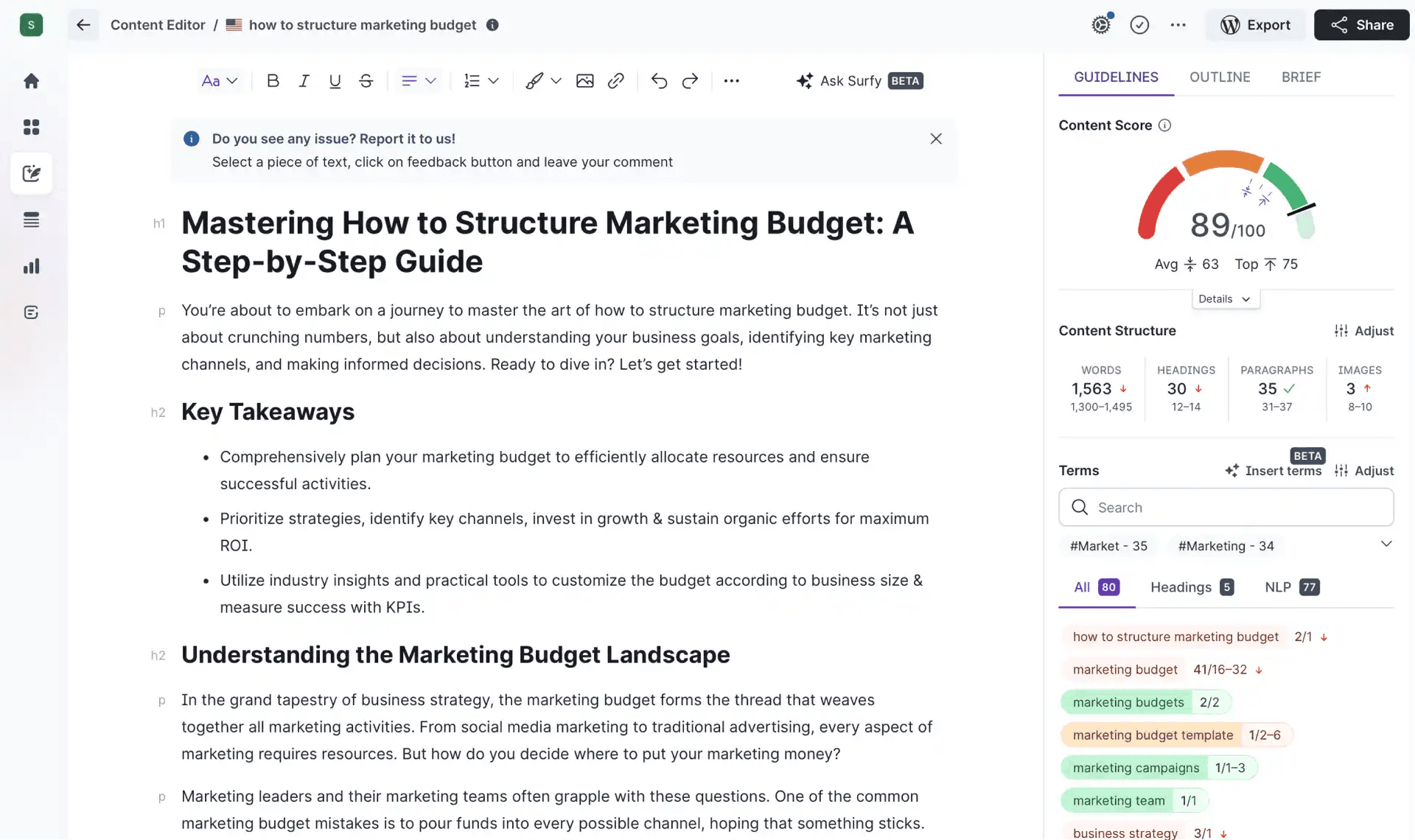
- Surfer’s Content Editor scores drafts live while you write, showing how closely your content matches top-ranking pages for the target keyword.
This is how a user gets guidelines about the content in Surfer:
- The SERP Analyzer breaks down what is actually ranking, including word count ranges, heading structures, keyword usage patterns, and backlink signals.
- Outline Builder generates data-backed content briefs by analyzing competitor pages, helping writers structure articles correctly before drafting.
- Keyword research and content gap analysis highlight low-competition opportunities and missing topics competitors are already covering.
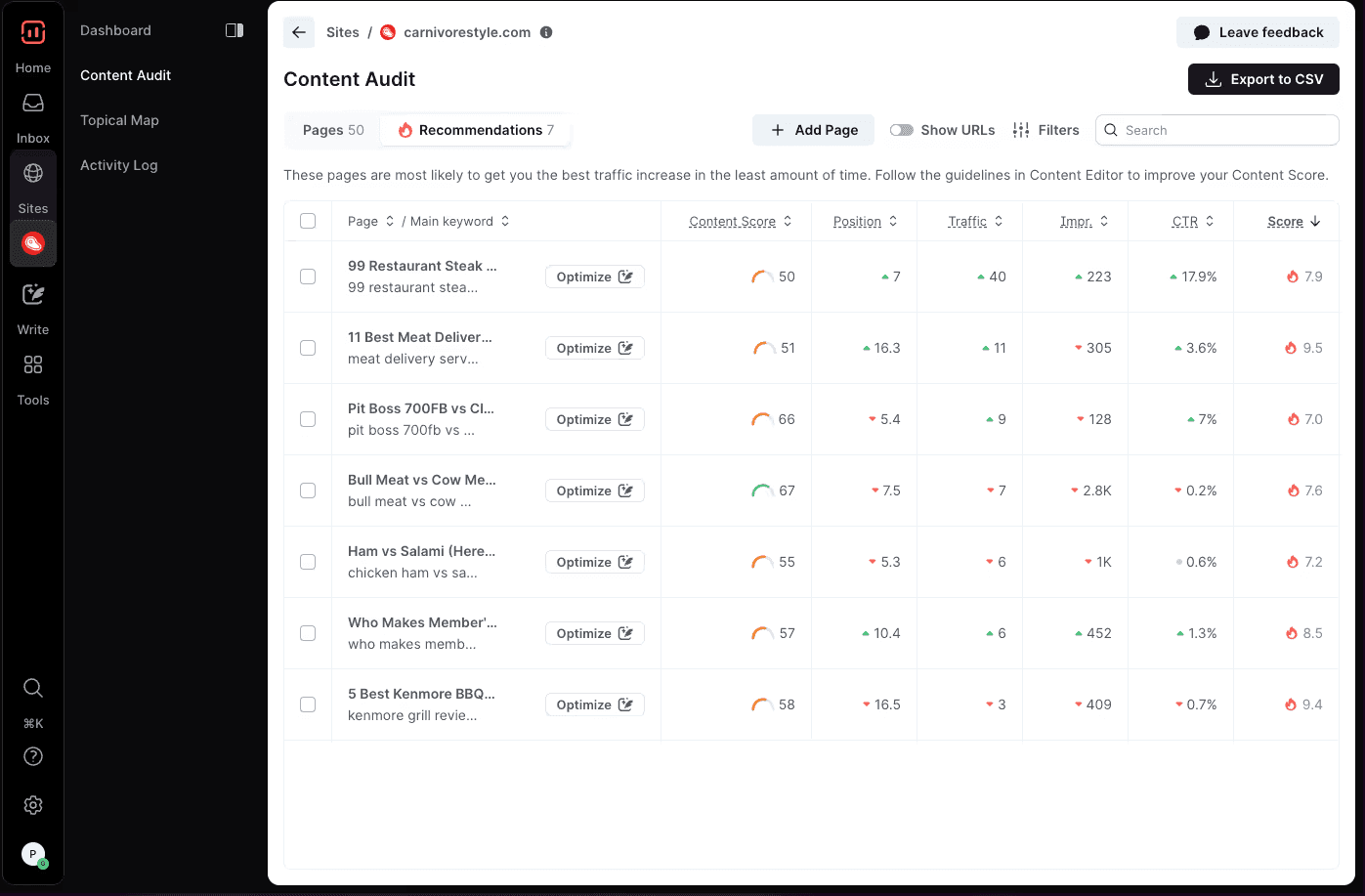
The given dashboard image illustrates how Surfer SEO content audit shows content scoring, traffic, CTR, etc. for better ranking.:
- Native integrations with Google Docs and Jasper allow teams to optimize content inside existing writing workflows without switching tools.
Pricing & Plans:
Surfer SEO offers multiple tiers starting with Discovery at $59 per month ($49/month annually), followed by Standard at $119 per month ($99 annually), Pro at $219 per month ($182 annually), and Peace of Mind at $359 per month ($299 annually). Enterprise access is also available starting around $999 per month.
2. SEMrush SEO Writing Assistant
Best for:
Marketing teams that manage SEO as a full growth channel and want content optimization tied directly to keyword strategy, rankings, and competitive intelligence.
What it is:
SEMrush SEO Writing Assistant is built for teams that need more than just on-page suggestions. It sits inside the SEMrush ecosystem, connecting content optimization with keyword research, competitor analysis, backlink data, and ranking performance.
Teams use it when content decisions need strategic context. Instead of optimizing a page in isolation, writers and marketers can see how a piece fits into broader search visibility goals, what competitors are doing differently, and how content improvements support ranking movement over time.
Standout Features:
- The SEO Writing Assistant provides real-time SEO recommendations based on selected target keywords and live competitor analysis from the SERP.
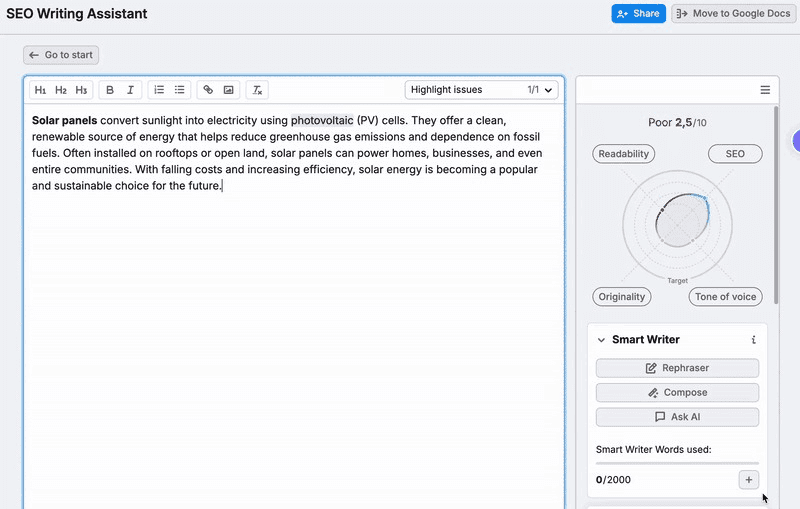
- Readability, tone, and content length checks help ensure the draft matches search intent and ranking patterns, not just keyword usage.
- An originality checker flags potential duplicate content risks before publication, reducing indexing and ranking issues.
- Optimization guidance pulls directly from SEMrush keyword research, position tracking, and competitive data, keeping strategy and execution aligned.
- Native integrations with Google Docs, WordPress, and popular CMS platforms allow teams to optimize content inside their existing publishing workflows.
Pricing & Plans:
The SEO Writing Assistant is included within SEMrush subscription plans rather than sold separately.
Pricing starts with the Starter plan at $199 per month ($165.17/month annually), followed by Pro+ at $299 per month ($248.17 annually) and Advanced at $549 per month ($455.67 annually).
3. Frase
Best for:
Content teams that need to produce SEO-optimized articles at scale without repeated revisions between SEO and writers.
What it is:
Frase is built to remove uncertainty from content creation. It analyzes top-ranking pages for a target keyword and turns that data into structured content briefs that clearly define what topics, questions, and depth are needed to compete.
Teams use Frase to align writers from the start. Instead of revising drafts for missing sections or SEO gaps, writers begin with a clear outline based on what already ranks.
The AI writer supports drafting and expansion, but most teams rely on Frase primarily for briefing, structure, and topic coverage rather than fully automated articles.
Standout Features:
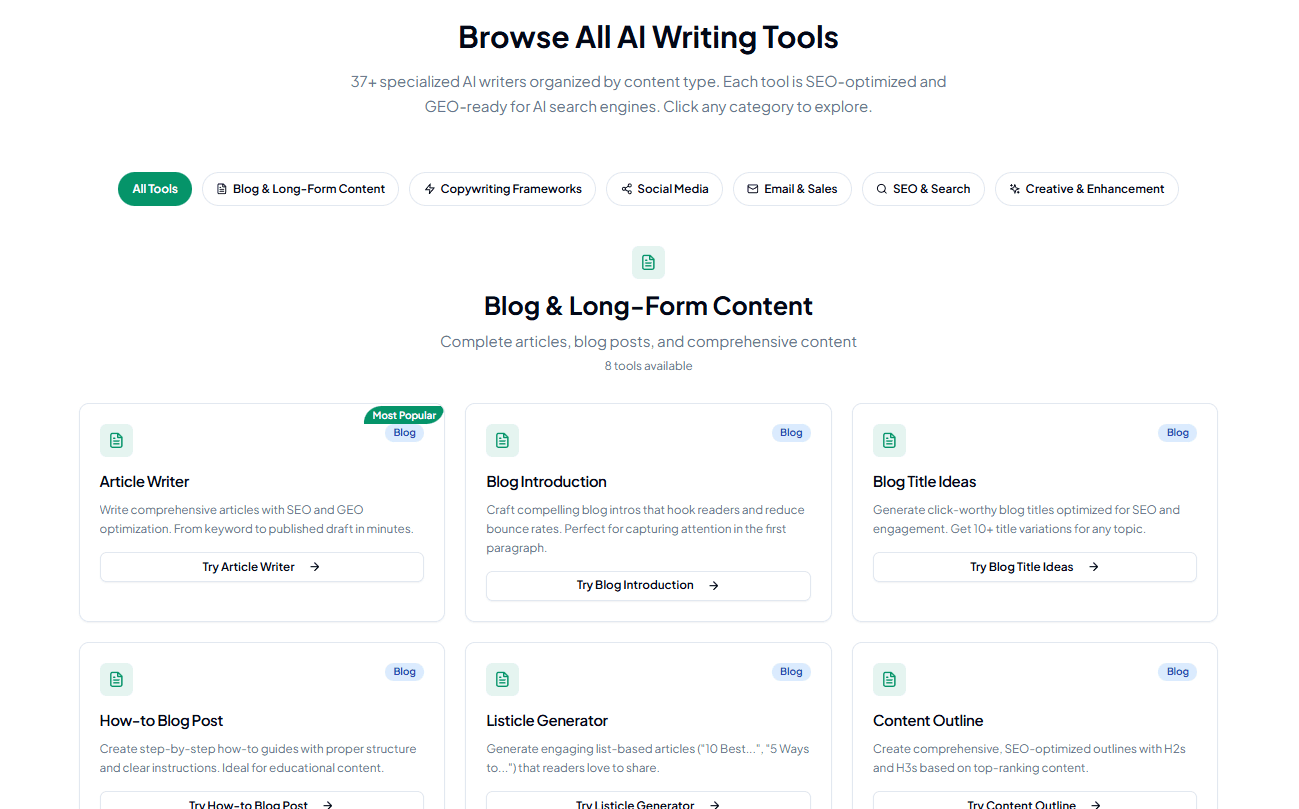
- Automated content briefs analyze competing pages and generate structured outlines based on topic coverage, headings, and semantic relevance.
This tells about the various types of content that you can write using Frase’s AI wrting tools:
- Question research pulls common user queries from search data so content addresses real search intent, not assumed topics.
- The AI writer generates section drafts and expansions directly from the brief, helping writers move faster without starting from a blank page.
- Content analytics track how published articles perform, allowing teams to identify pages that need updates or expansion over time.
- Team collaboration tools support assigning briefs, managing drafts, and reviewing content across writers and editors.
Pricing & Plans:
Frase pricing begins with the Starter plan at $49 per month ($39/month annually). Higher tiers include Professional at $129 per month ($103 annually) and Scale at $299 per month ($239 annually), with a custom Enterprise plan available for larger teams.
4. Clearscope
Best for:
Editorial and content teams that prioritize depth, accuracy, and authority over publishing at high volume.
What it is:
Clearscope is designed for teams competing in crowded search spaces where surface-level optimization is not enough. Instead of focusing on keyword density or basic SEO rules, Clearscope evaluates how thoroughly a topic is covered compared to top-performing content.
Media companies, SaaS brands, and content-led businesses use Clearscope when ranking depends on quality and completeness. Writers are guided to cover concepts, subtopics, and related ideas that search engines expect to see in authoritative content, making it especially useful for long-form articles and competitive keywords.
Standout Features:
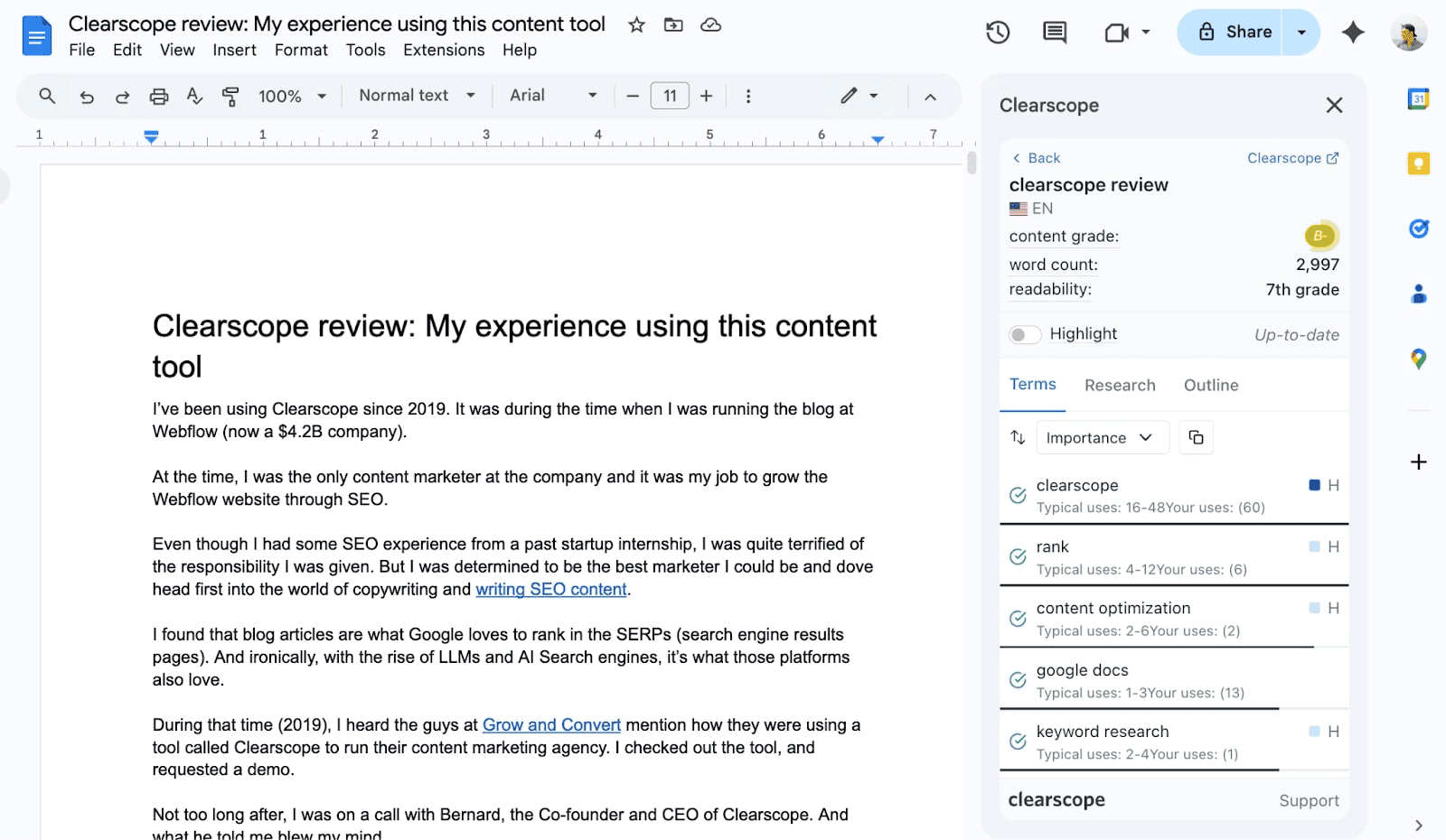
- Clearscope assigns a content grade based on semantic relevance and topic coverage, giving writers a clear benchmark for how complete an article is.
- Term recommendations focus on concepts and themes to address, helping writers expand depth rather than repeat keywords.
- Readability analysis ensures content stays clear and accessible while still meeting expectations for comprehensive coverage.
- Google Docs and WordPress integrations allow writers to optimize content directly inside their existing writing and publishing workflows.
This image shows how Clearscope’s integration allows using Google Docs and demonstrates how it provides readability analysis, term recommendations:
- Performance reporting helps teams understand which optimizations contributed to ranking improvements over time.
Pricing & Plans:
Clearscope offers the Essentials plan at $129 per month and the Business plan at $399 per month, with a custom Enterprise plan available for organizations that require larger-scale content optimization workflows.
Social Media and Distribution
5. Buffer (with AI Assistant)
Best for:
Small to mid-sized brands that need to publish consistently across multiple social platforms without building a large social media team.
What it is:
Buffer helps teams maintain active social accounts without spending hours on content creation and scheduling. It generates post variations, suggests optimal posting times based on engagement data, and repurposes long-form content into social snippets.
Community managers use it to keep feeds active while focusing time on engagement and conversation.
Standout Features:
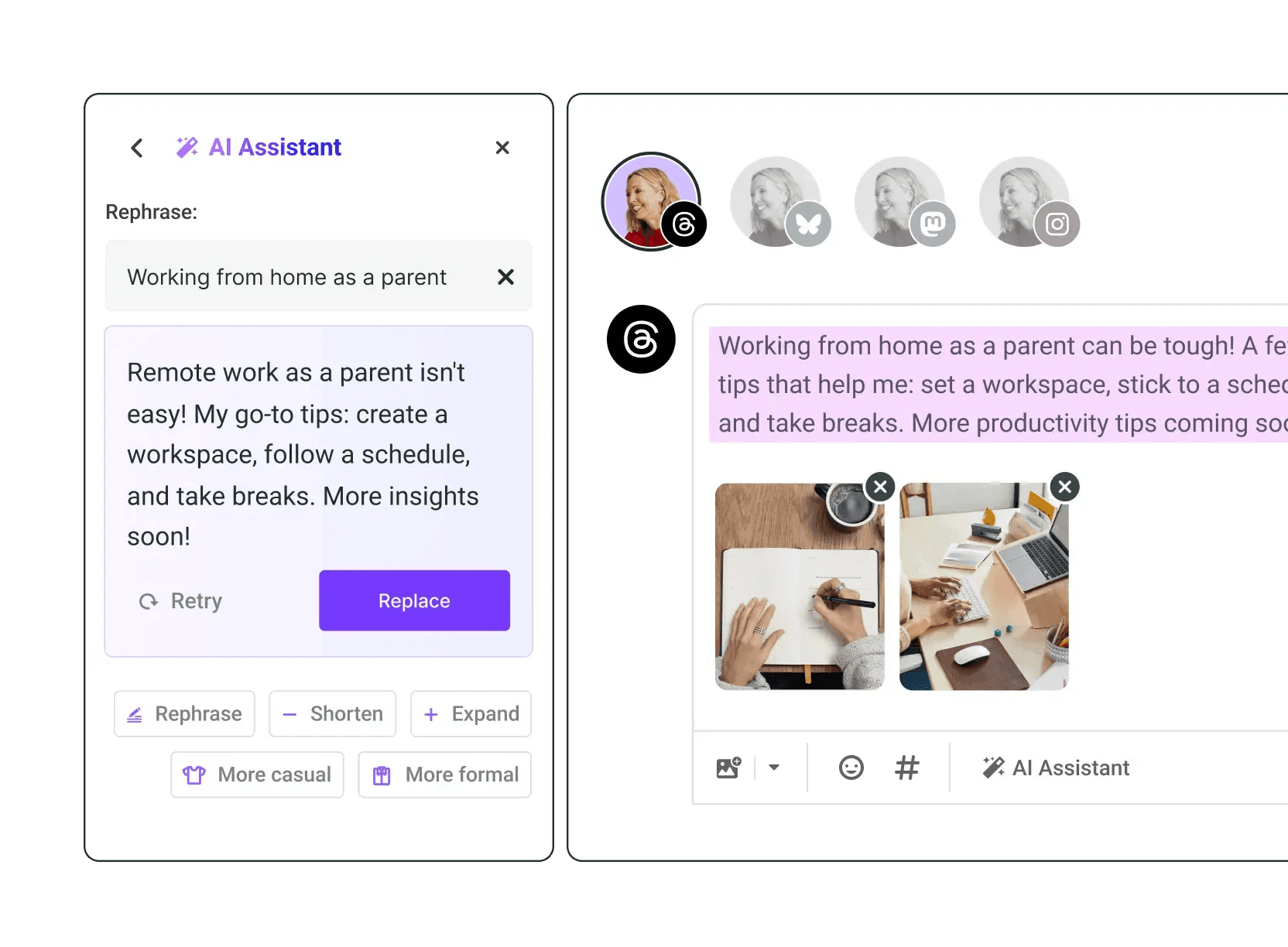
- The AI Assistant helps generate captions, rewrite drafts, and adjust tone for different platforms directly inside the post composer, reducing the time spent on manual edits.
Here’s how Buffer’s AI Assistant simplifies content rephrasing:
- Content can be adapted for platform-specific formats, allowing one idea to be reshaped for LinkedIn, X, Instagram, or Facebook without starting from scratch.
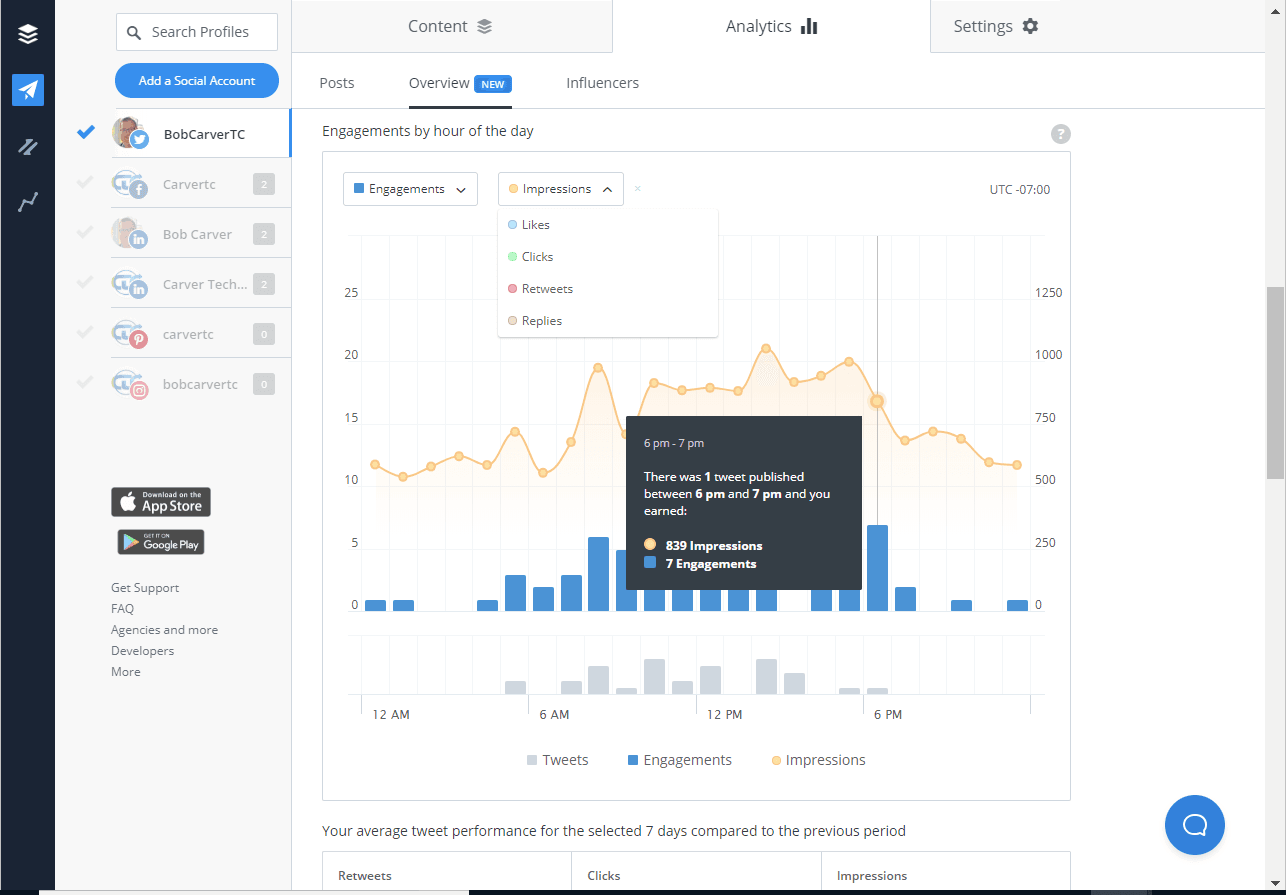
- Built-in analytics highlight which posts perform best, helping teams understand what content styles resonate and refine future AI-assisted drafts.
This dashboard view illustrates how Buffer helps in analyzing the traffic and posts:
- Buffer’s scheduling and queue system keeps posting consistently, even for teams managing multiple accounts with limited bandwidth.
- Collaboration features allow teams to draft, review, and approve posts without external tools, keeping social workflows centralized.
Pricing & Plans:
Buffer’s pricing depends on the number of connected channels. It includes a Free plan, followed by Essentials at $6 per month per channel ($5 annually) and Team at $12 per month per channel ($10 annually) for teams managing multiple social accounts.
6. Lately
Best for:
Brands that create long-form content like podcasts, webinars, blogs, or videos and want to turn them into sustained social media campaigns without manual rewriting.
What it is:
Lately uses AI to break long-form content into dozens of social posts while maintaining context and brand voice. Marketing teams upload webinar recordings, podcast episodes, or blog posts, and Lately generates a content calendar of social snippets.
It learns from your engagement data to improve which clips and angles it extracts over time.
Standout Features:
- Lately automatically breaks long-form content into dozens of context-aware social posts, preserving meaning rather than extracting random quotes.
- The AI model adapts to your brand voice by learning from previously published posts and their engagement performance.
- Engagement-driven feedback loops allow the system to refine future outputs based on what your audience actually interacts with.
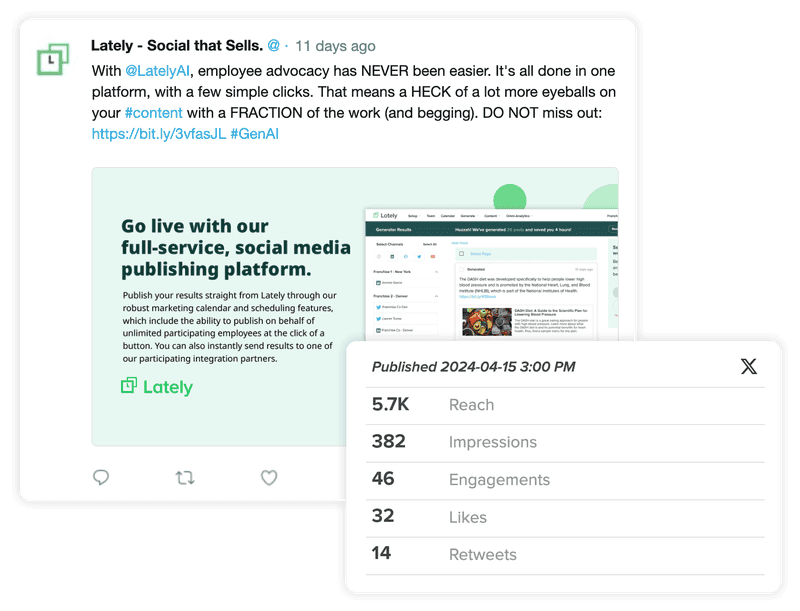
Lately helps in gathering audience interactions and feedback that are further used in refining the content:
- Platform-specific formatting ensures posts are customized differently for LinkedIn, X, Facebook, and Instagram rather than being reused verbatim.
- A built-in collaboration workspace lets teams review, edit, and approve AI-generated posts before scheduling.
Pricing & Plans:
Lately offers the Starter plan at $19 per month ($14/month annually) and the Growth plan at $239 per month ($199 annually). Larger organizations can opt for an Enterprise plan with custom pricing.
7. Hootsuite (with OwlyWriter AI)
Best for:
Enterprise brands requiring social management, monitoring, and AI content creation in one platform.
What it is:
Hootsuite combines comprehensive social media management (scheduling, monitoring, analytics, team workflows) with AI-powered content creation through OwlyWriter. Large marketing teams and agencies use it as a command center for social operations across multiple brands and regions.
OwlyWriter handles caption generation and post variations while the broader platform manages publishing and performance tracking.
Standout Features:
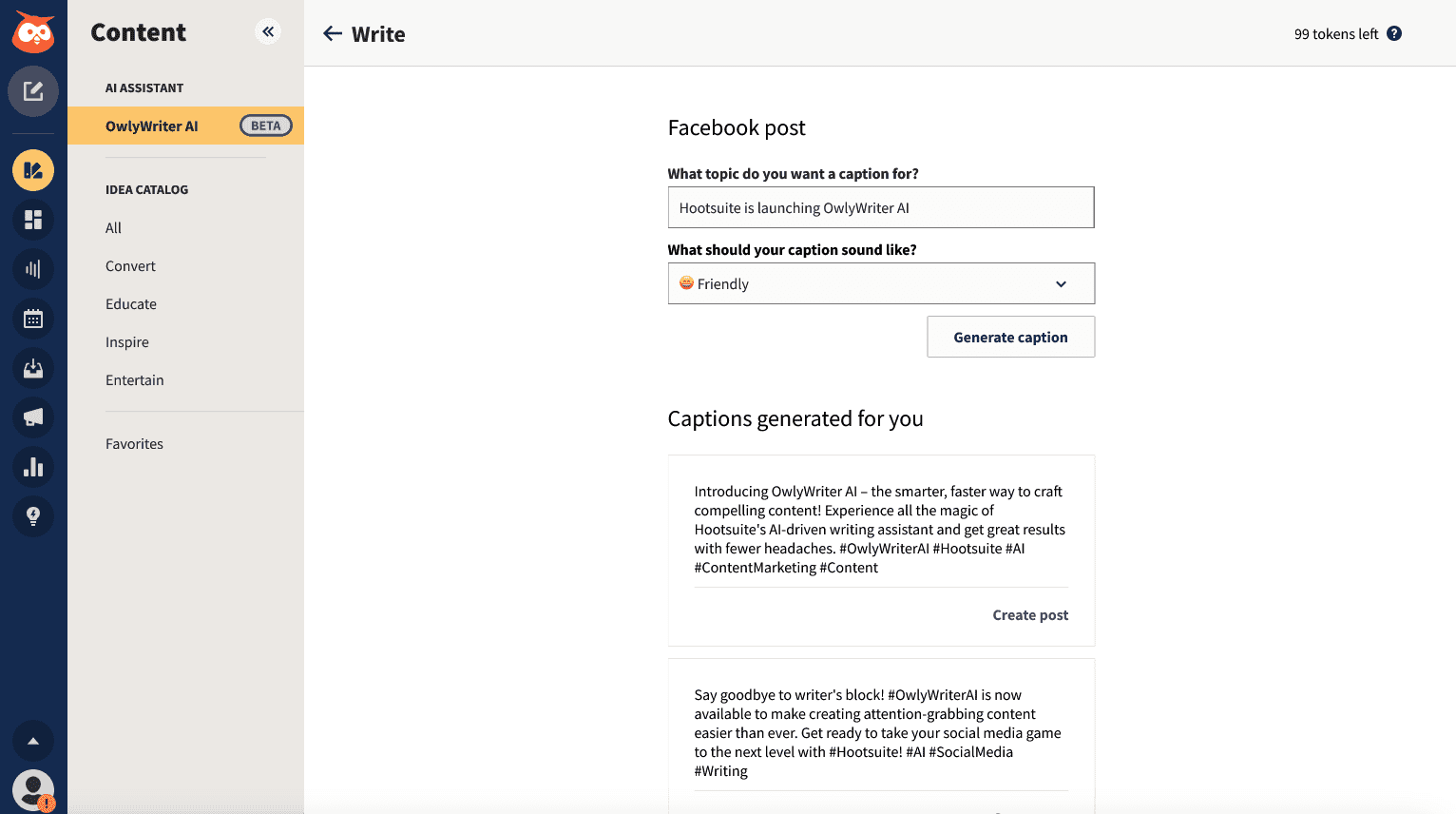
- OwlyWriter AI generates platform-ready captions, post ideas, and variations using prompts, URLs, or existing content as inputs.
This is the visual example of how OwlyWriter helps in generating posts:
- Built-in social listening tracks brand mentions, competitors, and industry conversations across major networks.
- Structured approval workflows support multi-level reviews before content goes live, which is important for regulated or enterprise environments.
- Audience-based publishing recommendations suggest optimal posting times using historical engagement data.
- Bulk scheduling tools allow teams to plan and publish large volumes of content efficiently across multiple profiles.
Pricing & Plans:
Hootsuite plans start with the Standard plan at $99 per user per month, the Professional plan at $199 per user per month, and the Advanced plan at $249 per user per month on annual billing (around $399 month-to-month). Larger organizations can choose the Enterprise plan, which requires requesting a demo and custom pricing.
8. Predis.ai
Best for:
E-commerce, DTC, and product-led brands that need high volumes of promotional social content without relying on designers or social media specialists.
What it is:
Predis.ai is purpose-built for product marketing on social media. Instead of starting with blank prompts, brands feed it product links, descriptions, or catalog details, and the platform generates complete social posts designed to sell. This includes visuals, captions, and platform-appropriate formatting in one flow.
The tool is commonly used by Shopify stores, Amazon sellers, and DTC teams that need consistent promotional output across Instagram, Facebook, LinkedIn, and other channels. Its strength is speed and standardization, making it useful for launches, offers, and recurring product promotions rather than brand storytelling or community-led content.
Standout Features:
- Predis.ai creates product-centric posts directly from URLs or product descriptions, reducing manual content setup.
- The platform analyzes competitors in the same niche to surface patterns in captions, formats, and posting styles that perform well.
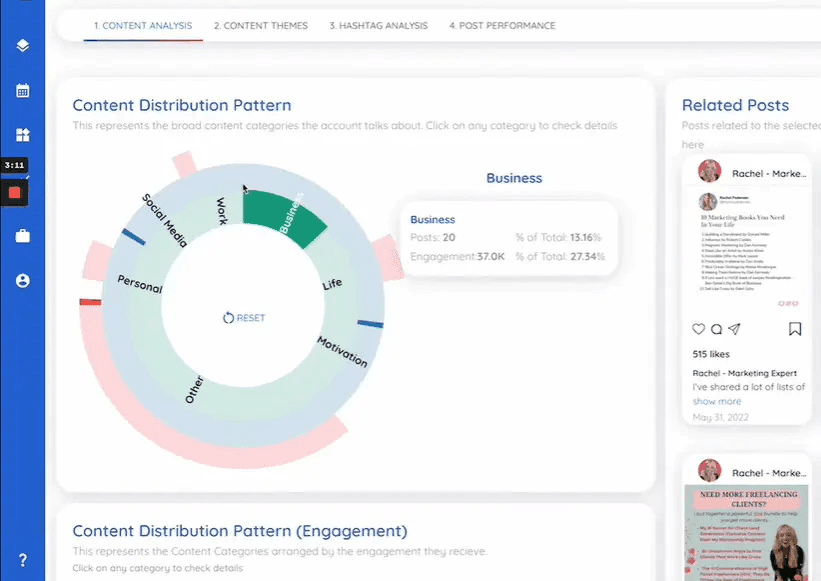
This dashboard image demonstrates how Predis.ai provides the Content Distribution Pattern:
- A single input can generate multiple formats, such as static posts, carousels, and short videos customized to each social network.
- Captions and hashtags are generated together, aligned with platform-specific engagement behavior.
- A built-in content calendar helps teams visualize scheduled posts and estimate performance before publishing.
Pricing & Plans:
Predis.ai offers three main tiers: Core at $32 per month ($19/month annually), Rise at $79 per month ($40 annually), and Enterprise at $249 per month ($212 annually), with higher tiers providing more AI content generation capacity and automation features.
PR and Brand Mentions
9. Brandwatch (Consumer Intelligence)
Best for:
Enterprise brands that need deep reputation monitoring, consumer sentiment tracking, and AI‑driven trend analysis across social media, news sites, forums, blogs, and review platforms.
What it is:
Brandwatch is a comprehensive consumer intelligence and social listening platform designed for large organizations that must monitor brand perception and market conversations at scale. Instead of simple mention counts, it uses advanced analytics and AI to identify patterns, sentiment shifts, crisis signals, and emerging topics that would be impossible to spot manually.
PR and communications teams use Brandwatch to assess campaign impact, detect early signs of reputation risks, and understand audience sentiment in nuanced detail. Its analytics can segment conversations by region, product line, or stakeholder group, making it a powerful tool for strategic decision‑making across brand, product, and market teams.
Standout Features:
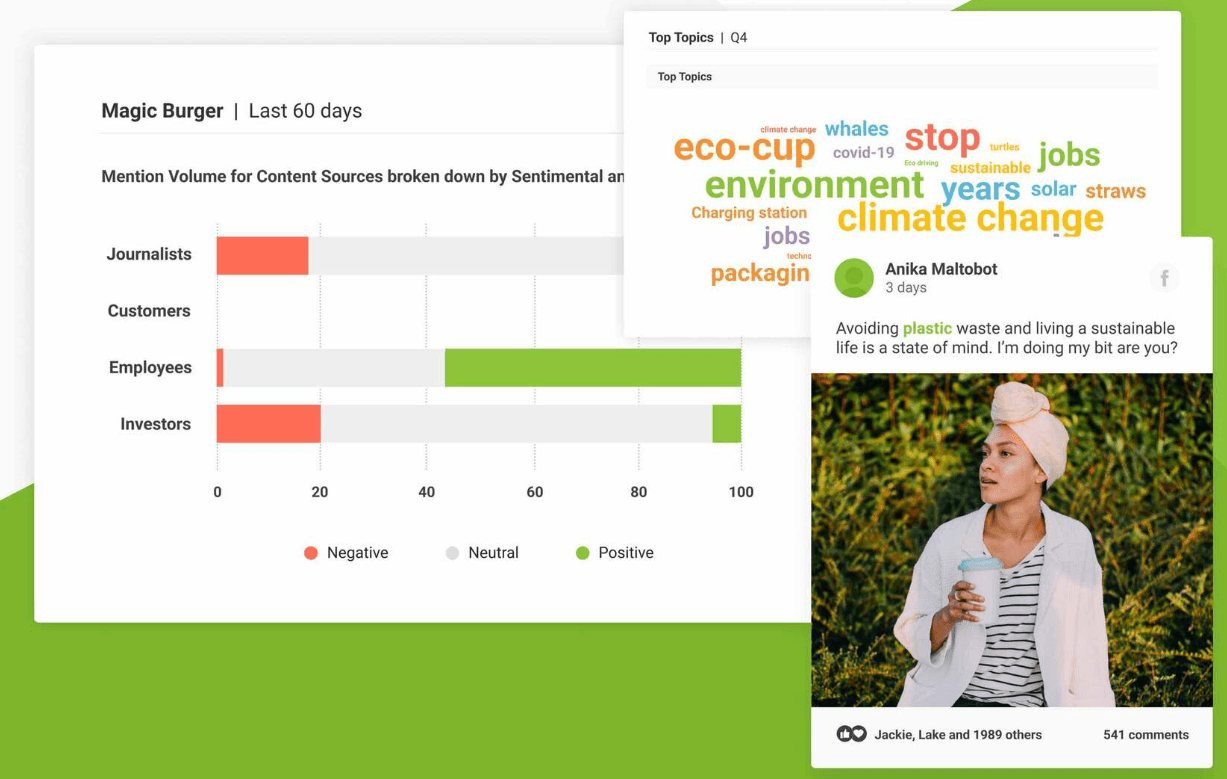
- AI‑powered sentiment analysis categorizes online mentions as positive, negative, or neutral while identifying themes and emotional context.
Below is the sentiment analysis done by Magaic Burger:
- Crisis detection flags unusual spikes in volume or negative sentiment, helping teams respond before issues escalate.
- Influencer identification surfaces accounts and creators driving key conversations about your brand or industry.
- Image recognition tracks visual brand appearances, such as logos and product mentions in shared media.
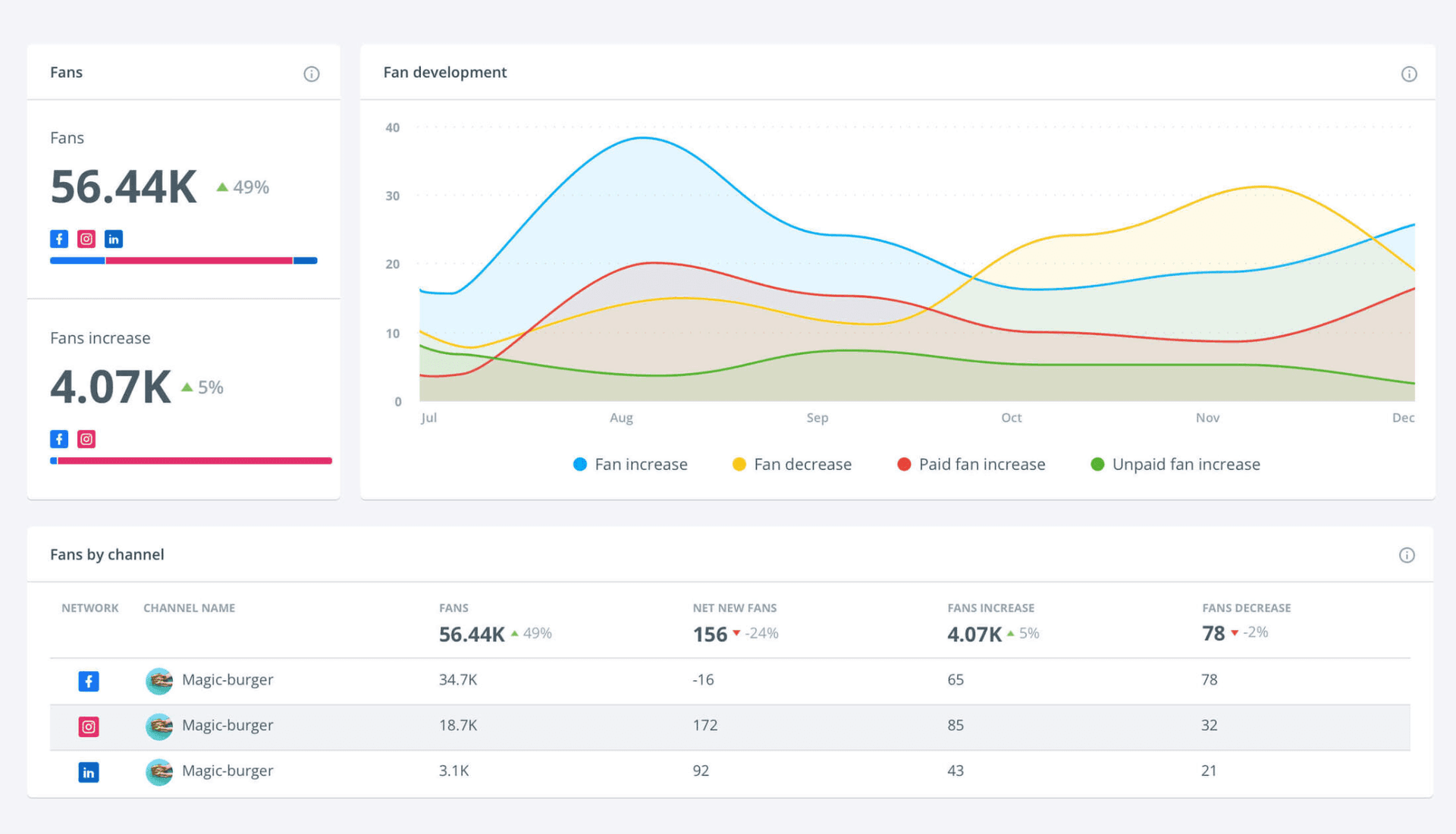
- Custom dashboards allow teams to segment intelligence by region, campaign, product line, or audience segment for targeted insights.
Here is an example of Brandwatch’s costme dashboard:
Pricing & Plans:
Brandwatch does not display pricing for its packages publicly. To find the plan that fits your needs, you’ll need to schedule a free demo with their team.
10. Meltwater
Best for:
PR teams and communications leaders who need to monitor media coverage across news outlets, broadcast channels, online publications, and social platforms.
What it is:
Meltwater is a media intelligence platform that tracks brand mentions and media narratives across traditional and digital channels. Unlike basic social listening tools, Meltwater combines press monitoring, broadcast tracking, and online news analysis in one place.
This helps PR professionals understand campaign reach, measure earned media value, and identify journalists or outlets that matter to their coverage goals.
The platform’s AI components surface the most meaningful mentions, prioritize trends, and highlight emerging narratives so teams can act quickly rather than react to volume alone. Meltwater is used by enterprise communications teams, agencies, and corporate PR functions that require holistic media oversight and measurement.
Standout Features:
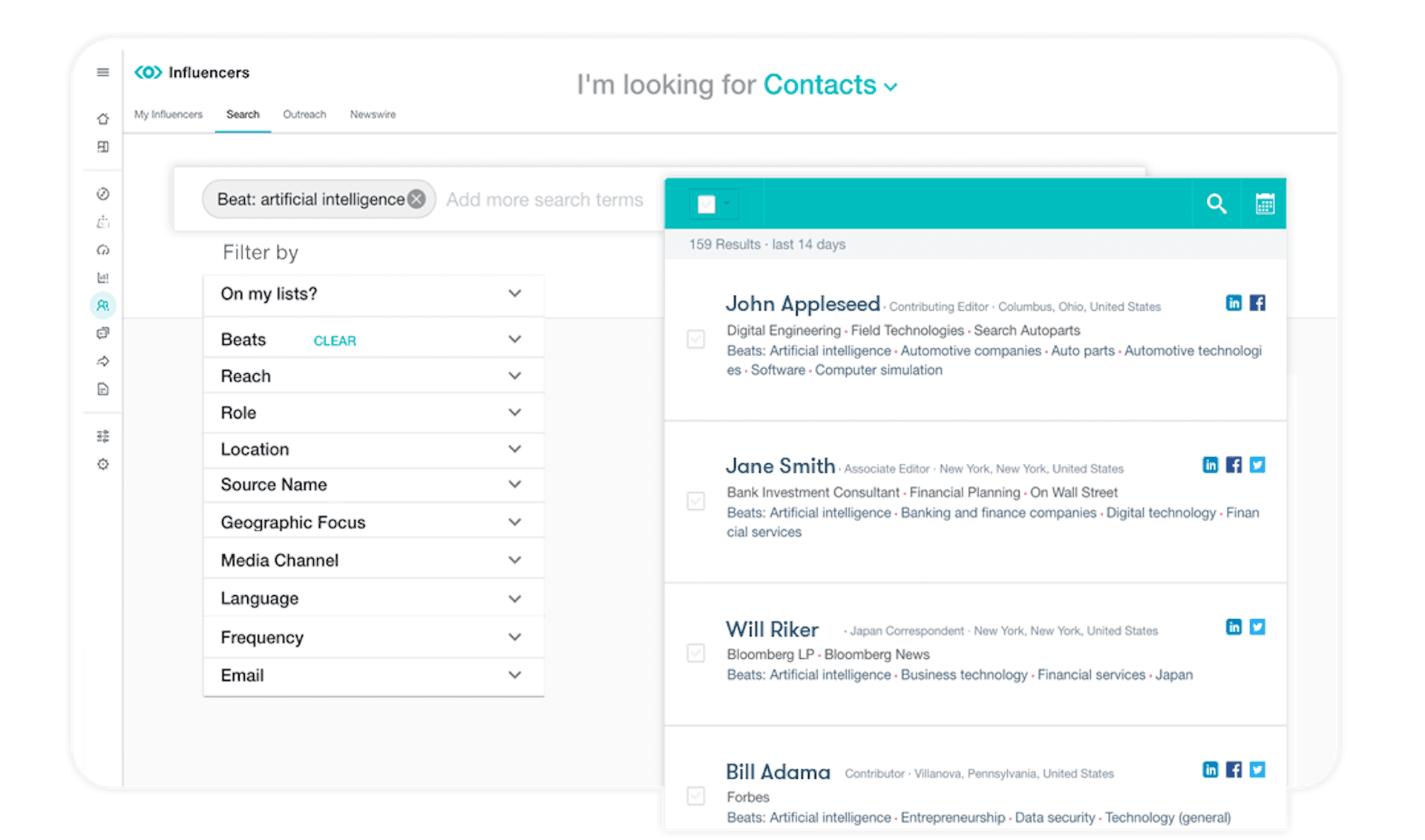
- Meltwater’s media database includes journalist profiles, publication details, and contact information to support targeted outreach and relationship building.
The visual below explains how users can filter out influences or journalist’s profiles and get information in Meltwater:
- AI‑powered media analysis identifies narrative trends, emerging topics, and key story angles from large volumes of coverage data.
- Share of voice metrics compare your media presence with that of competitors, helping teams benchmark PR performance.
- Broadcast monitoring captures mentions from TV and radio alongside online news, giving a fuller picture of brand visibility.
- Automated reporting tools produce coverage summaries, trend dashboards, and performance reports for stakeholders and leadership.
Pricing & Plans:
Meltwater does not publicly disclose pricing. Costs depend on factors like coverage volume, number of users, and add-on features. Interested teams must request a demo or custom quote from Meltwater’s sales team.
11. Mention
Best for:
Growing brands and marketing teams that need real-time media monitoring at an affordable price without the complexity of enterprise platforms.
What it is:
The platform is designed for teams building their online presence who want actionable insights without extensive setup or high costs. Real-time alerts and sentiment analysis help teams prioritize which mentions to address first.
Standout Features:
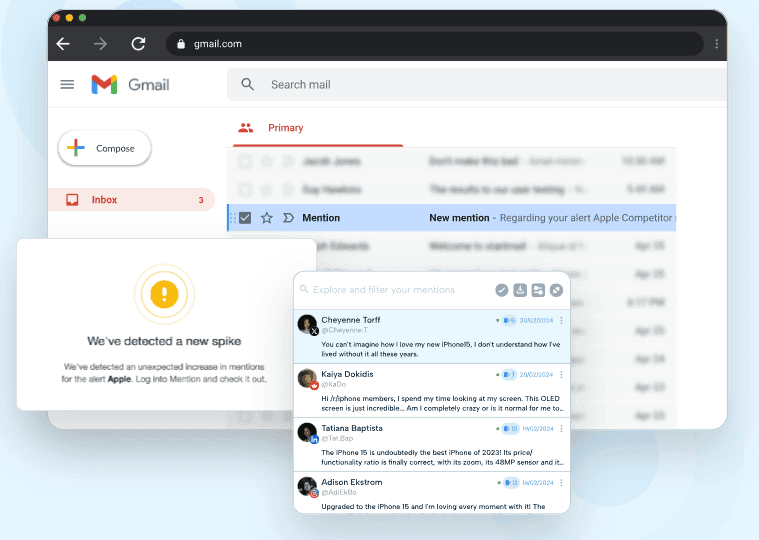
- Real‑time alerts notify you when your brand or keywords are mentioned across the web and social platforms.
Mention notifies the user instantly whenever your brand or any keyword is mentioned on any platform:
- Built‑in sentiment analysis categorizes mentions as positive, negative, or neutral to help you understand audience mood at a glance.
- Competitive monitoring lets you compare your mention trends against key rivals.
- Influencer scoring identifies accounts driving conversations around your brand or industry.
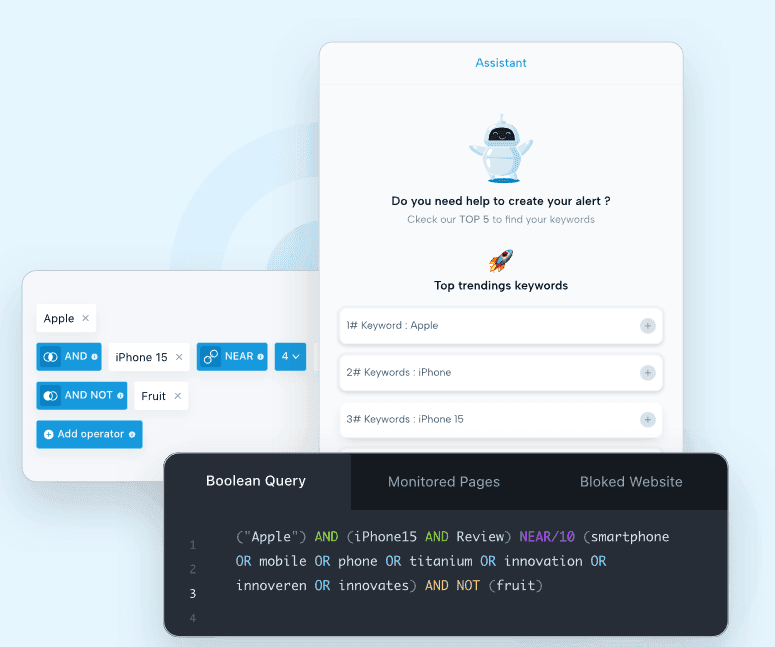
- Boolean search allows precise queries for complex monitoring (e.g., exact phrases or exclusion filters).
Here is how you can use Boolean search in Mention:
Pricing & Plans:
Mention’s pricing is enterprise‑grade and custom, with a clear entry point for business‑level monitoring. It usually starts at $599 per month.
12. Prowly
Best for:
In‑house PR teams that manage media relationships, press release distribution, and earned coverage tracking from a single platform.
What it is:
Prowly is a PR operations platform that supports the full media engagement workflow. It combines a searchable media contact database, a press release creation and distribution tool, and coverage monitoring into one solution. Unlike pure media listening tools, Prowly is built for teams that actively reach out to journalists, send announcements, and then measure where and how their news gets picked up.
Small to mid‑size PR and communications teams use Prowly to streamline press outreach, maintain media relationships, and see the impact of their earned media efforts without relying on multiple disjointed tools.
Standout Features:
- You can access over one million journalist contacts and outlets filtered by beat, location, or publication type.
- The press release builder includes SEO guidance and lets you embed images, videos, and other multimedia to make releases more discoverable.
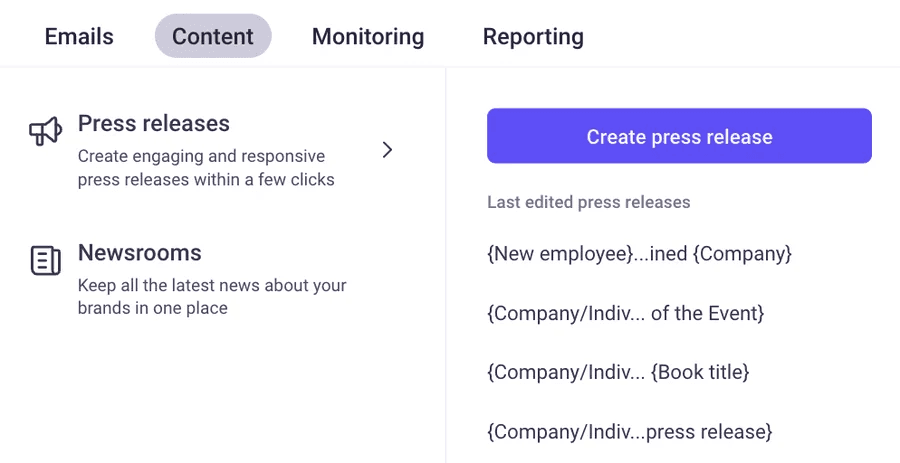
This shows how Prowly let’s use create press release, do editing etc.:
- You can distribute press releases directly to curated journalist lists with just one click.
- Coverage tracking shows where your releases are picked up and measures the reach and engagement of each mention.
- A branded online newsroom hosts your press releases, media kits, and assets in a centralized, easy-to-navigate space.
Pricing & Plans:
Prowly’s Basic plan costs $369 per month ($258/month annually), while the Pro plan costs $589 per month ($416 annually). Larger organizations can opt for the Enterprise plan with custom pricing and expanded PR management features.
AI Search Visibility
13. Profound
Best for:
Enterprise brands that need to track how AI answer engines describe and recommend them.
What it is:
Profound monitors how AI systems like ChatGPT, Perplexity, Gemini, Claude, and Google AI Overviews mention your brand. It tracks visibility share, citation sources, and sentiment across answer engines, and shows how that visibility trends over time.
Standout Features:
Answer Engine Insights track share of voice by topic across the major AI platforms.
Citation analysis shows which sources AI models pull from when they mention your brand.
Sentiment tracking and prompt volume data reveal how models frame your brand and how often buyers ask about your category.
Pricing & Plans:
Plans start from $99 per month for a limited Starter tier, with broader enterprise plans on custom pricing.
14. Peec AI
Best for:
Mid-market marketing teams that want clean AI search visibility, position, and sentiment analytics.
What it is:
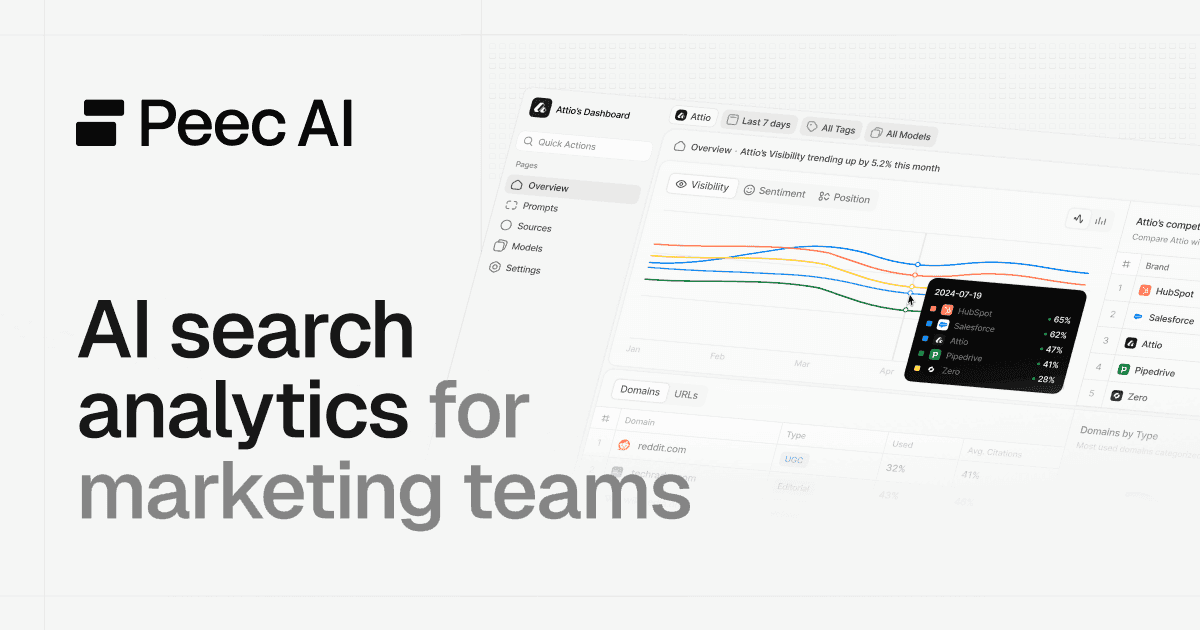
Peec AI presents AI search performance through a simple analytics model built around visibility, position, and sentiment. It tracks brand mentions across ChatGPT, Perplexity, Gemini, Claude, and other AI platforms, with competitor comparisons that show how prominently you are mentioned versus rivals. More than 3,000 brands and agencies use it.
Standout Features:
Visibility, position, and sentiment tracked per prompt across major AI assistants.
Competitive benchmarking compares mention frequency, response position, and sentiment against rivals.
Agency-ready reporting makes the data easy to share with stakeholders and clients.
Pricing & Plans:
Starter plans begin at $95 per month, with higher tiers for larger teams.
15. Otterly.ai
Best for:
Teams that want lightweight, affordable day-to-day AI search monitoring.
What it is:
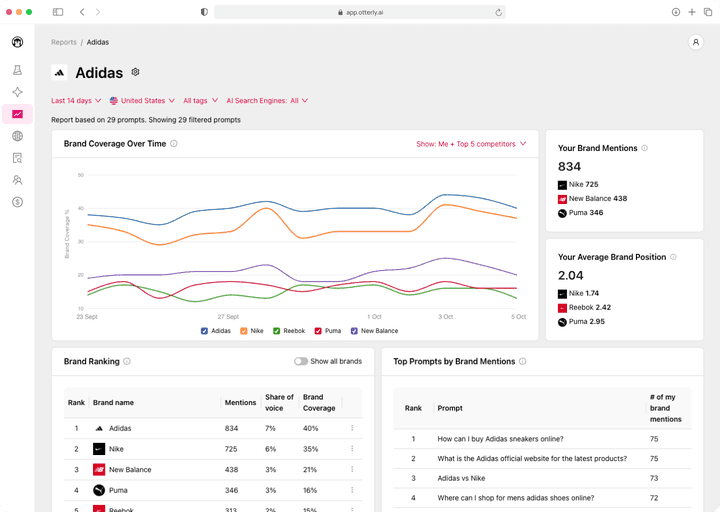
Otterly.ai is an AI search monitoring and optimization platform that measures how brands appear and get cited in AI-generated answers across ChatGPT, Google AI Overviews, Google AI Mode, Perplexity, Gemini, and Microsoft Copilot. It is built specifically for ongoing tracking rather than one-off audits.
Standout Features:
Prompt-level visibility tracking shows exactly where your brand shows up in AI answers.
Citation and mention tracking over time flags shifts as models update.
Simple setup makes it easy to keep daily watch on your category without enterprise overhead.
Pricing & Plans:
Plans start from $29 per month.
📖 Further reading
- Branding Guides and Insights — Tenet's hub for branding strategy, identity, and positioning.
- Brand Marketing vs Performance Marketing: Better ROI? — where brand visibility fits in your marketing mix.
- A Complete Visual Branding Guide for 2026 — how visual identity makes your brand recognizable.
Improve Your Brand Visibility With Tenet
AI tools can produce content quickly, but brand visibility comes from clarity, not volume. Without a clear position and consistent messaging, even the best tools create noise instead of recognition.
That is where Tenet comes in. We work with teams to define how their brand should be understood before AI enters the workflow.
Through brand research, audience insights, and positioning work, we help teams understand what needs to be said, who it is for, and where it should show up. This foundation allows AI tools to support the brand rather than shape it.
Our approach helps teams choose the right tools for their goals and use them with intent, so visibility builds steadily over time.
Here is a piece of our work that we did for one of our clients, IROS:
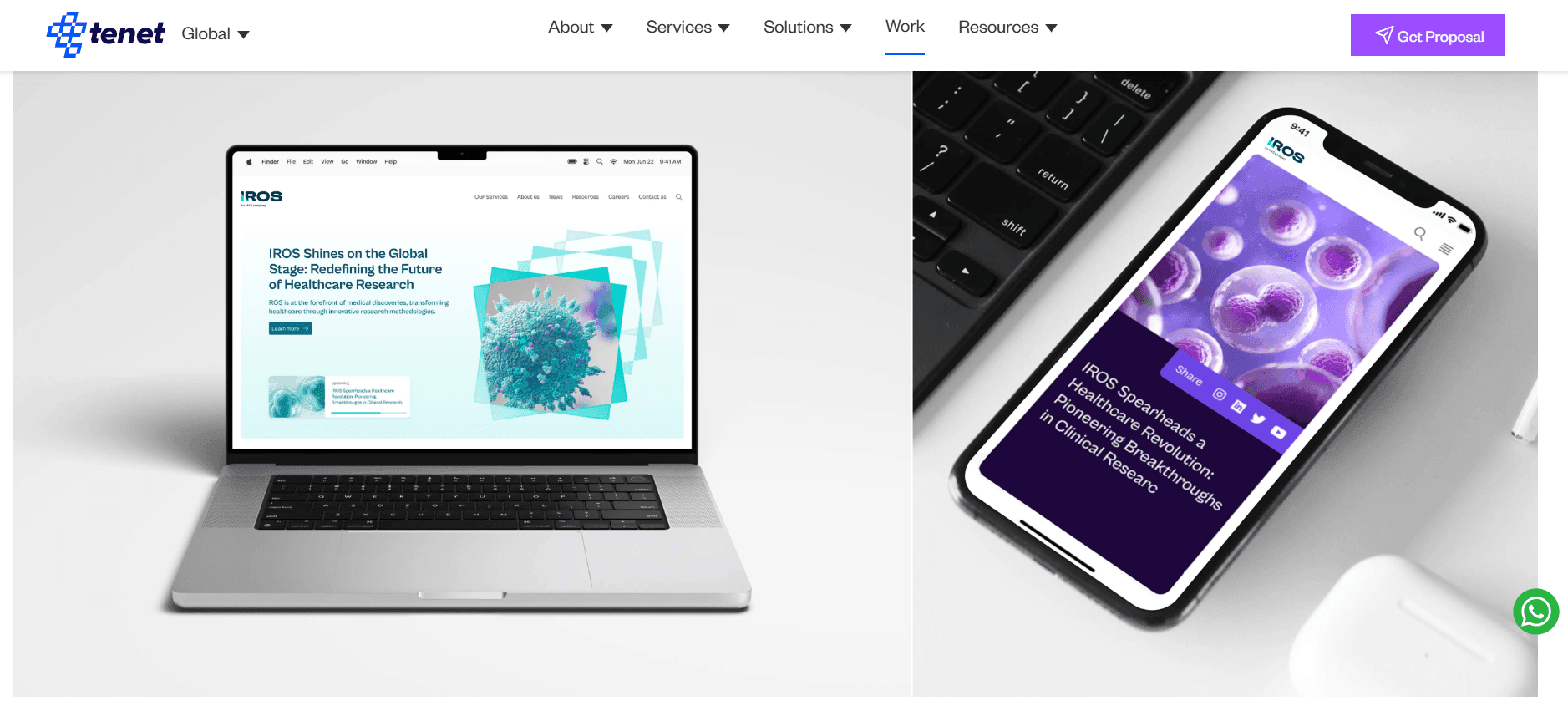
If you are refining how your brand shows up and want it to hold up long term, you can explore how we approach brand strategy and brand research, or start with a conversation to review your current setup.
If you want this kind of clarity for your own brand, request a branding proposal and we will show you exactly how we would sharpen your positioning and visibility.
Talk to Experts About Growing Your Brand Visibility
Talk to Experts About Growing Your Brand Visibility











Got an idea on your mind?
We’d love to hear about your brand, your visions, current challenges, even if you’re not sure what your next step is.
Let’s talk


