
Revenue Growth Strategies for B2B and Enterprise Companies
 By
By Share

Share
Get a quick blog summary with



Revenue growth in B2B and enterprise companies rarely happens by chance. It usually comes from deliberate planning and the ability to align sales, marketing, and operations around clear revenue goals. Unlike consumer businesses, B2B companies operate with longer sales cycles, multiple decision-makers, and contract-based revenue models. These factors make reactive or unstructured growth efforts costly and difficult to scale.
At Tenet, we have contributed to over $1.5B in client revenue by helping enterprise and SaaS companies improve how they attract, convert, and nurture buyers through complex sales cycles. This article outlines a structured approach to B2B revenue growth.
It explains how to assess your current growth position and then explores ten practical strategies companies use to build a qualified pipeline and more predictable revenue.
What Is a Revenue Strategy for B2B and Enterprises?
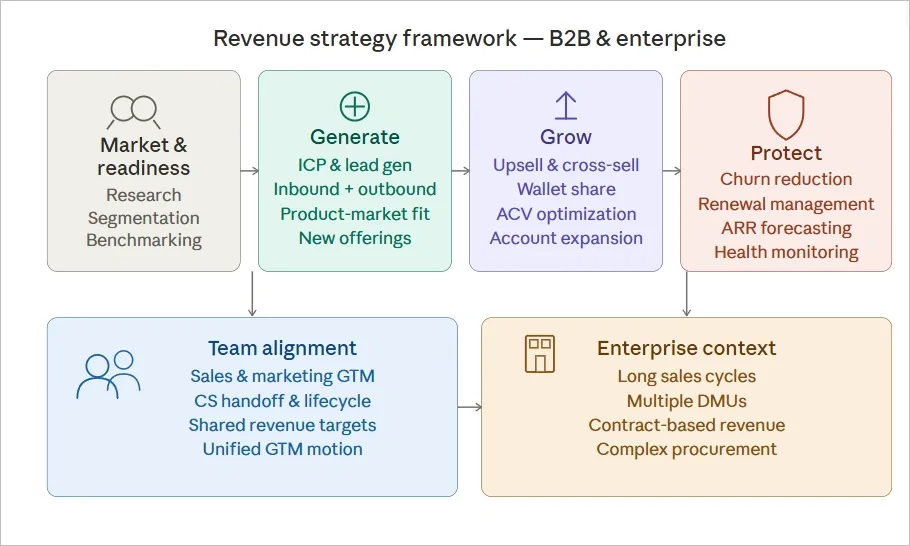
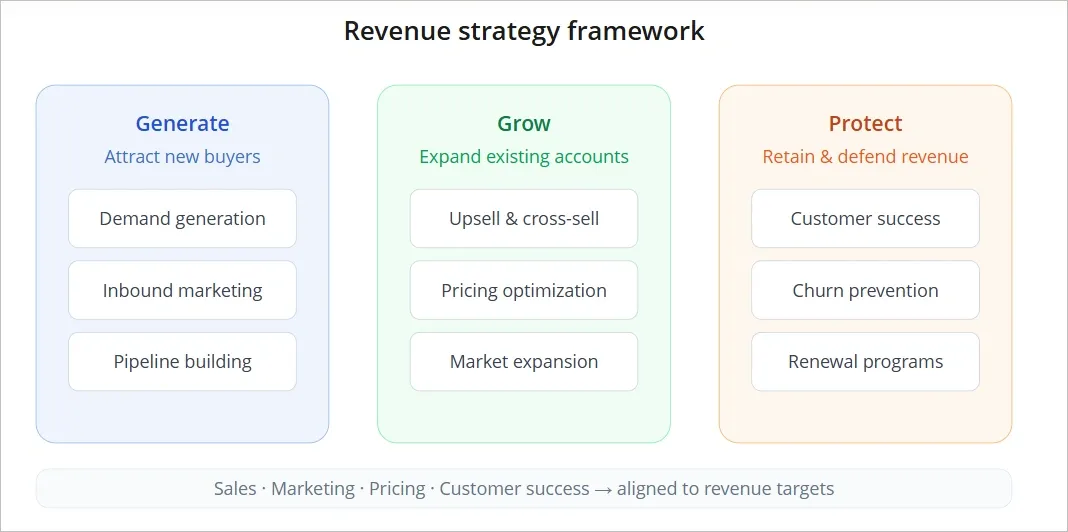
A revenue strategy is a structured plan that explains how a company will generate, grow, and protect its income over a defined period. It connects the work of sales, marketing, pricing, and customer success to clear business targets so that every team is working toward the same outcome.
It is broader than a marketing plan or a sales quota. A revenue strategy acts as the foundation that guides how a company attracts customers, converts them into revenue, and expands value over time.
The framework below shows how B2B companies structure their revenue strategy to generate, grow, and protect revenue.
Critical Factors to Assess Before Planning Revenue Growth Strategies
Choosing the wrong growth strategy due to an incomplete picture of your business position is one of the most common and costly errors in B2B. The factors below are not optional diagnostics.
They are the inputs your strategy depends on. Skipping them produces plans built on assumptions rather than data.
1. Market Position and Total Addressable Market (TAM)
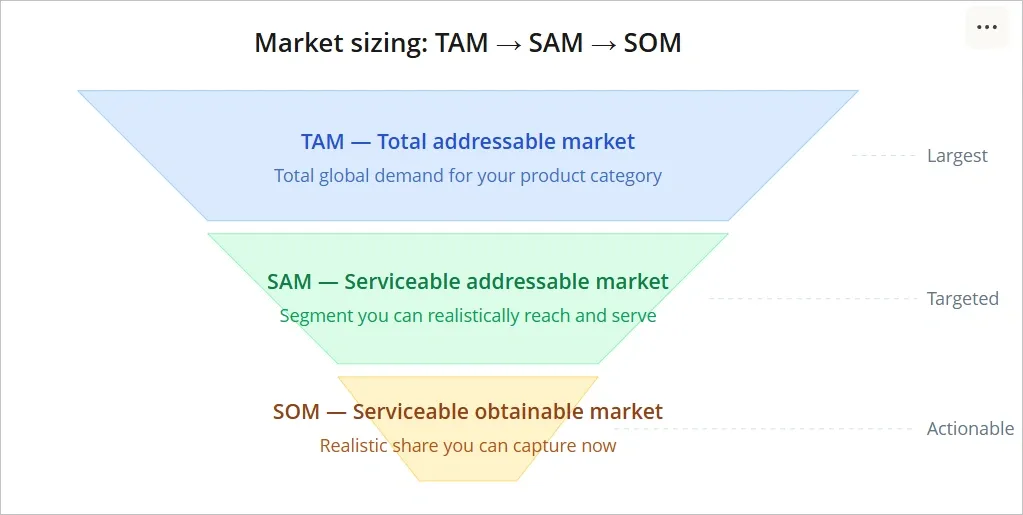
Before choosing a growth strategy, a company needs to understand how much room there is to grow in its market. This begins with estimating the Total Addressable Market (TAM), which represents the total demand for a product or service.
If the market is large and the company holds only a small share, growth can come from acquiring more customers in the same space. But if most of the market is already captured, expanding into new segments or industries may be the better option.
Understanding this early prevents companies from pursuing growth paths that simply do not exist.
The diagram below illustrates how market sizing is structured, moving from the total addressable market (TAM) to the realistically obtainable share (SOM).
2. Profitability and Unit Economics
Growth only works when the business can support it financially. Before planning expansion, companies need to understand whether each sale actually contributes to profit.
This is where unit economics matters. It answers a simple question: Does each customer generate more value than it costs to acquire and serve them?
If margins are already thin, pushing for rapid growth can increase costs faster than revenue. Instead of solving problems, it can make them larger. A clear view of profitability helps companies decide whether the priority should be scaling acquisition, improving pricing, or fixing operational costs first.
3. Revenue Mix and Customer Concentration
Many B2B companies grow quickly by landing a few large customers. At first, this looks like strong progress. But over time, it can create risk.
If a large share of revenue depends on one customer, one product, or one region, the business becomes fragile. Losing that single source can disrupt growth overnight.
Before choosing a growth strategy, it is important to understand where revenue actually comes from. A balanced mix across customers, products, and markets makes the business more stable and easier to scale. If the mix is too concentrated, diversification may need to come before aggressive expansion.
4. Customer Acquisition Cost vs. Lifetime Value (CAC: LTV)
Every new customer comes with a cost. Marketing spend, sales time, tools, and campaigns all add up. The question is whether the revenue from that customer justifies the cost of acquiring them.
In B2B, a healthy benchmark is a 3:1 ratio between lifetime value and customer acquisition cost. This means the revenue generated from a customer should be at least three times what it costs to win them.
If the ratio is lower, scaling acquisition may not be the right move. In many cases, improving retention, pricing, or expansion revenue can produce healthier and more sustainable growth.
5. Retention Rate and Net Revenue Retention (NRR)
Winning new customers is important, but long-term revenue growth depends just as much on keeping the customers you already have. If existing customers leave too quickly, new sales only replace lost revenue instead of creating real growth.
Retention rate indicates how many customers keep using your product over a given period. Net Revenue Retention (NRR) goes a step further and measures how revenue changes from existing customers through renewals, upgrades, or downgrades.
For many B2B SaaS companies, strong performance means reaching NRR above 120%. If retention is weak, the priority should be fixing churn before increasing acquisition efforts. Otherwise, growth efforts simply fill a leaking bucket.
6. Sales Cycle Length and Operational Capacity
Enterprise B2B sales cycles commonly run 6 to 18 months. That’s why, before investing heavily in new pipeline generation, companies should evaluate whether their sales team can realistically manage more deals at once.
If the team is already handling a full pipeline, adding more leads may not increase revenue. It can slow down follow-ups and reduce win rates.
Operational capacity matters as well. Product teams, onboarding specialists, and customer success managers must be able to support new customers without lowering service quality. Growth only works when the business can support the customers it brings in.
Revenue Growth Strategies
The following ten strategies are ordered to reflect a logical progression: start by strengthening the foundation of your existing business, then build outward toward new channels, segments, and market positions.
Each strategy should be evaluated against the assessment factors above, not applied uniformly.
1. Sharpen Focus on Your Core Product
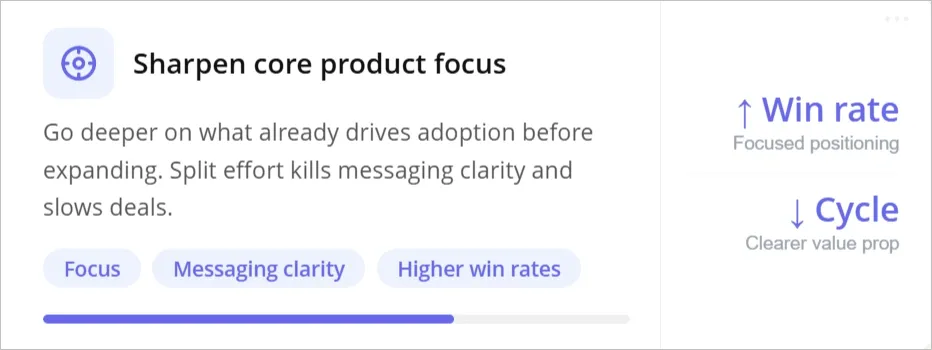
Many B2B companies try to grow by launching new products too quickly. The problem is that sales and marketing effort gets split across too many things, and none of them become strong in the market.
Growth usually comes from going deeper with the product that already works.
Start by identifying which part of your product drives the most customer adoption and renewals. That is the area where your company already has proof that the market cares. Strengthen that use case, improve the messaging around it, and make it easier for buyers to understand the value.
Several large SaaS companies followed this path early on. They built strong positions by solving one problem extremely well before expanding into additional products.
2. Build Marketing Into Your Growth Engine
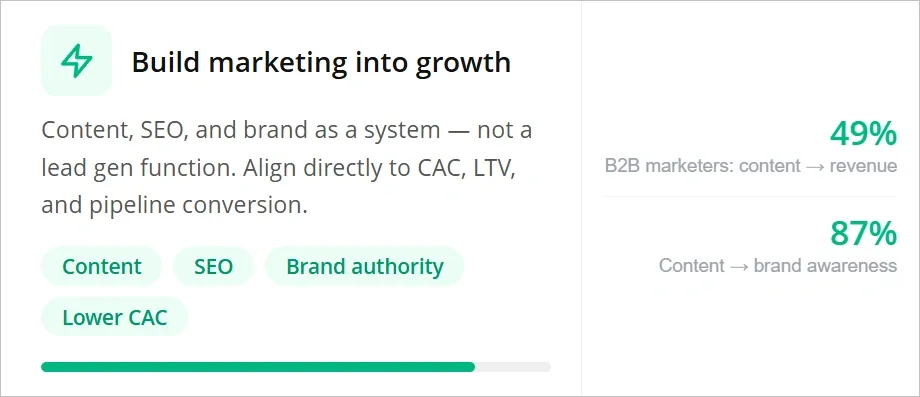
In many organizations, marketing is treated solely as a lead-generation channel. But the more productive model treats marketing as a system that shortens sales cycles, reduces CAC, and builds pricing power through brand authority and content reach.
This means investing in B2B content marketing that educates buyers at every stage of the decision process, building SEO that captures demand before competitors, and developing consistent visibility in channels where buyers conduct research. Aligning marketing directly to revenue KPIs such as conversion rate, CAC, and customer lifetime value replaces vanity metrics with accountable performance.
Research from Salesforce shows content marketing contributes to revenue generation for 49% of B2B marketers who use it strategically, rising to 87% for brand awareness. The difference often comes down to how well the content is connected to the rest of the buying journey.
3. Double Down on What Is Already Working
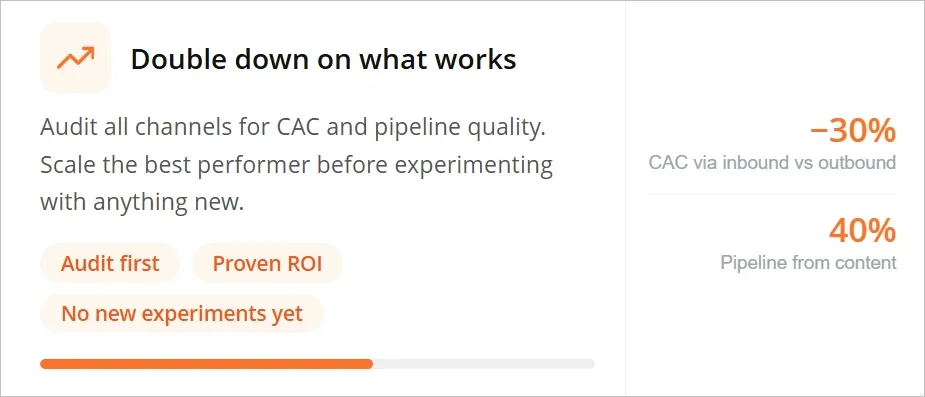
Before launching new initiatives, audit existing performance data to identify channels, segments, or content types delivering above-average returns. Then allocate additional resources to the source that is delivering stronger results at a lower acquisition cost and it usually makes sense to expand that effort before experimenting with something entirely new.
💡 Example:
If inbound content is generating 40% of your qualified pipeline at a CAC 30% lower than your outbound motion, the data-supported decision is to increase content and SEO investment before adding a new paid channel.
This reflects standard portfolio logic: maximize return on proven activities first. It also helps teams avoid the pattern of abandoning strategies that are working but not yet at scale, a common mistake in B2B growth planning.
4. Prioritize Quick Wins Through Conversion Rate Optimization (CRO)
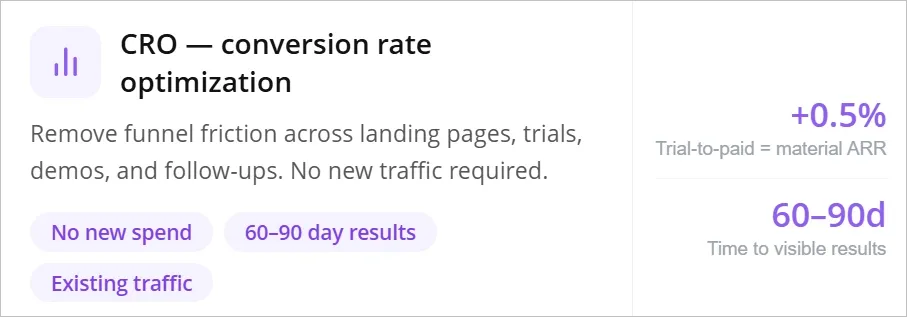
Conversion rate optimization (CRO) identifies and removes friction in the buyer's journey without requiring additional traffic or new product development. This can mean improving how trial sign-ups convert to sales conversations, how demos are structured, or how follow-up sequences are timed and personalized.
For digital-first B2B businesses, structured CRO audits can help identify where these drop-offs occur. This usually involves reviewing landing page performance, form completion rates, call-to-action placement, and how clearly the next step is presented to the visitor.
Even small improvements can have a noticeable impact. For example, increasing trial-to-paid conversion by just 0.5% on a high traffic page can translate into meaningful additional revenue over time.
Because these changes build on traffic that already exists, CRO initiatives often begin showing measurable results within 60 to 90 days.
5. Prioritize Retention Over Acquisition
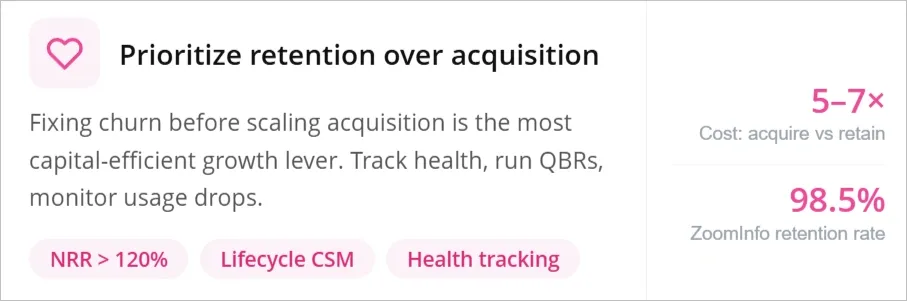
Many companies focus heavily on acquiring new customers, but usually it costs 5 to 7 times more than retaining an existing one. This means even a small improvement in retention can significantly increase long-term profitability.
`Retention usually improves when companies stay actively involved with their customers after the sale. This can include tracking account health to identify early signs of disengagement, running quarterly business reviews with key stakeholders, and monitoring product usage so the customer success team can step in when activity drops.
Organizations that treat customer success as a structured function often see stronger expansion revenue and higher renewal rates, which directly improve overall revenue stability.
💡 Real Example
ZoomInfo built its customer education around key moments in the customer lifecycle. New users receive onboarding webinars and on-demand training, engagement is reinforced around the 90-day mark when product usage often drops, and advanced training is delivered a few months before renewal so teams can get more value from the platform.
This structured training approach helps guide customers through the product over time and has helped ZoomInfo maintain around 98.5% retention.
6. Diversify Traffic and Demand Generation Channels
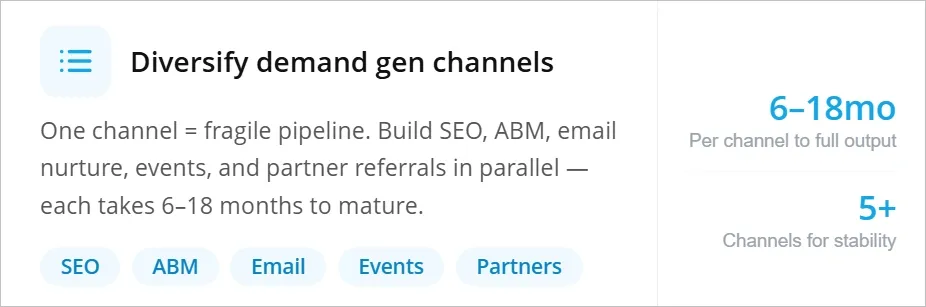
Relying on a single source of pipeline can make revenue unpredictable. If most leads come from one channel, such as paid search, any budget change, algorithm shift, or stronger competitor can quickly reduce incoming opportunities.
A more stable approach is to build demand across several channels at the same time. For B2B companies, a balanced channel mix typically includes organic search through B2B SEO, account-based marketing (ABM), structured email nurture, partner referrals, and community or event-based demand generation. Each channel attracts buyers differently and reduces reliance on any single source.
Each channel takes 6 to 18 months to reach consistent productivity, so the goal is to build toward diversification in parallel with optimizing existing channels, not by abandoning them.
7. Improve Pricing Strategy
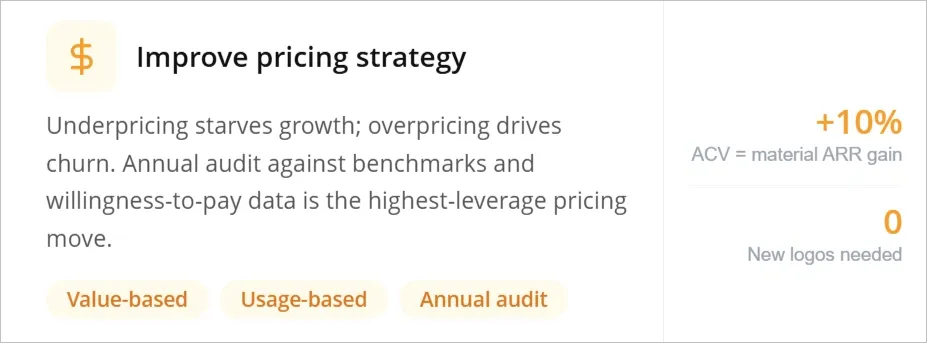
Pricing is one of the highest-leverage inputs in revenue growth, yet most B2B companies revise pricing too infrequently and without enough buyer data to support meaningful change. Underpricing reduces the capital available for sustainable growth, whereas overpricing without clear differentiation increases churn.
A practical step is to audit pricing annually against competitive benchmarks, customer willingness-to-pay data, and current value delivery. Evaluate whether value-based or usage-based pricing would produce better retention and expansion outcomes than flat seat-based structures.
In enterprise accounts, a 10% increase in average contract value, achieved through improved packaging and structured negotiation, can materially impact ARR without adding a single new customer to the base.
8. Expand Into Adjacent Markets
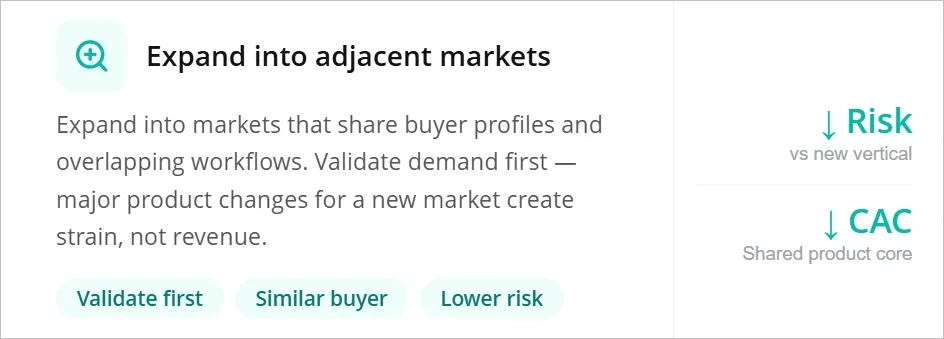
Once a company has built strong traction in its core market, the next step is often expansion into closely related markets. Adjacent markets share similar buyer profiles, problems, or workflows with your existing business, reducing the cost and risk of entry compared to entirely new verticals.
Before expanding, it is important to validate demand. This usually means speaking with potential buyers and understanding whether the current product can support their needs. If the product requires major changes, expansion can create operational strain instead of new revenue.
9. Optimize Enterprise Sales Cycles
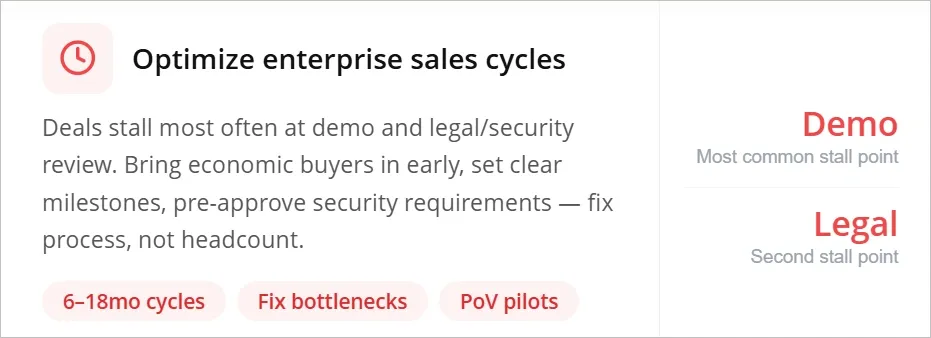
Long sales cycles are common in enterprise deals, but they can often be shortened by improving the sales process. Many deals slow down because the right decision makers are not involved early enough or because the next steps are unclear after the initial conversations.
Sales teams can improve outcomes by bringing economic buyers into discussions earlier and by setting clear milestones for the evaluation process. Simple steps such as outlining the decision timeline, defining responsibilities on both sides, and running focused proof-of-value pilots can help deals move forward with fewer delays.
It is also useful to review past deals and identify where they tend to stall. In many cases, delays happen after the demo stage or during security and legal reviews. Fixing these specific bottlenecks is usually more effective than simply increasing sales outreach.
Addressing the specific bottleneck in your process is more effective than adding headcount to compensate for an inefficient system.
10. Strengthen Partnerships and Channel Sales
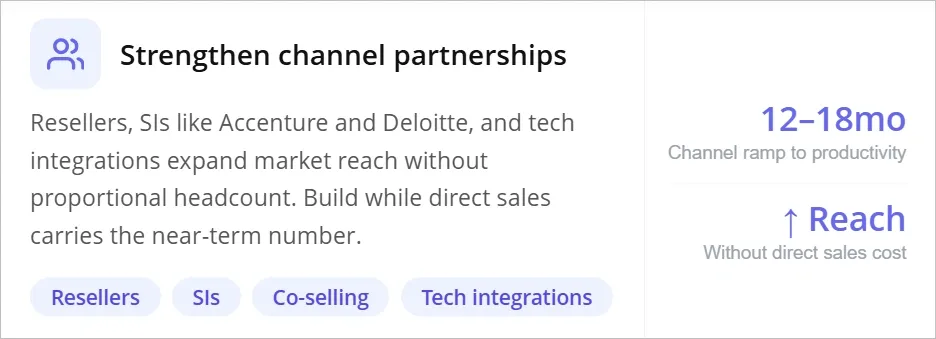
Partnership programs allow companies to generate revenue through ecosystems rather than relying entirely on direct sales capacity. This includes reseller arrangements, technology integrations, consulting firm referral programs, and co-selling motions with complementary vendors targeting the same buyer profile.
For larger companies, system integrator (SI) partnerships with firms such as Accenture, Deloitte, or regional consultancies can expand market reach significantly without proportional investment in direct sales headcount.
However, channel strategies typically take 12 to 18 months to reach full pipeline productivity, which means the partnership foundation must be built while direct sales carry near-term targets.
💡 Related resources:
- 11 UX Strategies to Boost Conversions: What Worked & Why?
- How To Increase Ecommerce Sales (16 Strategies)
- Enterprise Lead Generation: 8 Strategies That Work
Final Words
Revenue growth at the B2B and enterprise level requires clarity before action. The companies that consistently outperform are not necessarily the ones with the most aggressive strategies.
They are the ones with the most accurate understanding of their current position, which allows them to invest in the right strategies at the right time and direct resources where the return is highest.
The ten strategies outlined here are not a checklist to implement simultaneously. These are options to evaluate against your business's specific constraints and opportunities. Prioritize based on where your unit economics are weakest, where your customers churn most, and where the clearest gap exists between what you offer and what the market will pay for it.
If you are reviewing your growth marketing strategy and want a structured approach to improving conversion rates, demand generation, or enterprise positioning, Tenet's team works with B2B and enterprise companies on exactly these challenges. You can explore our growth marketing services here.
Get expert guidance to scale B2B revenue growth
Get expert guidance to scale B2B revenue growth























Got an idea on your mind?
We’d love to hear about your brand, your visions, current challenges, even if you’re not sure what your next step is.
Let’s talk


