
10 Powerful B2B Lead Generation Strategies To Use in 2026
 By
By Share

Share
Get a quick blog summary with



Most B2B marketing teams are generating leads, but far fewer are generating a qualified pipeline that consistently converts into revenue. Even according to HubSpot, 61% of marketers say generating high-quality leads is their biggest issue. The challenge is not a lack of tactics; instead, it’s because acquisition efforts are not aligned with buying intent and commercial relevance.
At Tenet, we have built an organic lead engine that generates 100+ organic leads per month, with SEO contributing nearly 50% of total inbound. We replicate this intent-driven model across B2B SaaS, enterprise software, and professional services. This article breaks down the strategies that consistently generate qualified B2B leads in 2026, with clear execution logic and measurable outcomes.
What Is B2B Lead Generation?
B2B lead generation is the process of identifying, attracting, and capturing interest from potential business buyers who are likely to purchase your product or service. The output is a qualified contact or account that your sales team can engage with a reasonable expectation of conversion.
Unlike B2C marketing, where the buyer is usually an individual making a personal decision, B2B lead generation targets decision-makers within companies. These buyers often include founders, CXOs, department heads, or procurement teams, and their decisions involve budget approval, risk evaluation, and longer sales cycles.
In practice, B2B lead generation includes activities such as:
- Capturing high-intent search traffic through SEO
- Running paid campaigns on platforms like LinkedIn and Google Ads
- Publishing case studies and commercial landing pages
- Hosting webinars and gated content assets
- Running outbound campaigns to target accounts
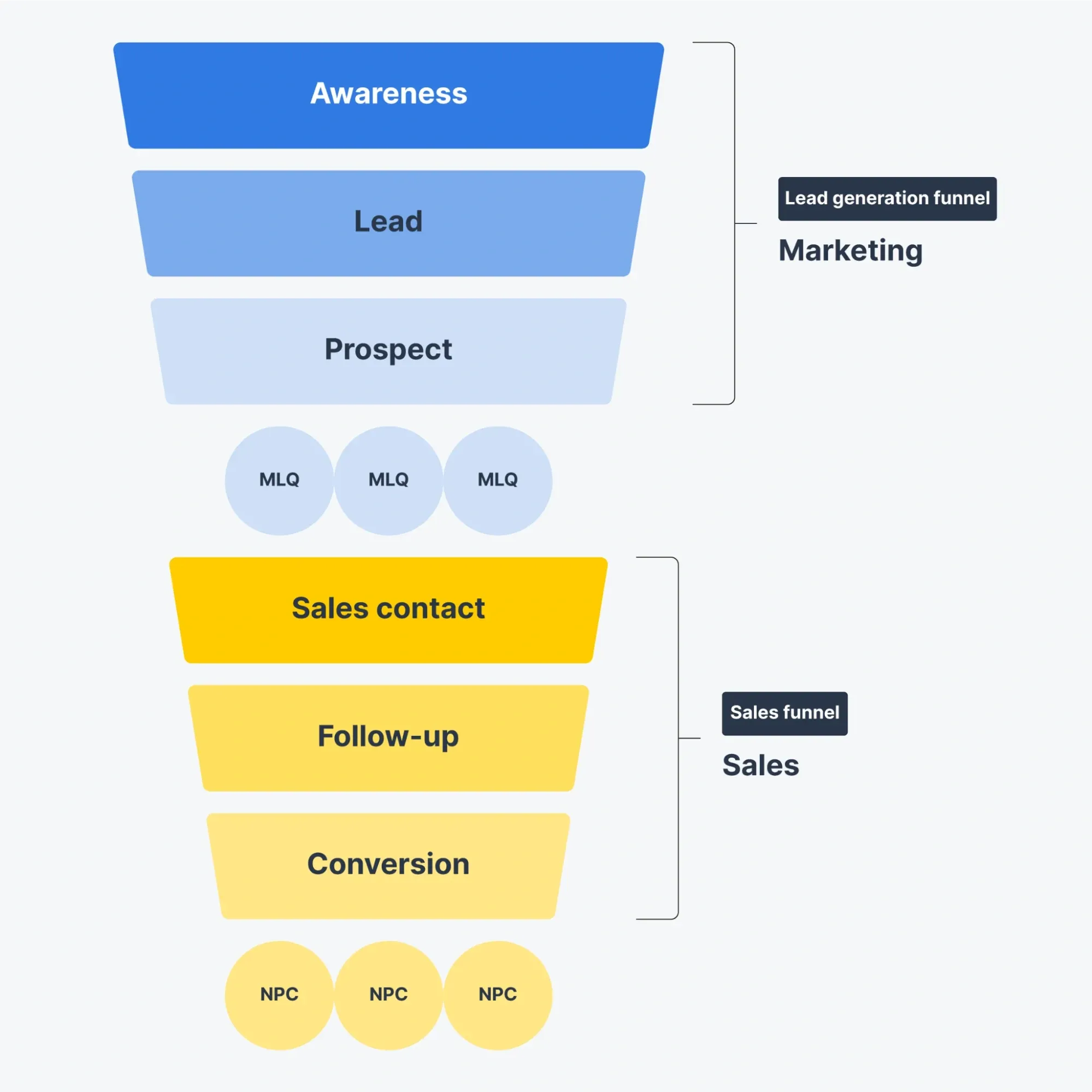
Here is a typical B2B lead generation funnel, illustrating the hand-off between marketing-driven traffic and sales-ready conversions.
Here are 10 proven ways to generate leads for B2B companies
The strategies below are selected based on their applicability to complex, high-ticket B2B environments. Each is built for long sales cycles, multiple decision-makers, and measurable pipeline impact.
1. Ranking for bottom-of-the-funnel keywords
What It Is
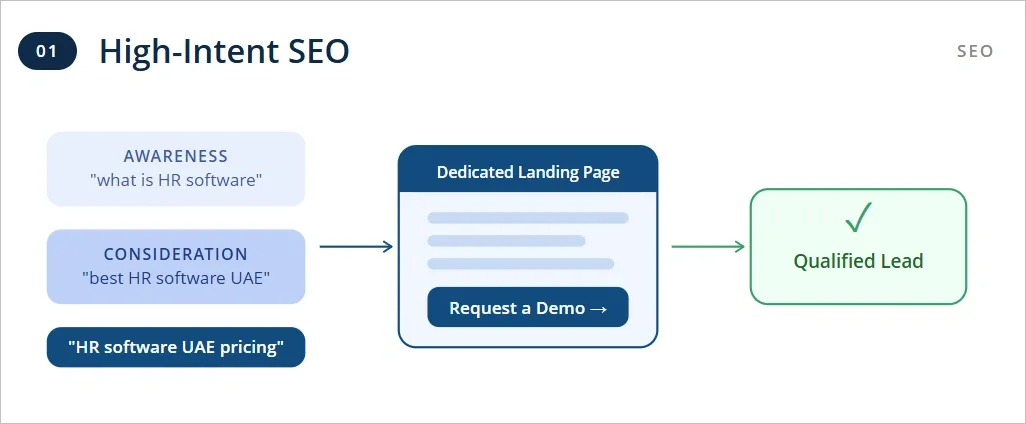
Bottom of funnel SEO targets keywords used by buyers who are ready to take action. These include comparison terms, pricing queries, reviews, integrations, and location specific searches. At this stage, users are evaluating options and looking for the best solution.
Why It Works in B2B
Most enterprise buyers complete their research before contacting vendors. They compare tools, check pricing, and read reviews independently. If your brand appears in these high intent searches, you influence the final decision stage where conversions happen.
How to Execute
Focus on keywords people search when they are ready to decide. Start by grouping your keywords into clear buckets:
- Comparison terms like “product vs competitor”
- Pricing searches like “product pricing” or “cost of product”
- Reviews and alternatives like “product reviews” or “tools like X”
- Use case queries like “best software for small teams”
- Location based searches like “payroll software UAE”
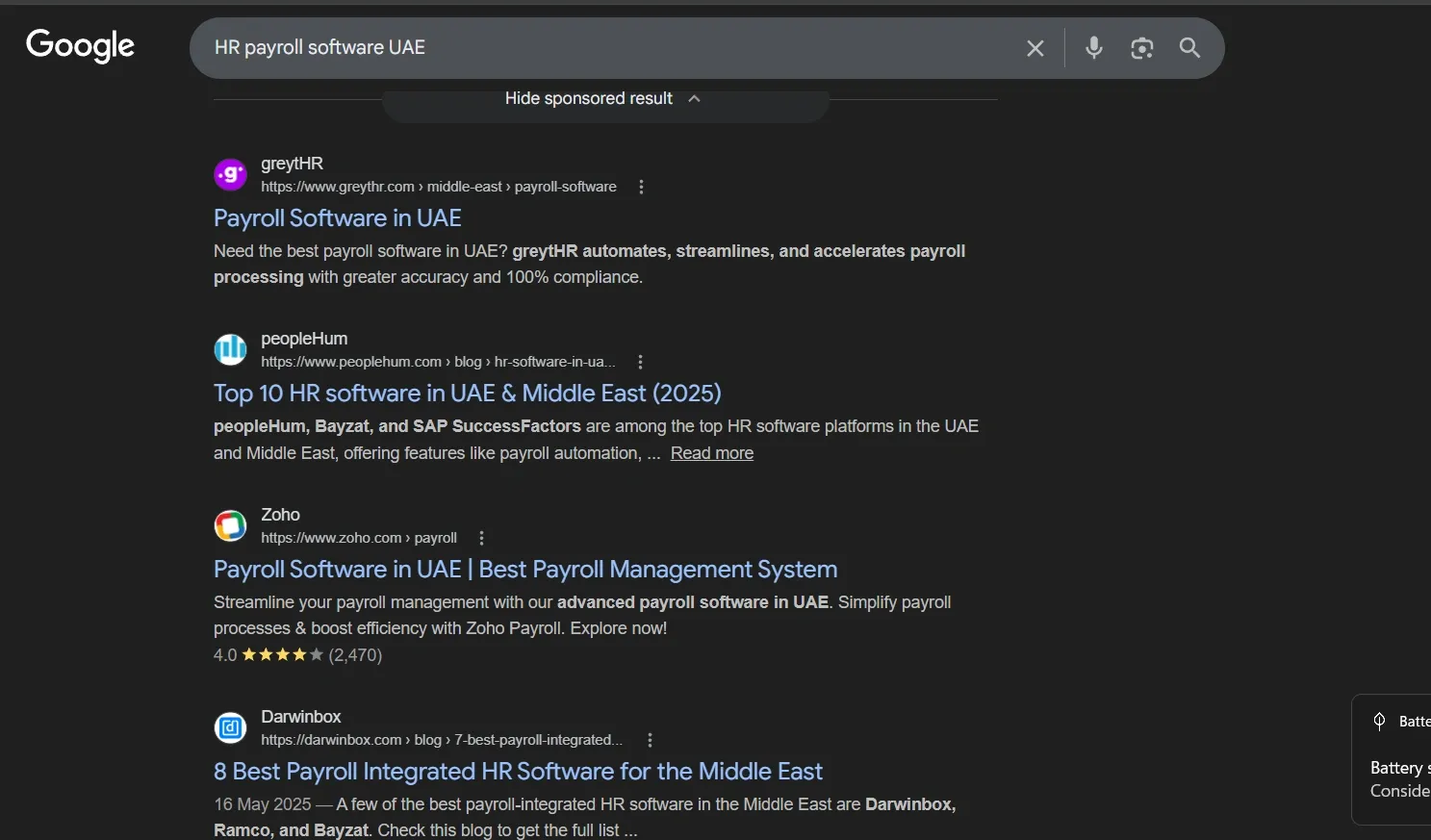
This Google search image is a perfect example of a location-based enterprise search query such as “HR payroll software UAE,” which attracts buyers looking for region-specific solutions.
Each group needs its own page. Do not combine different intents on one page. If someone searches pricing, they want pricing. If they search comparison, they want a clear comparison.
Build pages that answer exactly what the user expects. A comparison page should show side by side differences. A pricing page should explain plans in a simple way. A review page should show proof like testimonials and results. A use case page should explain how your product solves a specific problem. A location page should show how your solution fits that market.
👉 For a deeper look at how Tenet approaches B2B SEO.
What to Measure
Organic sessions from commercial intent keywords, keyword position tracking for target queries, and lead-to-close rate from the organic channel.
2. Comparison Pages That Capture Bottom-of-Funnel Traffic
What It Is
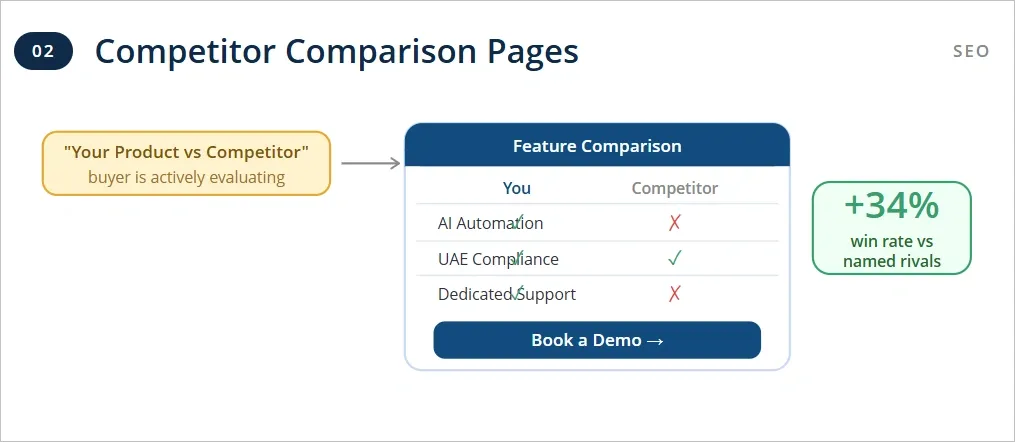
Comparison pages are dedicated landing pages that position your product directly against named competitors. These pages are designed to capture buyers who are already evaluating vendors and actively comparing them.
Why It Works in B2B
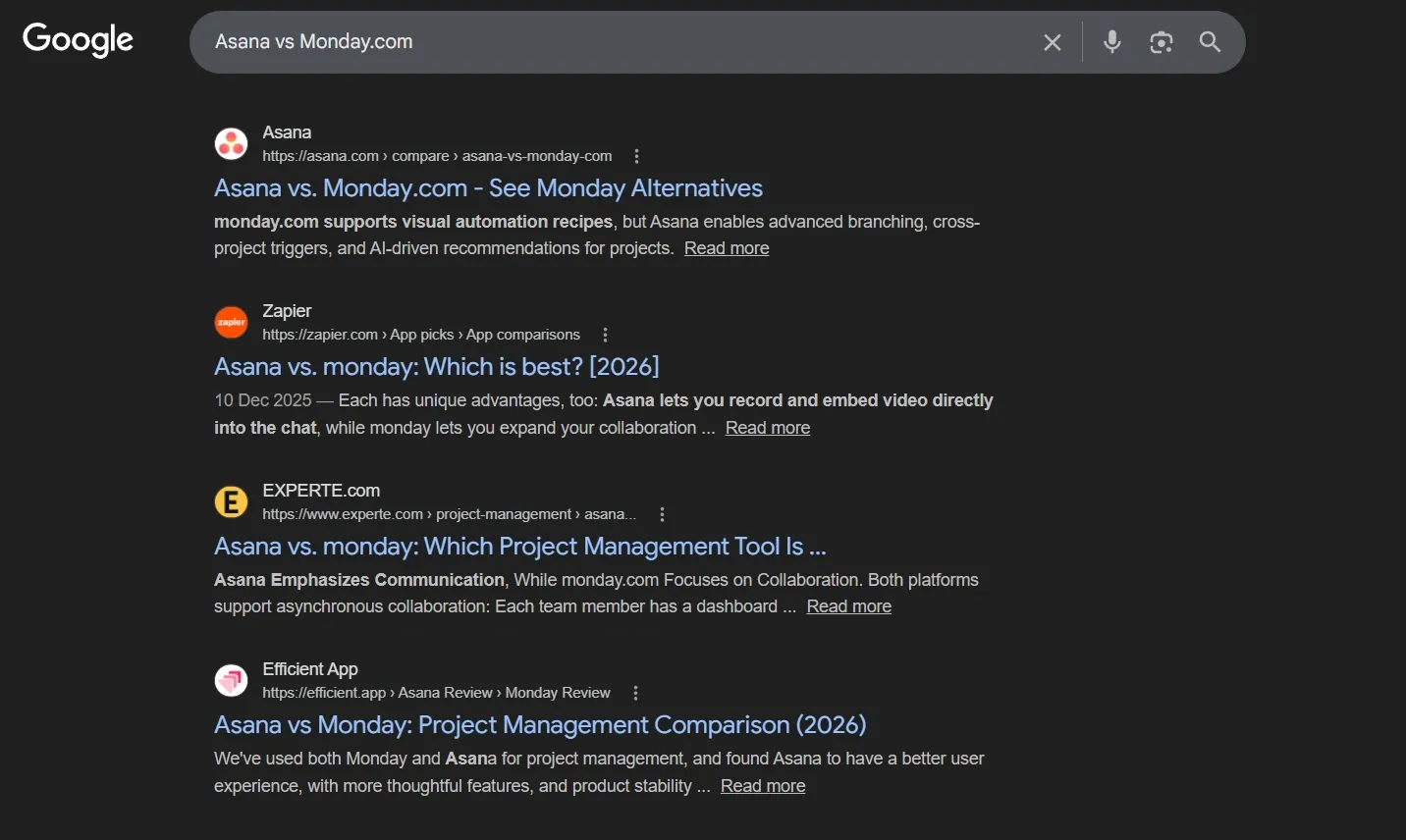
When procurement teams reach the final stages of vendor selection, they often search queries such as “[Your Product] vs [Competitor]” or “[Competitor] alternatives.” If you do not control that narrative, your competitor or a third-party review site will.
The image below shows how B2B companies often publish comparison pages to capture buyers searching for vendor evaluation queries like “Asana vs Monday.com.”
Data from Semrush shows that comparison and alternative keywords typically have lower search volume but significantly higher commercial intent than informational queries. That makes them disproportionately valuable for pipeline generation despite their lower traffic.
How to Execute
- Identify 5–8 key competitors based on their market share and search demand.
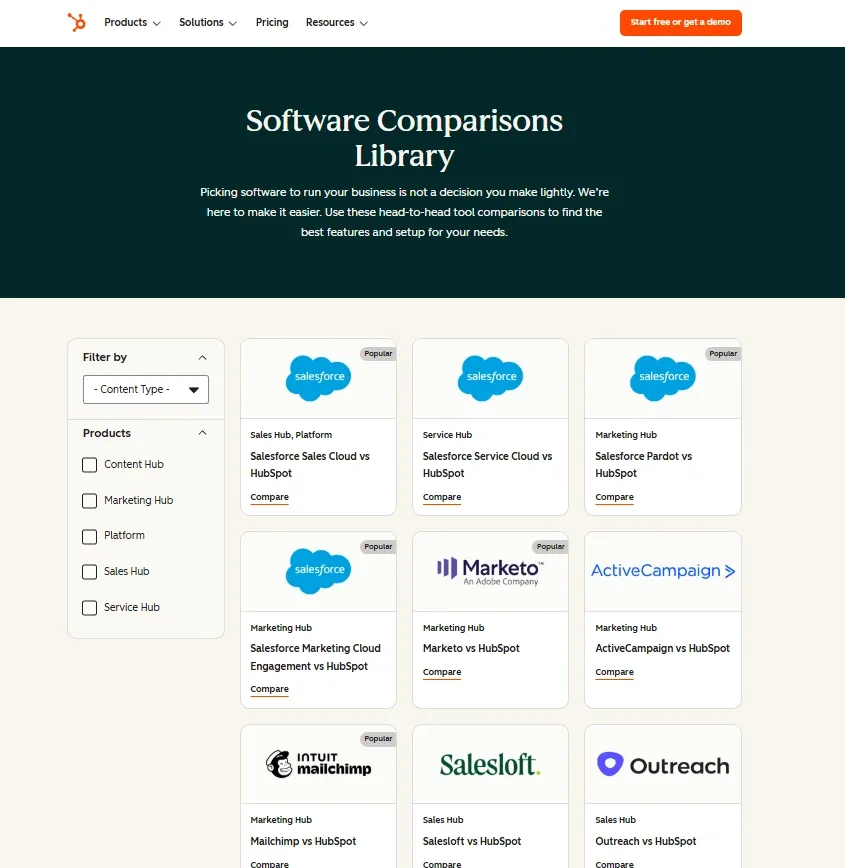
- Build individual comparison pages for each competitor rather than publishing a single generic overview page.
The following picture is of HubSpot’s software comparison library, showing how they publish comparison pages to help buyers evaluate competing tools.
- Include a transparent feature comparison table and support claims with evidence such as documentation, product screenshots, or customer proof points.
- Place a clear demo or free trial call-to-action above the fold so high-intent visitors do not need to scroll to convert.
What to Measure
Track organic traffic to comparison pages, demo requests originating from those pages, and your win rate against each named competitor to understand their direct revenue impact.
3. LinkedIn Authority Building for B2B Founders and Sales Leaders
What It Is
LinkedIn authority building is a structured approach to developing a personal brand on LinkedIn through consistent, high-value content published by founders, C-suite leaders, or senior sales executives. Instead of relying solely on a company page, the strategy focuses on building credibility and visibility through individual profiles that directly engage with the target audience.
Why It Works in B2B
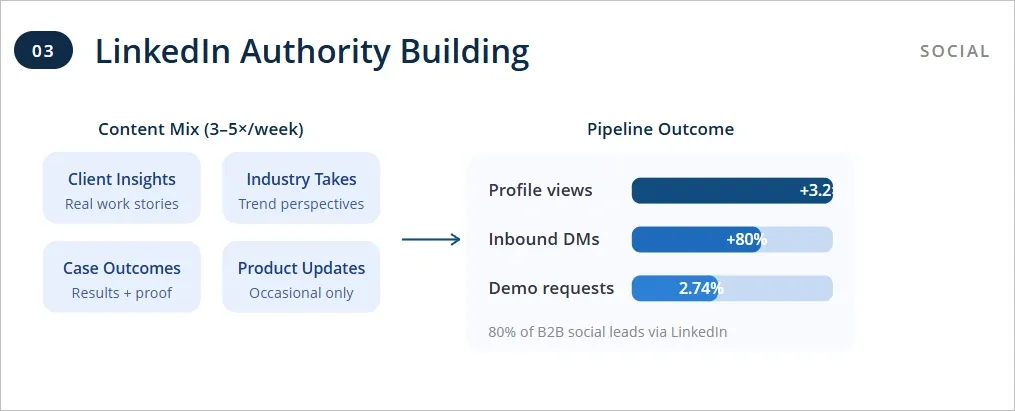
In B2B markets, buyers often trust individuals before they trust corporate messaging. That’s why platforms like LinkedIn play such a powerful role in lead generation. LinkedIn generates around 80% of B2B social media leads, and data from HubSpot shows its visitor-to-lead conversion rate is about 2.74%, higher than most other social platforms.
When founders or sales leaders regularly share insights about real industry challenges, they start building familiarity with potential buyers. Over time, this consistency builds trust, so by the time a sales conversation happens, the audience already sees them as a credible voice rather than just another company trying to sell.
How to Execute
- Publish content 3 to 5 times per week from the founder's or a senior leader’s account rather than relying only on the company page.
- Maintain a structured content mix that includes insights from real client work, thoughtful perspectives on industry trends, case study outcomes, and occasional product updates.
- Engage actively in the comment sections of posts published by your ideal customers before publishing your own content to build visibility within relevant conversations.
- Use tools such as LinkedIn Sales Navigator and PhantomBuster to identify and connect with target accounts once your content has started building credibility. You can also use tools like Apollo.io, Clay, Lemlist, and Expandi to find decision-makers, enrich contact data, and run targeted outreach campaigns.
👉 For a deeper breakdown of this approach, refer to Tenet’s B2B Marketing Strategy guides.
What to Measure
Track profile views, connection requests from your target ICP, inbound direct messages referencing your content, and demo requests that attribute LinkedIn as the initial touchpoint.
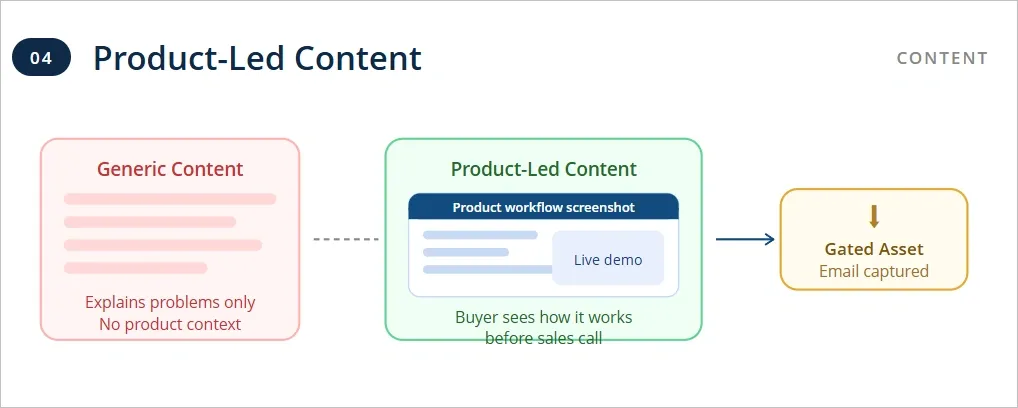
4. Product-Led Content That Converts Decision Makers
What It Is
Product-led content is educational content that addresses a real problem your buyers are trying to solve while naturally demonstrating how your product fits into the solution. Instead of separating education from the product, the product becomes part of the explanation.
Why It Works in B2B
Most B2B content stops at explaining the problem or discussing industry trends. However, decision-makers evaluating solutions want to understand how a problem can actually be solved in practice.
Product-led content bridges that gap by showing the workflow, process, or outcome in context. This allows buyers to see how the product fits into their operations without requiring a direct sales pitch.
How to Execute
- Identify your top 10 pain points your buyers face and build your content around them that explains how those problems are solved in practice.
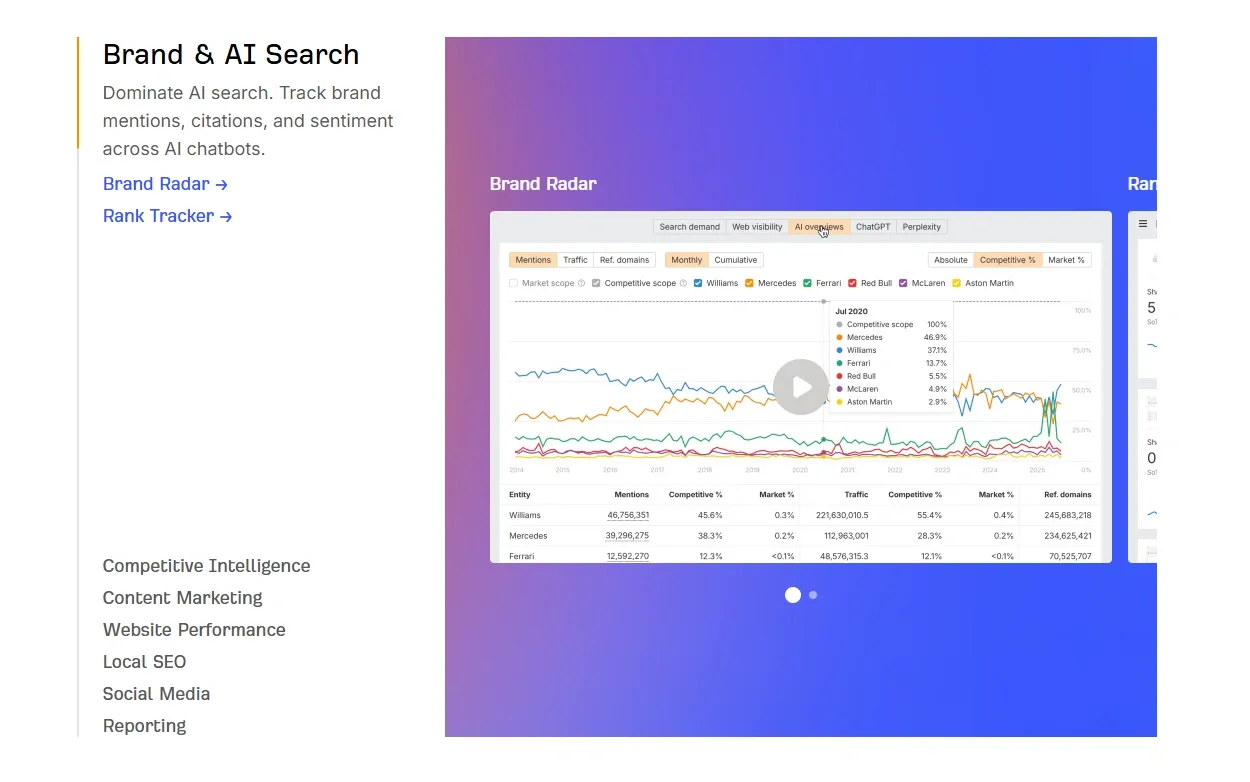
- Demonstrate the solution using real product workflows, screenshots, data outputs, or practical examples rather than abstract explanations.
This example from Ahrefs shows how product feature pages explain key capabilities and workflows to help potential buyers understand how the platform works.
- Gate a downloadable version (detailed template or framework) to capture email in exchange for a higher-value version.
- Distribute the content across SEO, LinkedIn, and your email newsletter so it reaches both new prospects and existing subscribers.
What to Measure
Measure engagement signals such as time on page and scroll depth, track conversion rates for downloadable assets, monitor MQL-to-SQL rate from content-sourced leads and content-attributed pipeline
5. Targeted ABM Outbound Paired With Intent Data
What It Is
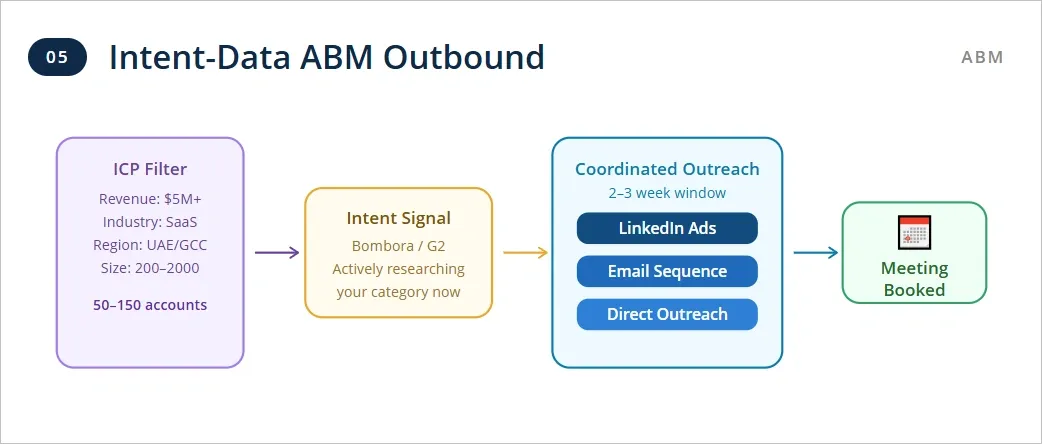
Account-Based Marketing (ABM) is a strategy in which marketing and sales teams align around a clearly defined list of high-value target accounts and coordinate personalized outreach to those companies. Instead of generating large volumes of leads, the focus is on engaging the specific organizations that closely match your ideal customer profile.
Why It Works in B2B
Most B2B purchases involve multiple stakeholders, including decision-makers, influencers, and procurement teams. ABM addresses this reality by focusing on entire accounts rather than individual leads.
By identifying companies that are a strong fit and engaging several stakeholders within those organizations, businesses can concentrate their efforts on opportunities with the highest revenue potential.
How to Execute
- Define your ideal customer profile (ICP) based on factors such as revenue range, industry, technology stack, geography, and company size.
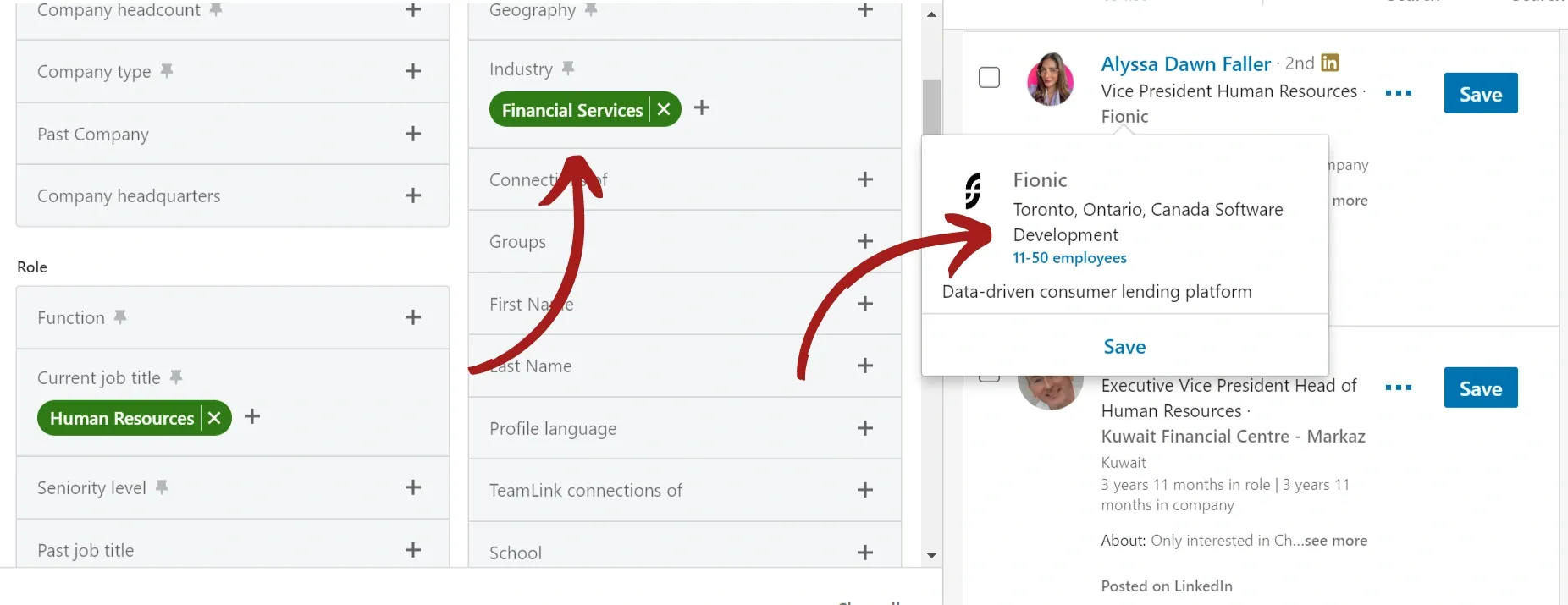
- Build a focused target account list of approximately 50 to 150 companies using platforms such as LinkedIn Sales Navigator or Apollo.io.
Here is the LinkedIn Sales Nav view showing how one can create a target account list using the filters:
- Use intent data platforms like Bombora and G2 to identify accounts actively researching relevant solutions.
- Coordinate multiple touchpoints across channels, including LinkedIn ads, direct outreach, and personalized email sequences, to the same accounts within the same 2 to 3 week window.
What to Measure
Track engagement levels across target accounts, measure how many meetings are booked within those companies, monitor the amount of pipeline generated from the account list, and compare the average deal size from ABM opportunities against other acquisition channels.
6. Strategic Retargeting Designed for Long B2B Sales Cycles
What It Is
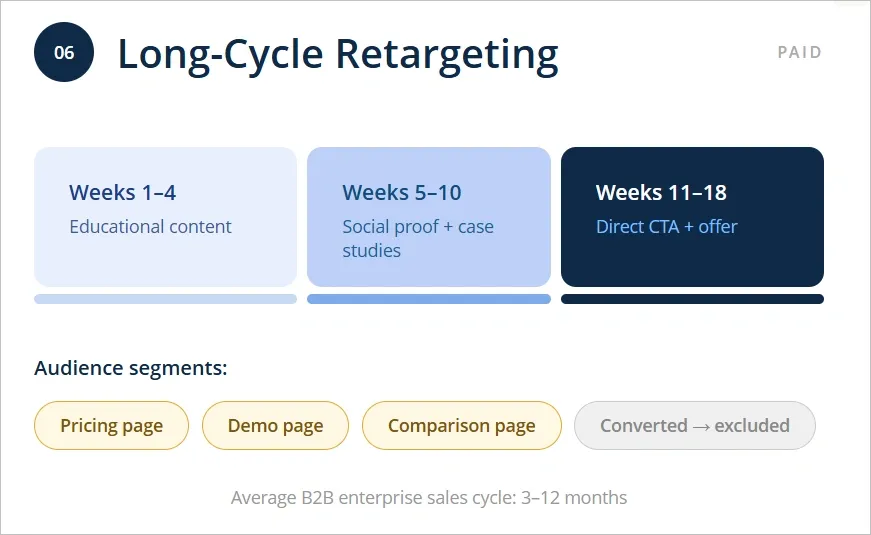
Strategic retargeting focuses on re-engaging website visitors and content consumers over an extended period (over a 90 to 180 day window) that reflects the typical length of a B2B buying cycle. Instead of running short campaigns that last only a few weeks, this approach keeps your brand visible to potential buyers for several months while they evaluate different solutions.
Why It Works in B2B
The average B2B sales cycle for enterprise software ranges from 3 to 12 months. Most retargeting campaigns run for 7 to 30 days, which is completely misaligned with the actual decision timeline.
A visitor who viewed your pricing page in month one may be ready to buy in month four. Staying visible during that entire evaluation window requires a structured long-cycle retargeting approach.
How to Execute
- Segment retargeting audiences based on the pages they visited, such as pricing pages, demo pages, comparison pages, or specific product pages.
- Structure campaigns as a sequence rather than a single ad set, beginning with educational content first (weeks 1 to 4), social proof and case studies in the middle (weeks 5 to 10), and direct CTA and offers in the final stage (weeks 11 to 18).
- Apply frequency caps to prevent overexposure and ad fatigue so that users continue to see the brand without being overwhelmed by repeated ads.
- Remove already converted leads from retargeting pools to avoid unnecessary ad spend.
💡 Retargeting campaigns are commonly executed through platforms such as LinkedIn Ads and Google Ads, which allow marketers to reach visitors across professional and search environments.
What to Measure
Measure cost per lead from retargeting campaigns, compare lift in demo request rate from retargeted vs. non-retargeted visitors, and track time-to-conversion for retargeting-influenced leads.
7. Build Resource Pages and Tools That Attract Qualified Traffic
What It Is
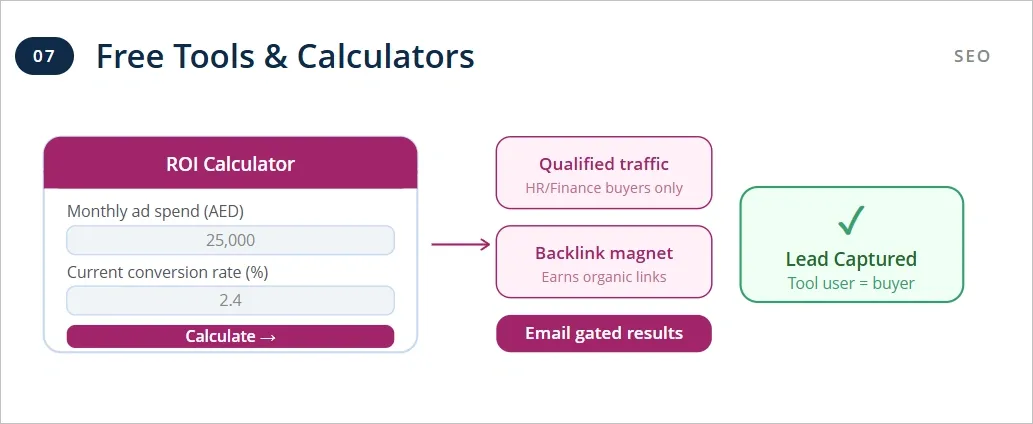
SEO-driven resource pages and tools are free utilities such as calculators, benchmark reports, or template libraries that attract highly targeted search traffic. These resources are designed to solve a specific operational problem while converting visitors into leads through optional or gated access to deeper insights.
Why It Works in B2B
Practical tools naturally attract a more qualified audience because they are used by professionals trying to solve a real business problem. For example, a payroll cost calculator on an HR software website will primarily attract HR leaders or finance managers who are evaluating workforce costs.
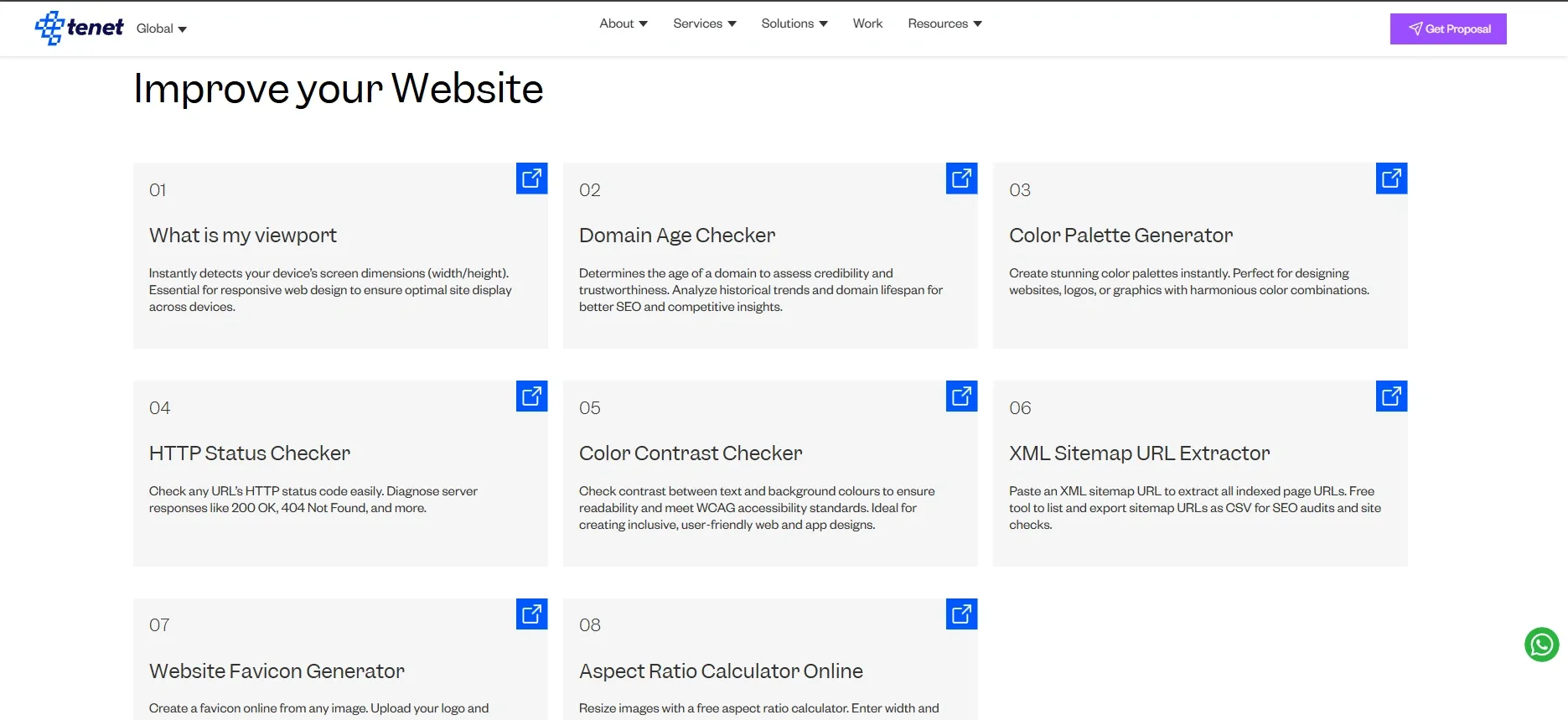
This example from Tenet shows how offering free tools such as domain checkers and generators can attract professionals actively looking to solve specific website or marketing problems.
In addition to generating leads, useful tools often attract backlinks and repeat visits, which strengthen long-term organic search visibility.
How to Execute
- Identify a calculation, assessment, or framework that your buyers currently perform manually, such as an ROI calculator, cost estimator, compliance checklist, or vendor comparison scorecard.
- Build the resource with a simple interface and provide deeper results through an optional email submission or downloadable report.
- Optimize the page around a clear search query, so it captures relevant organic traffic, such as “employee cost calculator” or “marketing ROI calculator.”
- Promote the resource through organic and paid distribution on platforms such as LinkedIn to generate initial traction and engagement.
What to Measure
Track organic traffic to the resource page, measure the conversion rate from tool usage to lead capture, and evaluate the quality of leads generated through the resource compared with other acquisition channels.
8. Email Nurture Sequences Aligned to Buying Committee Roles
What It Is
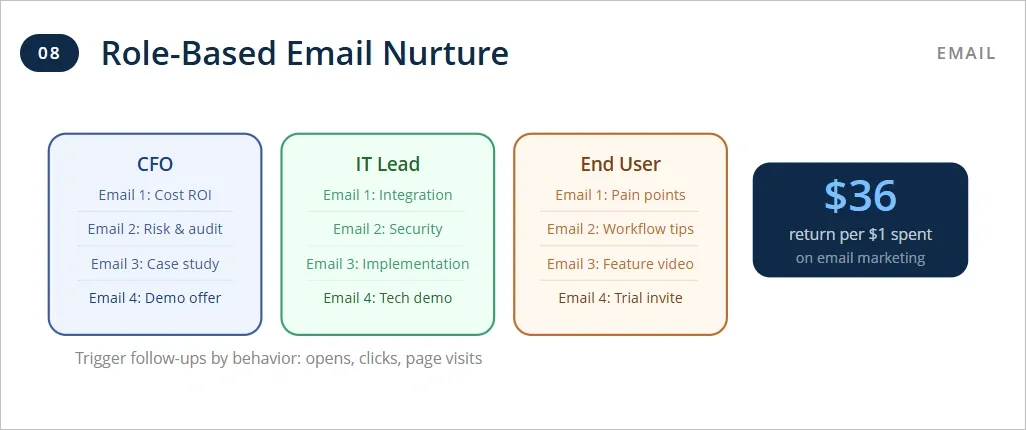
Email nurture sequences aligned to buying committee roles are structured email programs designed to deliver different messages to different stakeholders within the same account. Instead of sending a single generic sequence to every lead, the content is customized to the priorities of each role involved in the purchasing decision.
Why It Works in B2B
Most B2B purchases involve multiple stakeholders with different concerns. A CFO evaluating a solution is typically focused on cost structure, ROI, and risk, while an IT leader may prioritize integration, security, and implementation complexity. Sending identical messaging to all of them reduces relevance and engagement.
Email remains one of the most efficient channels for lead nurturing. Even research shows that email marketing generates an average return of $36 for every $1 spent.
When nurture sequences are personalized by role and stage of the buying journey, engagement and conversion rates tend to increase significantly.
How to Execute
- Segment your lead database by role categories such as C-suite, director-level leaders, managers, and end users.
- Build a 3 to 4 email sequence for each persona that starts with problem awareness, moves into solution framing, and later introduces case studies or implementation examples before presenting a direct yet soft call to action.
💡Instead of relying only on email, try a multi-channel outreach approach.
Example:
You might start with an email introducing the problem, follow it up with a LinkedIn connection request, and later send a short message referencing your earlier email or sharing a relevant insight.
This approach increases the chances of getting noticed, since buyers often engage with different platforms at different times. It also helps reinforce your message through multiple touchpoints, making your outreach feel more familiar rather than intrusive.
- Trigger follow-up emails based on behavior signals such as email opens, link clicks, page visits, or periods of inactivity.
- Remove or suppress leads who have already booked a demo or entered the sales process to avoid unnecessary communication.
👉 For detailed information, feel free to check out our B2B Email Marketing services.
What to Measure
Track open rates and click-to-open rates across different persona segments, measure how many demo requests originate from nurture sequences, and monitor the total pipeline value influenced by email engagement across buying committee roles.
9. Partner and Integration Co-Marketing for Warm Lead Access
What It Is
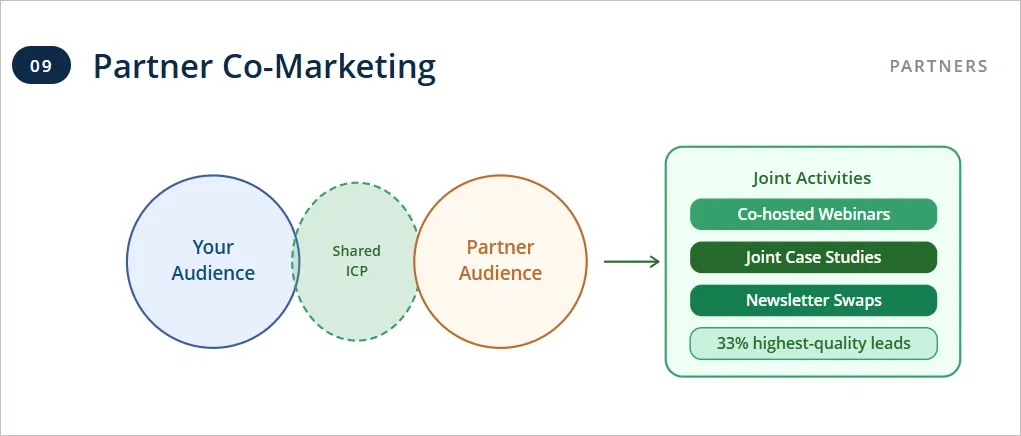
Partner and integration co-marketing involves forming structured collaborations with complementary software vendors, consultancies, or implementation partners. These partnerships allow both companies to introduce their solutions to each other’s audiences through joint initiatives such as webinars, case studies, and shared content distribution.
Why It Works in B2B
Leads generated through referrals or trusted ecosystems tend to convert at much higher rates than cold outreach because credibility already exists. According to industry reports, 33% of their highest-quality leads come from existing customer referrals.
Partner co-marketing expands that concept by placing your brand within ecosystems your buyers already trust, such as technology integrations or advisory partners they already work with.
How to Execute
- Identify 5 to 10 vendors, consultants, or service providers whose customer base overlaps with your ICP but who do not compete directly with your offering.
- Propose joint initiatives such as co-hosted webinars, collaborative case studies, integration guides, or newsletter swaps where both partners promote the content.
- Create dedicated landing pages for each partner collaboration so the messaging reflects the specific partnership and value proposition.
- Track partner-sourced opportunities inside your CRM using a clear attribution field to measure the impact of each relationship.
What to Measure
Monitor the number of leads generated through partner initiatives each month, track the close rate of partner-referred opportunities, compare their average deal size against other acquisition channels, and evaluate the overall cost per lead generated through partnerships.
10. Demand-Generation Webinars Structured Around Buyer Pain Points
What It Is
Demand-generation webinars are live or on-demand sessions built around a specific operational or strategic challenge your target buyers are trying to solve. Instead of presenting a generic product demonstration, these webinars focus on a real problem and guide the audience through practical ways to approach it, with the product positioned naturally within the discussion.
Why It Works in B2B
Webinars tend to attract highly engaged prospects because attending a session requires a meaningful time commitment. When professionals register for a webinar on a specific work-related problem, they are often already researching solutions or exploring ways to improve an existing process.
This level of engagement makes webinars an effective channel for starting deeper conversations with potential buyers.
How to Execute
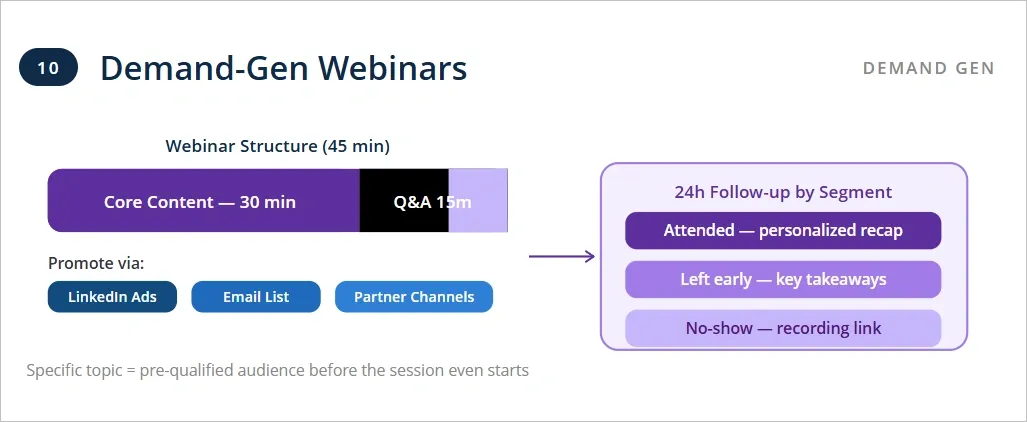
- Choose a topic that is specific enough to pre-qualify your audience (not "How to improve sales" but "How enterprise HR teams reduce payroll processing time by 60%")
- Promote the webinar through targeted distribution channels such as LinkedIn ads, outreach to your existing email database, and promotion through partners or industry communities.
- Structure the session to deliver meaningful insights, typically keeping the webinar around 45 minutes, with 30 minutes of core content and 15 minutes for Q&A.
- Follow up within 24 hours with a personalized email based on whether they attended, left early, or registered but did not attend.
What to Measure
Track the number of registrations compared with actual attendance, attendee to MQL conversion rate, pipeline generated per webinar and the cost per MQL from the webinar channel.
How Tenet Helped a B2B HR Platform Generate 100+ High-Ticket Leads in 6 Months
Yomly, an enterprise HR and payroll SaaS platform for mid‑to‑large organisations in the UAE and GCC, was getting only 2–3 SEO leads per month and relying on paid ads for 90% of its traffic. The platform was strong, but invisible in organic search and too expensive to scale.
Tenet rebuilt Yomly’s organic acquisition engine in three key areas:
- Technical SEO: fixed crawl issues, restructured site architecture, and improved Core Web Vitals.
- Commercial keyword targeting: created dedicated landing pages for enterprise‑focused terms like “payroll software UAE” and “HR software GCC.”
- Content and authority: produced decision‑maker‑focused content that earned backlinks from regional business outlets and strengthened internal linking.
Alongside, paid search was re‑planned around decision‑maker intent, with tightly themed ad groups, intent‑matched landing pages, and long‑cycle retargeting for high‑value visitors.
Results after six months:
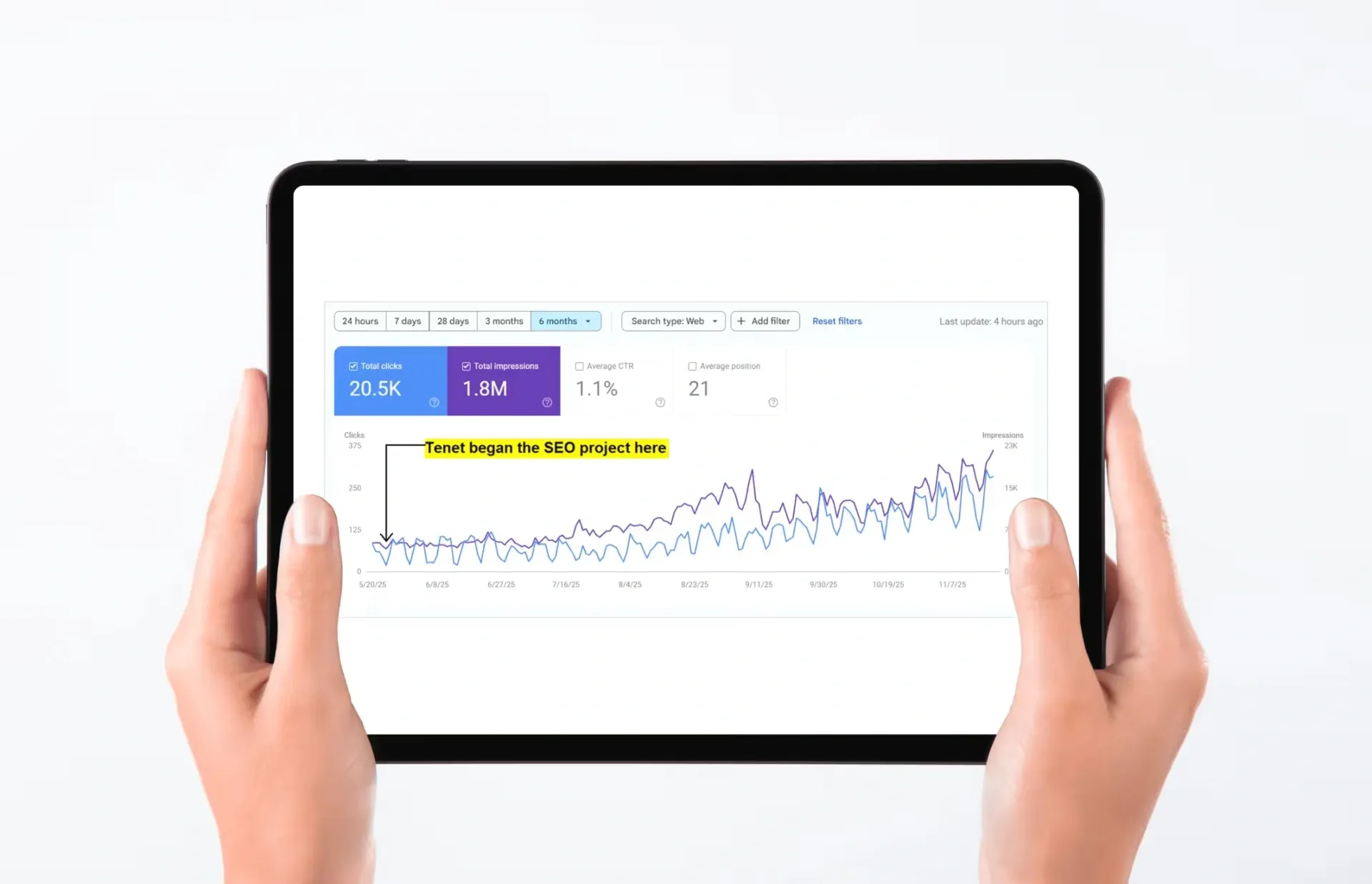
- SEO leads grew from 2–3 per month to 40+.
- Total high‑ticket leads: 100+.
- SEO became the primary acquisition channel, materially reducing dependency on paid ads.
This graph illustrates how Tenet’s SEO strategy helped Yomly scale organic visibility and inbound leads over time.
👉 The full case study with detailed metrics is available here: Yomly SEO case study by Tenet.
If your B2B lead generation delivers volume but not a qualified pipeline, the strategies in this article offer a starting point. Tenet works with B2B founders, CMOs, and growth teams to build organic and paid engines that produce a measurable, enterprise‑grade pipeline.
Explore Tenet’s B2B Marketing Services or request a growth proposal to align with your pipeline targets.
Generate high-quality B2B leads with organic and paid channels. Ask for a proposal.
Generate high-quality B2B leads with organic and paid channels. Ask for a proposal.










Got an idea on your mind?
We’d love to hear about your brand, your visions, current challenges, even if you’re not sure what your next step is.
Let’s talk


