
Website Migration Cost in 2026 (+ 📋 Downloadable Checklist)
 By
By Share

Share
Get a quick blog summary with



Key Highlights
- Website migration moves a site to a new platform, domain, structure, design, or hosting setup.
- Costs range from $300 for basic transfers to $250,000+ for complex enterprise migrations.
- Pricing depends on site size, platform complexity, integrations, SEO work, and redesign scope.
- CMS, domain, hosting, e-commerce, and international migrations each carry different costs and risks.
Most people think website migration is simple: pay a developer a few thousand dollars, switch hosts or platforms, and it’s done.
Then the nightmare begins when traffic disappears overnight, Google rankings vanish, and sales can drop by $50k or more in just a few months.
Because of this, a “simple” $2,000 to $6,000 quote can quickly grow to $15,000 to $80,000 when you include emergency fixes, lost revenue, and rushed recovery work.
We see this constantly happen to so many companies.
At Tenet, we’ve managed 100+ website migrations across multiple industries, helping clients maintain traffic, protect search rankings, and avoid unexpected costs. Our projects have collectively safeguarded millions in revenue while keeping migrations on time and on budget.
Based on our expertise, this guide reveals what you will realistically pay for website migrations in 2026, with costs detailed by migration type and platform.
What is a website migration?
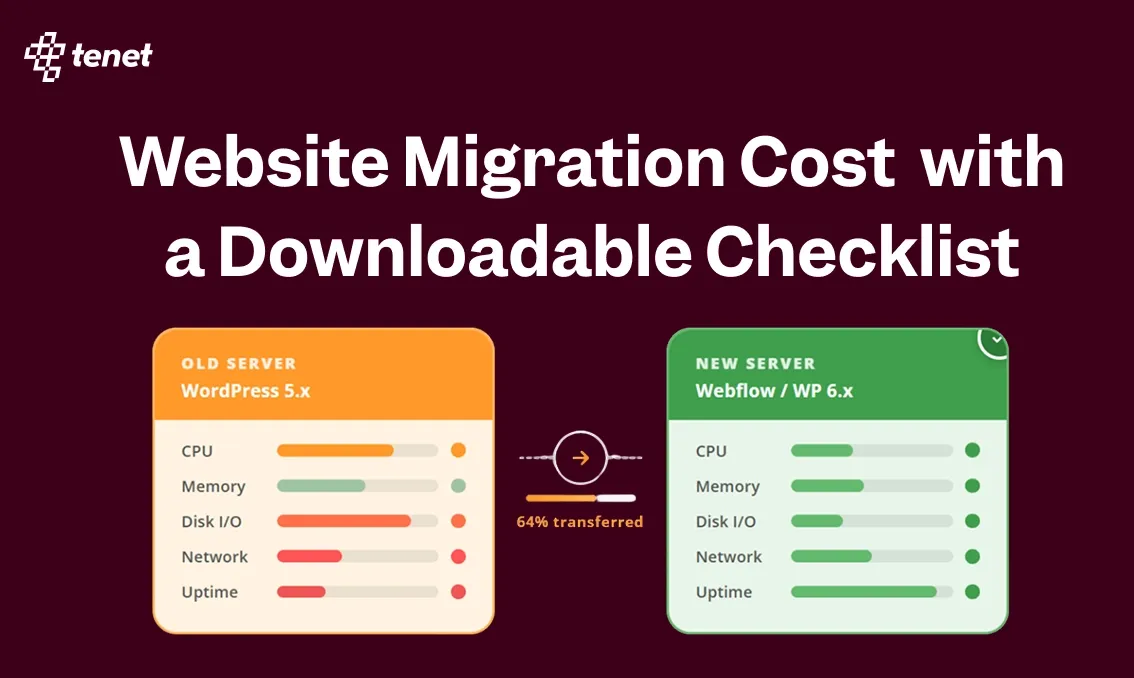
A website migration happens when a website moves to a new platform, domain, structure, design, or hosting setup. These changes shift the site from its current system to a new one.
Common migration examples include changing CMS platforms, moving to a new domain, updating URLs, switching hosting providers, or launching a redesigned site. Because search engines rely on site structure and URLs, migrations must be carefully planned with redirects and SEO checks to prevent traffic and ranking loss.
👉 Here’s the true website redesign cost in 2026 (pricing breakdown)

How Much Does Website Migration Cost?

Website migration costs range from $300 for a basic host transfer to over $100,000 for a full enterprise replatform.
For most small to mid-sized businesses, migrations typically fall between $1,000 and $25,000. Moving an enterprise platform with extensive custom development, integrations, and additional SEO work can easily push costs beyond $50,000
The main factors that drive pricing include the migration type, the number of pages or products being moved, the complexity of your current platform, and any additional services like redesigns or SEO preservation.
The table below gives an overview of common migration types, their typical cost ranges, and timelines based on industry data:
What Are the Types of Website Migration?1. Platform or CMS Migration
Average cost: $5,000 to $75,000
Platform or CMS migrations involve moving your website from one content management system to another. The complexity depends on content volume, custom functionality, and third-party integrations, as well as any SEO work needed after launch.
For example, moving a 100-page WordPress site to Webflow typically ranges from $8,000 to $20,000, while a complex Drupal multi-site migrating to a headless CMS can exceed $150,000.
Usually, Small and medium sites often spend $1,000 to $5,000, whereas large, custom-built sites with integrations easily surpass $10,000.
⭐ A poorly planned CMS migration often introduces technical debt that drains your SEO performance for months.
So, if you want to avoid those hidden traps, our breakdown of SEO mistakes is a smart read before you start.
2. Domain or URL Structure Migration
Average cost: $3,000 to $20,000
Changing a root domain, subdomain structure, or URL taxonomy carries high SEO risk. Each URL requires a 301 redirect, and missing redirects can result in 404 errors, harming domain authority and search rankings.
Costs are driven by redirect mapping, full-site crawl audits, and 90-day post-launch monitoring. Sites with over 10,000 URLs typically need $12,000 to $20,000 for SEO and development support.
⭐ URL structure changes and redirect mapping are two areas where getting the SEO fundamentals right from the start saves tens of thousands in the long run. Tenet's SEO services cover end-to-end technical SEO support, including full redirect audits for migrating sites.
3. Server or Hosting Migration
Average cost: $500 to $25,000
Moving from shared hosting to VPS, cloud (AWS, GCP, Azure), or managed hosting is often underestimated. Many hosting providers offer free migration for new customers.
For simple sites, it is a $500 to $2,000 operation. Applications with custom server configurations, containerized environments, or compliance requirements such as PCI-DSS or HIPAA push costs higher.
Tasks like database migration, SSL setup, CDN configuration, and load testing all contribute to the total.
4. Redesign and Platform Migration Combined
Average cost: $20,000 to $250,000+
The most expensive migration type combines a platform change with a full UX overhaul. New design system, new CMS, new page templates, new content architecture, all of which must launch without SEO disruption.
Projects at this scale require dedicated project management, multiple QA cycles, and post-launch monitoring for 90 to 180 days. A full content overhaul on top adds $1,000 to $10,000 depending on page count and optimization requirements.
👉 Understanding what your product pages must include to convert before launching your new platform can make the difference between a post-migration traffic bump and a revenue dip.
5. HTTPS or Security Migration
Average cost: $500 to $5,000
An HTTPS migration upgrades a website from an unsecured HTTP protocol to a secure HTTPS. Although this is now a standard requirement for trust and search visibility, the scope can vary depending on site size and technical configuration.
For most websites, the process involves SSL certificate installation, server-side redirect implementation, and a mixed-content audit to ensure all assets load securely. However, enterprise sites with thousands of pages, hardcoded HTTP resources, third-party embeds, and complex CDN environments require additional development time to prevent security warnings and ranking issues.
6. International or Multilingual Migration
Average cost: $15,000 to $150,000+
International or multilingual migrations introduce additional structural and SEO considerations. This type of migration may involve implementing hreflang tags, restructuring regional subdomains, consolidating properties into country-specific subdirectories, or launching localized content across multiple markets.
Each of these changes affects search visibility at a regional level. Geo-targeting configuration, content localization, and regional hosting decisions all add cost layers.
Because implementation errors can remove rankings across entire countries, enterprises typically require specialist international SEO expertise and a structured recovery plan to safeguard performance.
Here are some real risks of website migration when it is done without proper planning and SEO involvement:

Website Migration Cost by Platform
1. WordPress Migration Cost
WordPress migration involves transferring the database, files, themes, plugins and content from one host or platform to another. It includes setting up the new environment, configuring permalinks, handling media files, and implementing 301 redirects for SEO preservation.
Cost typically depends on the size of the site (number of pages or posts), whether WooCommerce or other e-commerce features are present, the extent of custom themes or plugins that require updates, and whether the migration is completed manually or through tools like Duplicator.
Average pricing ranges from $100 for basic plugin-based moves to $2,500 for professional handling of mid-sized sites, with complex migrations reaching $5,000. Tools like WP Migrate add $125-$249 for advanced features.
2. Shopify Migration Cost
Shopify migration covers exporting products, customers, orders, and content from platforms like WooCommerce or BigCommerce, then importing to Shopify. It includes theme recreation or adaptation, app integrations for payments/shipping, custom code porting, and URL redirects to maintain search rankings.
The overall budget is shaped by catalog size (SKUs and variations), the number of third-party integrations such as ERP or CRM systems, the level of data cleanup required, and store features like multi-language or multi-currency support.
Average pricing starts at $300-$1,000 for DIY with native tools, $2,000-$7,500 for freelancer-managed mid-range stores, and $10,000-$50,000 for agency-handled enterprise migrations. Shopify Plus adds $10,000-$50,000 for larger setups.
⭐ Check out eCommerce solutions that are built to handle this exact intersection, combining UX continuity with SEO-safe migration support.
3. Magento Migration Cost
Magento migration, often from version 1 to 2 or other platforms, entails data transfer of products/customers/orders, theme redevelopment, extension replacements or custom builds, and database optimization. It includes testing for compatibility, security patches, and SEO redirects.
Pricing is largely determined by the depth of customization, total data volume (such as large product catalogs), the number of integrations including ERP or PIM systems, and whether the store runs on Open Source or Enterprise editions.
Pricing averages $10,000-$50,000 for standard migrations, with Open Source at $15,000-$40,000 and Enterprise/Cloud at $75,000-$250,000 for high-complexity cases. Upgrades from older versions add 10-20% for unforeseen issues.
4. Wix to WordPress Migration Cost
Migrating from Wix to WordPress requires manual content export (via RSS/XML), design recreation using themes/plugins, media file transfers, and custom code for features like forms or galleries. It includes URL mapping for redirects, SEO metadata preservation, and e-commerce setup if using WooCommerce.
The final cost reflects the total number of pages, whether e-commerce functionality is involved, the complexity of the existing design, and whether a full rebuild is necessary due to Wix’s limited export capabilities.
Costs range from $700-$1,500 for small sites (5-10 pages) to $2,500-$6,000 for e-commerce or medium sites (10-30 pages). Professional services handle the closed-system constraints of Wix.
5. Custom Website Migration Cost
Custom website migration involves moving bespoke code, databases, and assets from one server/environment to another, often requiring full rebuilds or re-platforming. It includes code auditing, dependency updates, integration porting (e.g., APIs), performance testing, and security hardening.
Budget requirements vary based on the underlying tech stack (such as PHP or Node.js), overall site scale, the presence of custom features like user portals, and the volume of data being transferred.
Pricing varies from $5,000-$20,000 for simple custom sites to $50,000-$150,000+ for complex enterprise setups with heavy integrations. Re-platforming adds costs for adaptation.
Download website migration checklist
Planning a website migration? This checklist walks your team through every step, from the initial audit to 90 days post-launch. Six phases. 60+ tasks.
Each one is tagged by priority, assigned to the right person, and explained so nothing gets misunderstood. This is built from 100+ real migrations, so the tasks that actually cause traffic loss are the ones that get flagged first.

How Tenet Helps You Mitigate Website Migration Risks
Website migrations are among the highest-risk digital operations a business can undertake. The SEO and technical consequences of a poorly executed migration are measurable, severe, and often long-lasting.
In fact, a 10% to 30% traffic dip in the first month is common even in well-managed migrations, as search engines process changes. Poorly executed migrations can result in 40% to 60% traffic loss within weeks, with some sites never fully recovering.
How Tenet Mitigates Website Migration Risks
Migrations go over budget for three predictable reasons: undiscovered technical debt found mid-project, SEO remediation after a poor launch, and extended timelines due to inadequate planning. Tenet's Discovery and Audit phase surfaces every one of these risks before development begins.
Here is our 5-Phase Migration Framework:
Specific steps that reduce cost and risk on every Tenet migration:
- Pre-migration audits reduce mid-project surprises. Full crawl-based audits before any development begins catch database issues, broken internal links, and missing metadata that would otherwise surface post-launch at a higher cost.
- Automated redirect testing across 100% of mapped URLs. Missing redirects are the most common cause of post-migration traffic loss. Every redirect is verified before launch.
- Staging environment validation catches integration failures before they affect live revenue.
- 90-day post-launch monitoring protocol ensures ranking recovery is tracked and addressed immediately when issues arise.
- Fixed-scope migration proposals for qualifying projects, removing cost uncertainty before sign-off.
If you're thinking about migrating or running into migration issues, feel free to contact Tenet’s team.
Plan Your Website Migration Cost for 2026
Plan Your Website Migration Cost for 2026
























Got an idea on your mind?
We’d love to hear about your brand, your visions, current challenges, even if you’re not sure what your next step is.
Let’s talk


