
OpenAI Quietly Pulls Back Sora, Here’s What That Really Means
 By
By Share

Share
Get a quick blog summary with



When OpenAI introduced Sora, it marked a significant step in the evolution of generative AI. The model demonstrated the ability to convert simple text prompts into high-quality, realistic video outputs, expanding the scope of AI beyond text and images into more complex visual formats.
This capability immediately attracted attention across industries. Content creators, marketers, and enterprises began exploring how such technology could reduce production timelines, lower costs, and enable new forms of storytelling. Sora was not just positioned as an experimental tool, but as a potential shift in how video content could be created at scale.
However, recent developments indicate a clear change in direction.
OpenAI Confirms Sora App Shutdown
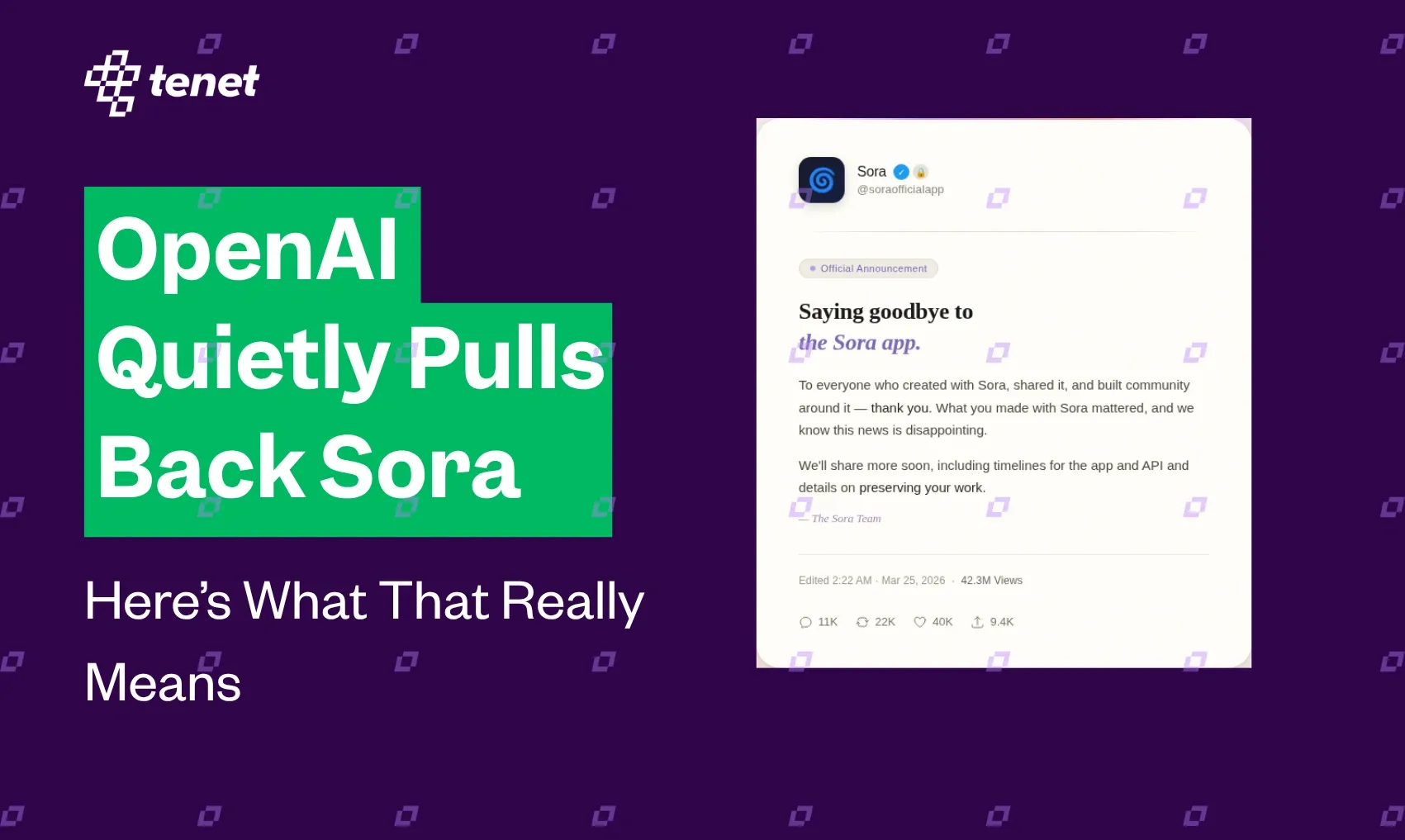
OpenAI has officially confirmed that it is discontinuing the Sora app. In an update shared via its official Sora channel, the company stated that it is “saying goodbye to the Sora app,” with further details on timelines, API changes, and user data expected to follow.
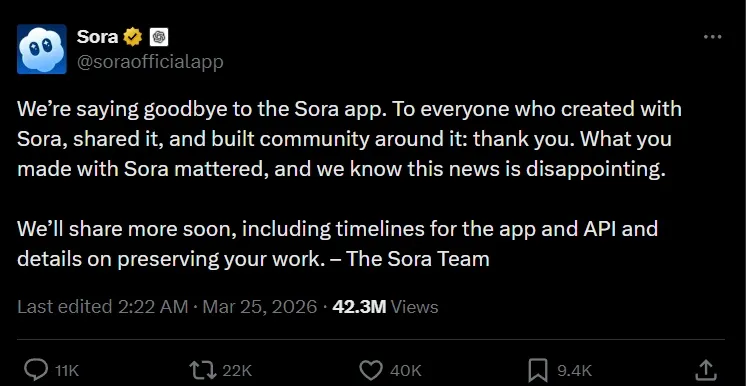
This announcement establishes that the shift is not a gradual decline in visibility or access. It is a defined step to wind down the current product.
Scope of the Shutdown
While the announcement focuses on the app itself, early signals suggest that the impact may extend further. Reports indicate that associated APIs and integrations could also be affected, pointing to a broader restructuring of how Sora-related capabilities are being managed.
At this stage, OpenAI has not released detailed documentation outlining the full scope of the transition. However, the available information suggests that this is not a temporary pause, but a product-level decision that may influence how similar capabilities are developed and deployed in the future.
For businesses and developers who were closely following Sora, this creates a need to reassess expectations around timelines and accessibility.
Why Sora Was Different from Other AI Tools
Sora’s differentiation came from the quality and coherence of its outputs. Unlike earlier video generation tools, it demonstrated an ability to create scenes that were visually consistent, detailed, and closely aligned with real-world physics and motion.
This level of realism introduced new possibilities across multiple use cases. Brands could explore faster content production cycles. Creative teams could test ideas without traditional production constraints. Enterprises could evaluate new formats for communication and engagement.
At the same time, the realism of AI-generated video also introduced new risks. Video content carries a stronger sense of authenticity compared to text or images. This increases the importance of safeguards related to misinformation, identity misuse, and synthetic media regulation.
This is where innovation starts colliding with responsibility.
The Hidden Challenge: Scaling Video AI
Beyond content-related concerns, video generation introduces significant technical complexity. Producing high-quality video requires substantially more computational power than generating text or images. It also involves longer processing times and more advanced infrastructure.
Scaling such systems for wider access involves multiple considerations:
- Infrastructure and compute costs
- Output consistency across different prompts
- Latency and user experience
- Moderation and governance frameworks
Each of these factors plays a role in determining whether a technology can move from controlled demonstrations to reliable, large-scale deployment.
In the case of Sora, these challenges are particularly relevant given the quality benchmark it set during its initial demonstrations.
A Strategic Shift in Focus
The discontinuation of the Sora app also reflects a broader shift in how AI companies are prioritizing product development. Tools that integrate directly into existing workflows, such as conversational AI and enterprise-focused solutions, are currently seeing faster adoption and clearer monetization pathways.
In comparison, video generation remains a more complex category. It requires higher investment, more extensive safeguards, and more defined use cases before it can achieve widespread adoption.
This suggests that companies may be allocating resources toward areas where immediate impact and scalability are more achievable, while continuing to develop more complex technologies in parallel.
How the Industry Is Reacting
The response from the AI ecosystem has been measured. Similar patterns have been observed across other emerging technologies, where early breakthroughs are followed by a phase of refinement and controlled deployment.
In many cases, initial demonstrations highlight what is technically possible. The next phase focuses on building systems that are stable, compliant, and usable in real-world environments.
Sora’s trajectory fits within this broader pattern. Its early capabilities demonstrated clear potential, while its current discontinuation reflects the operational considerations required to bring such technology to scale.
What This Means for the Future of AI Video
Sora’s pullback doesn’t signal the end of AI-generated video. If anything, it highlights how important and complex the space has become.
The technology itself is clearly viable. What’s still evolving is how to deploy it in a way that balances creativity, accessibility, cost, and safety.
Future iterations of tools like Sora will likely come with:
- Stronger safeguards
- More controlled access
- Clearer use cases tied to real-world needs
Rather than disappearing, AI video is moving into a more thoughtful phase of development.
What This Means Going Forward
Sora’s early demonstrations highlighted the advancing capabilities of generative AI, particularly in transforming text prompts into high-quality video outputs. This positioned it as a potential tool across content production, advertising, and creative workflows.
However, its current pause reflects a broader pattern seen across emerging AI systems like initial capability often precedes readiness for large-scale deployment. Factors such as model reliability, infrastructure requirements, and content governance remain key considerations before wider release.
This is consistent with how other AI platforms have evolved, where new features are introduced in controlled phases before being scaled with additional safeguards and performance improvements.
For businesses, this reinforces the need to separate early demonstrations from deployable solutions. While the underlying technology continues to advance, practical adoption depends on stability, compliance, and integration into existing workflows.
At Tenet, we continue to monitor these developments to help brands evaluate emerging AI technologies, understand their practical applications, and integrate them into scalable digital strategies.
Expertise Delivered Straight to Your Inbox
Expertise Delivered Straight to Your Inbox







Got an idea on your mind?
We’d love to hear about your brand, your visions, current challenges, even if you’re not sure what your next step is.
Let’s talk


