
How Long Does SEO Take? Beyond the 3-6 Month Generic Answer
 By
By Share

Share
Get a quick blog summary with



If you're wondering how long SEO takes to show results, there is no single timeline that applies to every website.
After working on 70+ SEO projects and generating more than $12M worth of leads for clients, we’ve seen that SEO timelines vary significantly between new and established websites.
In this guide, we break down when you can expect rankings, traffic, leads, and sales from SEO.
How long does SEO take to show results?
SEO typically takes four to six months for a new website to show visible growth, while an established website can start seeing results within 2 to 3 months.
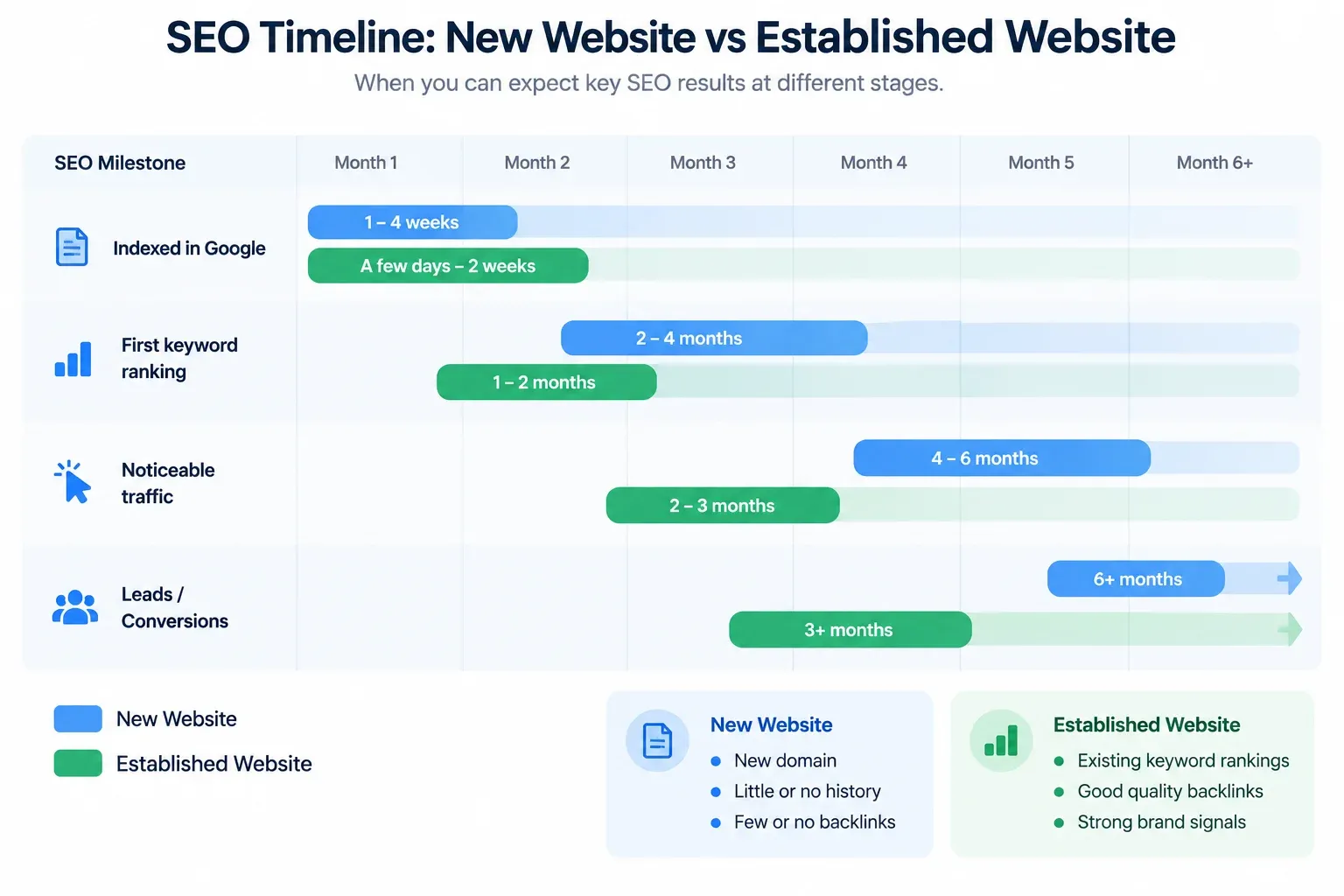
For a new website, SEO can take at least 4 to 6 months to show visible growth. It is rare to see significant traffic or a steady flow of leads within the first three months because Google needs time to understand the website, index pages, rank pages on the SERP, authority and relevance.
The first 4 to 6 months should therefore be viewed as the period when SEO starts gaining traction, not as the point when results are fully maximized.
Here’s what a Reddit user says about SEO taking longer time for a brand new domain:

On the other hand, established websites can see results sooner. These are websites with a history of ranking for hundreds of keywords, strong quality backlinks, established domain and brand signals, and strong branded search demand. For such websites, visible SEO improvements can start appearing within 2 to 3 months.
How long does SEO take to show up in AI?
AI visibility can start changing within a few weeks, but building consistent visibility across tools such as ChatGPT, Gemini, and Perplexity can take 2 to 4 months or longer.
The timeline largely depends on your Google rankings for target keywords, your overall brand presence across the web, and brand signals such as reviews, digital PR, relevant mentions, and authoritative third-party coverage.
The stronger your search visibility and online brand presence, the more opportunities AI systems have to discover, understand, and mention your brand in relevant answers.
What factors determine how long SEO takes?
There is no fixed timeline for SEO because every website starts from a different position. A domain that has ranked for years, earned quality backlinks, and built brand demand has a very different starting point from a new website with no search history.
Here are the main factors that can speed up or slow down SEO results.
1. Website history
Before starting SEO, look at what Google already knows about the website. Has the domain ranked for relevant keywords before? Does it already have hundreds of keywords in its history? Has it attracted organic traffic and backlinks over time?
An established history can make it easier to regain rankings after a period of decline. Google already has information about the domain and its content.
The opposite can also happen. If the website has received a manual action or has a history of serious SEO violations, rebuilding its organic visibility can take much longer. The team may first need to identify and resolve the underlying problems before focusing on growth.
2. Current backlink profile
Backlinks can influence how quickly a website builds authority. In fact, Google’s Andrey Lipattsev confirmed that backlinks are among Google’s strongest ranking factors.
Consider two websites targeting the same keyword. One has almost no relevant backlinks, while the other already has quality links from industry publications, editorial websites, digital PR campaigns, and trusted sources.
The first website needs to build that authority from the ground up. That takes time because quality links are earned, not created instantly.
The second website already has a foundation of authority. This doesn't guarantee rankings, but it can give the site a stronger starting position when you optimize new content or existing pages.
3. Competition level
The level of competition determines how much work your website needs to do before it can gain visibility.
A local business targeting a specific service in a smaller market may face fewer strong competitors. In contrast, finance, gaming, and health related searches often have established websites competing for valuable keywords.
In a competitive niche, publishing one good article may not be enough. You may need a larger content library, stronger topical coverage, quality backlinks, better internal linking, and ongoing optimization. The more established your competitors are, the more evidence your website needs to build before it can compete with them.
4. Technical issues
Technical SEO can either help your campaign move forward or keep it stuck at the starting line.
Google needs to crawl, render, and index your important pages before they can compete in search results. Technical issues such as blocked pages, incorrect noindex tags, broken internal links, poor site architecture, or rendering problems can interfere with this process.
JavaScript can also become an issue when important page content depends heavily on client side rendering. If search engines cannot properly access or process that content, the SEO team may need to fix the technical problem before other optimization work can have its full effect.
5. Branded search demand
People searching for your brand by name can provide an important sign of existing brand awareness.
For example, searches such as “Nike running shoes,” “HubSpot CRM,” or “Tenet SEO agency” show that people already know the brand and are actively looking for it.
In our experience working with more than 60 brands worldwide, we have found that websites with established branded search demand can be easier to build on than websites with no existing audience. These brands already have people searching for them, which gives the SEO campaign a stronger starting point.
6. Content scale
Your publishing capacity also affects how quickly you can expand your search visibility.
A website publishing one useful article each week has fewer opportunities to target new searches than a website that can consistently publish five or six well researched pieces each week.
But scaling content does not mean filling a website with thousands of low-quality AI-generated pages. Each page should have a clear purpose, target a relevant search, and provide useful information.
As you build more quality pages, you create more opportunities to rank for relevant keywords. Those rankings can then bring more impressions, clicks, and organic traffic.
7. Keyword strategy
The final question is not simply, “How quickly can we rank?”
For a business, the more important question is, “How quickly can SEO bring qualified leads and revenue?”
That depends heavily on the keywords you target.
Informational keywords can bring visitors who are researching a topic but may not be ready to buy. High-intent keywords are different.
A strong SEO strategy therefore combines traffic opportunities with commercial intent. Targeting the right keywords can help you move from simply gaining rankings to attracting visitors who are more likely to become leads or customers.
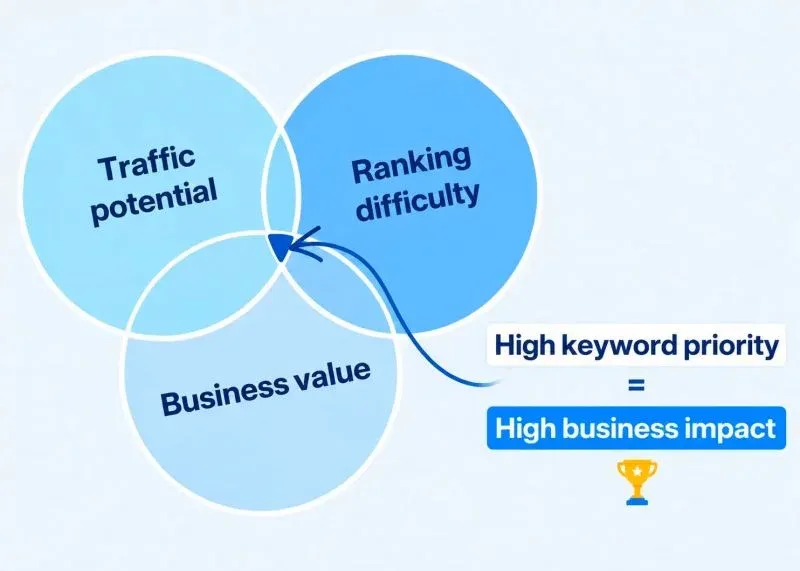
For example, at Tenet, we use keyword priority analysis to identify and prioritize keywords that help businesses generate leads and sales.
SEO timeline: What happens month by month?
Month 1: Build the SEO foundation and target quick wins
The first month is about getting the SEO work moving in the right direction. The process usually starts with audience research and keyword research to understand what potential customers are searching for and which searches have the strongest business value.
At the same time, the SEO team can work on low-hanging opportunities that do not require months of effort. This can include updating meta titles and descriptions, fixing obvious technical SEO issues, improving internal links, optimizing existing pages, and updating content that already has some ranking potential.
New landing pages and SEO optimized service pages can also be created and published based on the keyword research. Content production usually starts during this stage as well, giving the website more relevant pages to compete for search visibility.
Basic backlink activities such as citations, company profiles, and digital PR can also begin in the first month. This may include identifying link opportunities, improving existing brand mentions, and starting relevant outreach or digital PR activities.
For an established website, these changes can sometimes produce early improvements because the domain already has search history, backlinks, and existing rankings. For a new website, the first month is more about building the foundation and giving Google enough information to understand the site.
Months 2 to 3: Rankings start developing
By the second and third months, the SEO strategy moves from setup into consistent execution. New content continues to be published, existing pages are improved, technical issues are addressed, and backlink activities continue.
Established websites can start showing much clearer changes during this period. You may see the number of keywords ranking in the SERPs increase, existing keywords move to better positions, organic traffic grow, and more visitors enter the website through search. For businesses with strong existing traffic and commercial pages, these changes can also start contributing to lead flow and conversion rate improvements.
For a new website, the picture is usually different. Much of the work is still about implementing the SEO strategy and allowing Google to crawl and index the new pages. Some pages may start appearing for relevant keywords, particularly for less competitive searches, but consistent organic traffic and leads may still take longer to develop.
This is also the stage where SEO teams can start identifying what is working. Pages that gain impressions or move up in rankings can be expanded and improved, while pages that show little movement may need changes to their content, search intent, internal linking, or keyword targeting.
Months 4 to 6: SEO gains become more visible
By months 4 to 6, an established website can begin seeing more meaningful SEO growth when the earlier work has been implemented consistently. More keywords can enter the SERPs, existing rankings can move closer to page one, and organic traffic can become more consistent.
The business impact can also become easier to measure. Pages targeting commercial and high intent keywords may start generating more enquiries, leads, and conversions. At this point, the focus shifts from simply getting pages to rank to improving the quality of the traffic and increasing the number of visitors who take valuable actions.
For a new website, months four to six can be an important transition period. Google has had more time to crawl and index the website, understand its content, and evaluate its relevance. Some keywords may begin moving into stronger positions, while long tail and lower-competition searches can start bringing the first meaningful traffic.
However, this does not mean every new website will generate strong traffic or leads by month six. Competition, content quality, backlinks, technical health, search intent, and the speed of SEO implementation can all affect the timeline.
Final words: Ask better questions than ‘How long does SEO take?’
SEO is not one result with one fixed timeline. Instead of asking how long SEO takes, ask when your pages will be indexed, when rankings can improve, when traffic may become consistent, and when SEO can start generating leads and sales.
So, these questions give you a clearer picture of progress and business impact.
Does SEO work faster for an established website?
Yes. An established website can start showing SEO improvements within 2 to 3 months, while a new website may need 4 to 6 months or longer to build meaningful visibility.
Established websites already have search history, existing rankings, backlinks, organic traffic, and brand signals. This gives Google more information to evaluate when new pages or existing content are optimized.
For example, improving a page that already ranks on page two can produce results faster than trying to rank a completely new page on a new domain.
How long does it take to index a new webpage?
A new webpage can be indexed within days, but it can also take several weeks depending on the website and page.
Google needs to discover, crawl, and process the page before adding it to its index. Internal links, XML sitemaps, crawlability, website authority, and the overall quality of the page can influence how quickly this happens.
Remember that indexing does not mean ranking. A page can be indexed but still take weeks or months to gain meaningful search visibility.
How long does it take to get the first keyword ranking?
A new page can start ranking for some keywords within a few weeks to a few months after being indexed.
Lower competition and long tail keywords can often provide earlier ranking opportunities, while competitive keywords require more time, content depth, authority, and backlinks.
For a new website, the first rankings may appear as Google starts understanding the domain and its content. An established website can sometimes rank new pages faster because it already has relevant authority and search history.
How long does it take to reach page 1?
Reaching page one can take around 3 to 6 months for realistic, lower to moderate competition keywords, while highly competitive terms can take 6 to 12 months or longer.
The timeline depends on keyword difficulty, search intent, content quality, website authority, backlinks, and the strength of competing pages.
A page already ranking on positions 11 to 20 may have a shorter path to page one than a new page starting with no ranking history. This is why improving existing opportunities can often be an important part of an SEO strategy.
How long does it take to get SEO traffic?
A website can start receiving SEO traffic within 1 to 3 months, but meaningful and consistent traffic often takes 3 to 6 months or longer.
New websites may initially receive small amounts of traffic from long tail and lower competition keywords as their pages get indexed and start ranking. Established websites can see traffic improvements sooner because they already have ranking keywords and organic visibility.
The amount of traffic also depends on search volume. Ranking for a keyword with very few monthly searches will not produce the same traffic as ranking for a high demand search.
How long does it take to get consistent organic traffic?
Consistent organic traffic generally takes around 3 to 6 months for an established website and around 4 to 6 months or longer for a new website.
Consistency comes from building multiple rankings across different pages and keywords rather than relying on one page to generate all your traffic. As more relevant pages gain visibility, the website becomes less dependent on individual rankings.
Regular content updates, internal linking, technical SEO, and authority building can help maintain and expand this organic visibility over time.
How long does it take to generate SEO leads?
SEO can start generating leads within 3 to 6 months, although the timeline can be shorter for established websites targeting high intent keywords.
The type of keywords you target has a major impact. Searches such as “SEO agency in Dubai” or “employee benefits broker Dubai” indicate a clearer business need than broad informational searches.
However, rankings alone do not generate leads. Landing page quality, calls to action, conversion rate, pricing, trust signals, and the overall user experience also determine whether organic visitors become enquiries.
How long does it take to generate sales from SEO?
SEO sales can take 6 to 12 months to develop consistently, although established websites targeting high intent keywords may generate sales earlier.
Sales usually come later in the SEO funnel. A user must first find the page, visit the website, trust the business, submit an enquiry or take another conversion action, and then complete the buying process.
The timeline also depends on the sales cycle. A customer buying a low cost service may convert quickly, while B2B software, consulting, or high value services can require several weeks or months between the first organic visit and the final purchase.
Talk to Our SEO Experts and Build a Strategy That Drives Growth
Talk to Our SEO Experts and Build a Strategy That Drives Growth


















Got an idea on your mind?
We’d love to hear about your brand, your visions, current challenges, even if you’re not sure what your next step is.
Let’s talk


