
What HubSpot’s Financial Reports Say About AI ROI
 By
By Share

Share
Get a quick blog summary with



HubSpot's AI usage is growing quickly. But that does not mean AI revenue is growing at the same rate.
That is the most useful lesson from HubSpot's first two quarters of 2026.
In Q1, HubSpot reported strong AI adoption, rising credit consumption and growing demand for larger AI-enabled deals. In Q2, AI adoption continued to rise.
Monthly agentic actions more than tripled during the year, more than 55% of Pro+ customers were using agents or Breeze Assistant, and credit consumption continued to grow.
Yet some of the metrics that support future SaaS growth moved in the opposite direction.
HubSpot added 10,800 customers in Q1 but only 7,000 in Q2. Net revenue retention moved from 103% to 102%. The company also lowered its full-year revenue guidance after Q2 and said it now expected net new ARR growth to be below constant currency revenue growth for 2026.
This does not mean HubSpot's AI strategy is failing.
It shows something more important: AI adoption, AI usage and AI monetization are three different things.
How we collected data: We collected data from HubSpot’s official Q1 and Q2 2026 quarterly results. We reviewed press releases, investor presentations, and earnings call transcripts, then compared AI usage with revenue growth, customer additions, NRR, and guidance.
The number that doesn't add up
Put HubSpot's last two reported quarters side by side and something strange jumps out.
Usage went up rapidly.
- Monthly "agentic actions" across HubSpot's customer base rose more than 3x from the start of 2026 through Q2.
- AI credit consumption grew 67% quarter over quarter in Q1, and kept growing into Q2, even after HubSpot cut the price of its agents in April.
- HubSpot agent adoption among its Pro+ customers went, in CEO Yamini Rangan's words, "from high-single digits to mid-teens this year."
- Data Agent activations jumped from about 9,000 customers in Q1 to over 16,000 by Q2, up 80% quarter over quarter. Prospecting Agent went from roughly 14,000 to about 17,000 activations over the same stretch.
- Customer Agent's ticket resolution rate climbed to 72% by Q2, up from roughly 20% a year earlier.
Growth, on the other hand, slowed down.
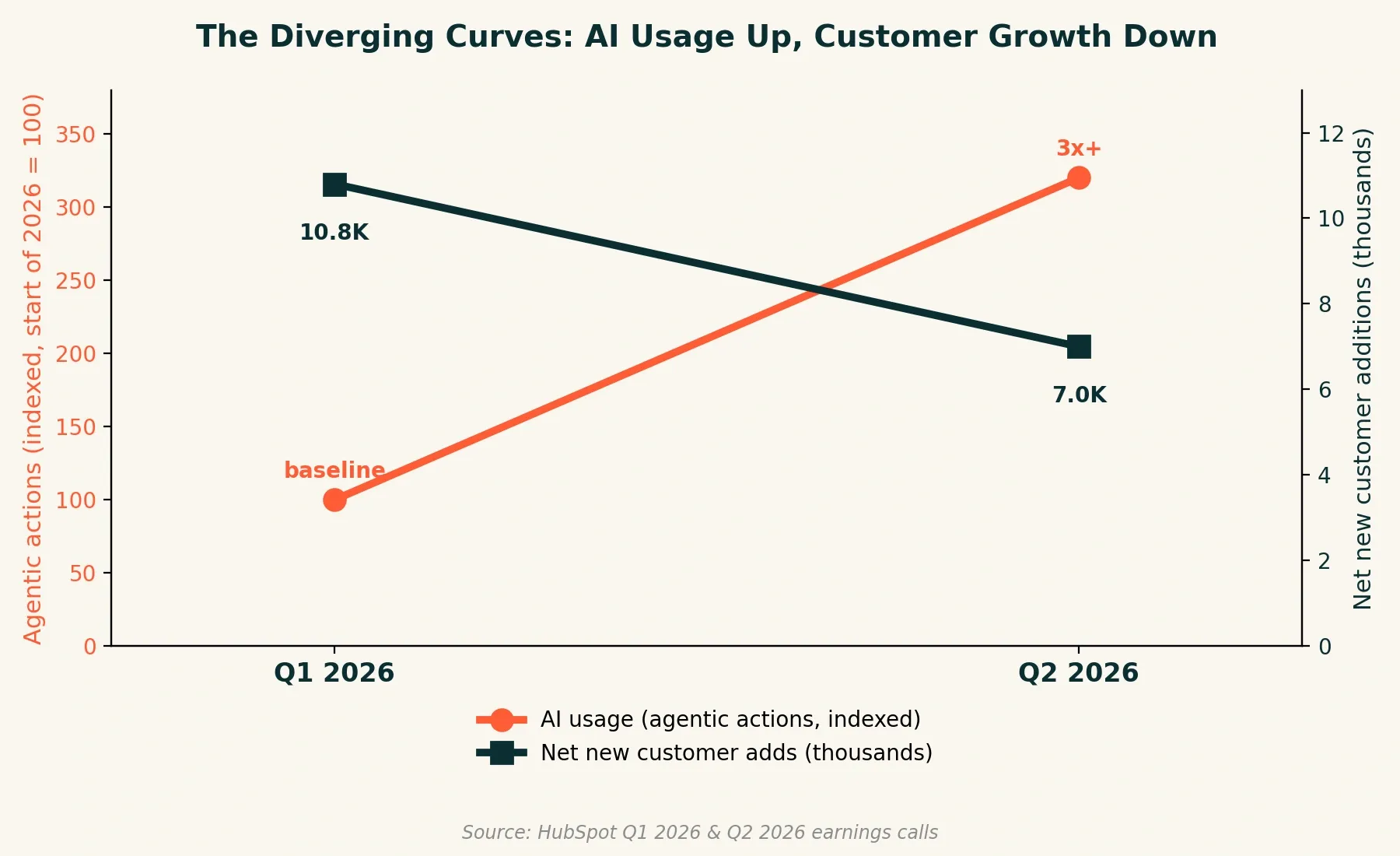
- Net new customer additions fell from 10,800 in Q1 to just 7,000 in Q2, missing HubSpot's own guidance of 9,000 to 10,000.
- Net revenue retention slipped from 103% to 102%.
- HubSpot now expects net new ARR growth to come in below constant currency revenue growth for the full year, a reversal from where things stood after Q1.
- Full year revenue guidance got cut, and next quarter's net adds guidance dropped from 9,000 to 10,000 down to 5,000 to 6,000.
If AI usage were the clean leading indicator most SaaS narratives assume it is, revenue and retention should have sped up right along with it. Instead, HubSpot's own CEO opened the Q2 earnings call by just saying it plainly: "April got off to a slow start, and the quarter we expected did not fully materialize."
Naming the shift: token-maxing vs. value-maxing
During the Q2 call, an analyst asked about ‘token-maxing.’ Rangan responded that the market was entering a sorting phase, where companies would move away from token-maxing and toward value-maxing.
Talking about the first half of 2026, she said there's "a lot of token-maxing, and that phase is not very healthy, and it is not tied to value and outcomes of what customers are getting."
She added that she expects "a sorting phase" in the market, as AI spend moves away from momentum driven experimentation and toward something more disciplined and outcomes driven.
Why usage kept climbing
Value-maxing doesn't mean less AI use. It means more deliberate use, the kind that comes out of a trial or proof of value period instead of a snap purchase.
HubSpot rolled out 28-day free trials for its key agents and AEO in April for exactly that reason. As Rangan put it, "customers adopting AI want proof of value before they commit and predictability in what it costs."
Why growth slowed down
Those same trial periods, plus a shift to outcome-based pricing (Customer Agent now bills per resolved conversation, Prospecting Agent bills per qualified lead), created a temporary air pocket in bookings.
HubSpot actually saw this coming. CFO Kate Bueker flagged as early as the Q1 call that the April sales retraining "reduced sales capacity during the month," and added that "Q2 got off to a slow start and we've reflected these dynamics in our guidance."
Why buying committees got bigger
This part had nothing to do with anything HubSpot itself changed. On the demand side, Rangan described "increased budget sensitivity" where "purchase decisions are facing greater scrutiny, buying committees are larger and more deals require C-suite and board approval."
That's a category wide signal, not something specific to HubSpot. Unpredictable AI and token costs are making finance teams cautious everywhere, and HubSpot just happened to be reporting earnings while that shift was playing out in real time.
HubSpot's own scoreboard: Reach, Depth, Quality, Growth
To figure out whether its AI strategy was actually working, and not just generating usage headlines, HubSpot built an internal framework it shared for the first time on the Q2 call.
Rangan said they measure it "through four lenses: reach, depth, quality and growth." It's a genuinely useful way to check your own AI feature rollout, and HubSpot's own Q2 numbers work as a real-world example.
1. Reach. Are people even trying it?
This is just the percentage of the customer base that has activated the AI feature at all. HubSpot's Pro+ agent adoption moved from high single digits to mid teens over the course of 2026. That's real movement, but on its own it's also the easiest number to inflate and the least predictive of anything financial.
2. Depth. Are they coming back?
This one is about repeat, workflow embedded usage, not a one time trial. HubSpot's monthly agentic actions rising 3x is a Depth signal. Customers aren't just clicking a button once out of curiosity, they're actually building the tool into how they work day to day.
3. Quality. Is it actually delivering the outcome?
Customer Agent's resolution rate climbing from about 20% to 72% is the clearest Quality data point in either earnings call. It's also the metric HubSpot leans on hardest to justify outcome based pricing, since customers can look at a resolved ticket count and see exactly what they're paying for.
4. Growth. Is it showing up in the business?
This is the metric that actually answers the board's real question, and it's the one that lagged in Q2. Net adds down, NRR down, guidance cut. Reach, Depth, and Quality were all strong. Growth wasn't, yet.
That gap is really the whole story. HubSpot didn't have an adoption problem in the first half of 2026. It had a pricing and timing problem, one it created on purpose through its own trial and outcome pricing pivot, on top of a market wide budget scrutiny headwind it didn't control. Those are two different problems with two different fixes, and mixing them up is exactly the mistake this Reach, Depth, Quality, Growth framework is built to prevent.
What this means for AI-based SaaS Brands
1. Ship trials before you ship pricing
Here's the thing about HubSpot's growth dip: it wasn't really a demand problem. It was a sequencing choice they made on purpose.
They rolled out 28-day free trials for their key agents because, in Rangan's words, customers want "proof of value before they commit and predictability in what it costs."
So, if you're building AI features, bake trials into the plan from the start instead of adding them later once people start complaining about the price tag. Yes, it slows down your first close. But it also means the customer who signs actually trusts the number on the invoice, and that matters more long term.
2. Stop pricing AI like it's just another seat
HubSpot moved Customer Agent to pricing based on resolved conversations, and Prospecting Agent to pricing based on qualified leads. In other words, they tied the price directly to the value delivered instead of bundling it into a flat seat or credit package.
Do this early if you can. Retrofitting outcome-based pricing onto a customer base that's used to seat pricing is basically what created HubSpot's bookings slowdown in the first place. Save yourself that pain.
3. Track four different numbers, not one big "adoption" metric
HubSpot built something worth stealing here: a framework they call Reach, Depth, Quality, and Growth. The reason it exists is that a single adoption percentage hides way too much.
Here’s the framework used by HubSpot:
- Reach: how many customers even tried the feature
- Depth: are they coming back and using it weekly, not just once
- Quality: is it actually doing the job well (resolution rate, accuracy, time saved)
- Growth: is any of this showing up in revenue or retention
If Reach and Depth look great but Growth is flat, that's not a product problem. That's a pricing and proof problem, and it's a much easier fix.
4. Budget scrutiny will hit you even when your product is doing everything right
This is the part founders tend to miss. HubSpot's own usage numbers, credit consumption, activations, resolution rates, all kept climbing through Q2.
The slowdown came from somewhere else entirely: bigger buying committees and more C-suite or board sign-off getting required for AI spend. Rangan called this out as a market-wide shift, not something specific to HubSpot.
Tip: Get your economic buyer into the conversation earlier than you would have a couple years ago, because AI line items get a lot more scrutiny now than a regular feature upgrade used to.
5. Start with the internal use case, not the customer-facing one
Look at how HubSpot's adoption actually played out. Data Agent and Smart Deal Progression, both internal tools that enrich records or update the CRM, took off fast because the risk of a bad output is low and easy to validate. Prospecting Agent and Customer Agent, which actually talk to real customers, took longer to gain trust.
If you're sequencing your own roadmap, ship the low-stakes internal thing first. It builds confidence and usage data before you ask anyone to let AI near their customers.
6. Let consumption pricing reward you for getting better
Here's a genuinely encouraging data point: HubSpot's credit consumption kept growing even after they cut agent prices in April. That's the beauty of consumption pricing done right.
Every time your model gets better, revenue goes up without you having to have another pricing conversation. But don't rush into this model until you can actually show quality improving on its own. Otherwise you're just hoping the flywheel spins.
7. Don't panic when growth dips because of a trade-off you chose on purpose
HubSpot's board approved an extra $1 billion buyback the same quarter they cut growth guidance. That's a pretty clear message: a short-term bookings dip caused by a deliberate pricing pivot isn't a failure; it's the plan working as expected.
If you're going to make a similar move, especially if you answer to a board or investors, say this out loud before the dip shows up, not after. Something like, "usage and quality are what we're optimizing for right now, growth might lag for a quarter or two while pricing catches up." Set that expectation early.
8. Your real moat is the data, not the model
HubSpot's biggest upmarket wins, deals over $120K ARR growing 38 to 64 percent year over year, came from customers consolidating onto their platform specifically to give AI clean, unified data to work with. It wasn't because any one agent was the smartest on the market.
Models get commoditized fast. Proprietary customer data doesn't. So be honest with yourself about which side of that line you're actually on before you bet your whole roadmap on having the best agent.
The bottom line
HubSpot's 2026 results show that AI adoption alone does not guarantee monetization. SaaS brands need to connect AI usage with clear customer outcomes and a pricing model that reflects those outcomes.
The biggest lessons are simple. Prove value before asking customers to commit. Track reach, usage, quality and business growth separately. Give customers predictable control over AI spending. Tie pricing to outcomes when possible. And make the economic case clear enough for senior buyers and finance teams.
For AI based SaaS brands, the goal should not be to maximize AI usage alone. The goal should be to build AI products that customers use repeatedly, deliver measurable value and are willing to pay for as that value grows.
The real AI monetization test is not how many customers use your AI. It is whether better AI usage creates better customer outcomes and sustainable revenue growth.
Data and quotes are drawn from HubSpot's Q1 2026 (07-May-2026) and Q2 2026 (05-Aug-2026) earnings call transcripts and investor presentations. Quoted language is reproduced in short excerpts with attribution to HubSpot CEO Yamini Rangan and CFO Kathryn Bueker. For full context, refer to the original transcripts.
Get expert guidance on building AI strategies that drive customer value, stronger monetization, and sustainable SaaS growth.
Get expert guidance on building AI strategies that drive customer value, stronger monetization, and sustainable SaaS growth.



















Got an idea on your mind?
We’d love to hear about your brand, your visions, current challenges, even if you’re not sure what your next step is.
Let’s talk


