
How Digital Agencies Can Generate B2B Leads
 By
By Share

Share
Get a quick blog summary with



B2B lead generation should not depend on referrals, random campaigns, or unpredictable bursts of traffic.
At Tenet, we have worked on 450+ projects and maintain a 98% client satisfaction rate, giving us a clear view of what it takes to build and scale digital growth systems.
In this guide, we break down a practical framework digital agencies can use to attract the right B2B prospects, generate qualified leads, improve conversions, and build a more predictable pipeline.
Level 1: Define Your Target B2B Audience
The first step is to stop trying to sell to everyone. If your agency works with SaaS, ecommerce, healthcare, startups, and enterprises, your message will likely feel too generic to all of them.
Start with your best existing clients. Look at who pays you the most, stays the longest, gets strong results, and is easy for your team to work with. Then find the common patterns.
For example, you may find that your best clients are B2B SaaS companies with 50 to 500 employees, an in house marketing team, and a clear need to grow qualified pipeline through SEO.
Now define who you need to reach inside these companies. It could be a CMO, VP of Marketing, Head of Growth, or SEO Director. Go beyond the job title and understand their goals, problems, targets, and buying concerns.
Finally, identify what triggers them to look for an agency. A new CMO, funding round, website redesign, market expansion, traffic decline, or failed agency relationship can create a strong buying opportunity.
Put all of this into a simple ICP document. Define your ideal industry, company size, location, buyer role, problems, buying triggers, budget, deal size, and the type of prospects you do not want.
Here’s a ICP template: The 4 part framework:
Level 2: Create a Clear UVP and Strong Positioning
Once you know who you want to attract, you need to explain why they should choose your agency. This is where your unique value proposition becomes important.
A weak agency positioning statement sounds like this:
"We are a full service digital marketing agency that delivers results."
There is nothing wrong with the statement, but almost every agency can say it. Your positioning needs to make the connection between your audience, their problem, your solution, and the outcome you create.
For example:
"We help B2B SaaS companies turn organic search into a predictable source of qualified pipeline."
That statement is much stronger because it tells the buyer who the agency serves and what business outcome it focuses on.
You can make it even more specific by adding a clear market or business stage.
"We help B2B SaaS companies with established marketing teams increase qualified pipeline through SEO and AI search visibility."
Now the buyer can quickly decide whether the agency is relevant. Your positioning also needs evidence. A strong claim without proof will not create much trust. Use case studies, customer results, original research, client interviews, reviews, expert content, screenshots, examples, and clear explanations of your process.
This is especially important because buyers often form their opinions before they contact an agency.
6sense found that 94% of buying groups ranked their vendor shortlist before contacting sellers, while the preferred vendor at the end of the selection phase went on to win about 80% of the time.
Your agency therefore needs to influence the buyer before the sales call, whereas your website should make it easy for a prospect to answer three questions.
- "Do they understand companies like mine?"
- "Can they solve my problem?"
- "Have they done it successfully before?"
If the answer to all three is yes, your positioning starts doing part of the sales work for you.
Level 3: Choose One or Two Marketing Channels
Most digital agencies start LinkedIn, Instagram, YouTube, SEO, Google Ads, cold email, webinars, podcasts, events, newsletters, and communities at the same time.
The result is usually mediocre execution everywhere. Instead, choose one primary channel and one supporting channel.
The right channel depends on where your buyers spend time and how they search for solutions.
SEO can work well when your audience actively searches for services and problems. A B2B SaaS company may search for terms such as "B2B SaaS SEO agency," "enterprise SEO services," or "SEO agency for SaaS."
LinkedIn can work well when your buyers are senior professionals who consume business content and follow industry experts.
The important question is not "Which channel is popular?"
- Ask: "Where does my target buyer already go to learn about this problem?"
Then build your acquisition system around that behavior.
Level 4: Build a Repeatable Marketing Strategy
Choosing a channel is only the beginning. A channel tells you where you will reach people. A strategy explains what you will do once you reach them.
For example, saying "We will use LinkedIn" is not a strategy.
A real LinkedIn strategy could involve publishing expert opinions three times a week, sharing client results every week, commenting on posts from target buyers, creating industry research once a month, sending personalized messages to high-intent prospects, and directing interested users to specific landing pages.
The same principle applies to SEO. Do not simply say "We will publish 10 blogs every month."
Build content around the problems your ICP is trying to solve.
Create educational content for people who are still understanding the problem. Create comparison content for people evaluating different solutions. Create commercial pages for people looking for an agency. Create case studies for people comparing vendors. Create pricing content for people close to making a decision.
Level 5: Turn the Strategy Into a Marketing System
Start by assigning clear ownership. Someone should own content research. Someone should create content. Someone should publish and distribute it. Someone should manage campaigns. Someone should handle lead qualification. Someone should update the CRM. Someone should review performance.
In a small agency, one person can have several of these responsibilities. The important thing is that every responsibility has an owner.
Next, create a marketing calendar. Your calendar should show what is being published, which campaign is running, which audience it targets, what offer it promotes, where it will be distributed, and who owns the task.
Level 6: Capture and Nurture Your Leads
A website visitor becomes useful to your business when you give them a clear next step.
For a digital agency, that next step could be requesting an audit, booking a strategy call, downloading research, accessing a benchmark report, requesting a proposal, joining a webinar, subscribing to a newsletter, or using a free tool.
The offer should match the buyer's intent.
Someone reading an introductory article about SEO may not be ready to book a sales call. Asking for a large commitment too early can reduce conversions. But someone reading your service page, pricing page, comparison page, or case study may have much stronger buying intent.
Platforms such as Snov.io combine prospect discovery, email verification, mailbox setup, and email sequencing in one workflow. Similar tools can handle parts of the same process.
However, the tool does not decide who your ideal prospect is, how you qualify them, or when a lead should move to the next stage. Your agency still needs to define the segmentation, qualification rules, messaging, and reporting process that turns outreach activity into measurable pipeline.
You can send educational content, relevant case studies, research, webinars, customer stories, useful tools, and practical advice.
The objective is not to constantly ask for a meeting. The objective is to become more useful and more credible until the buyer is ready.
Level 7: Build a Performance Reporting System
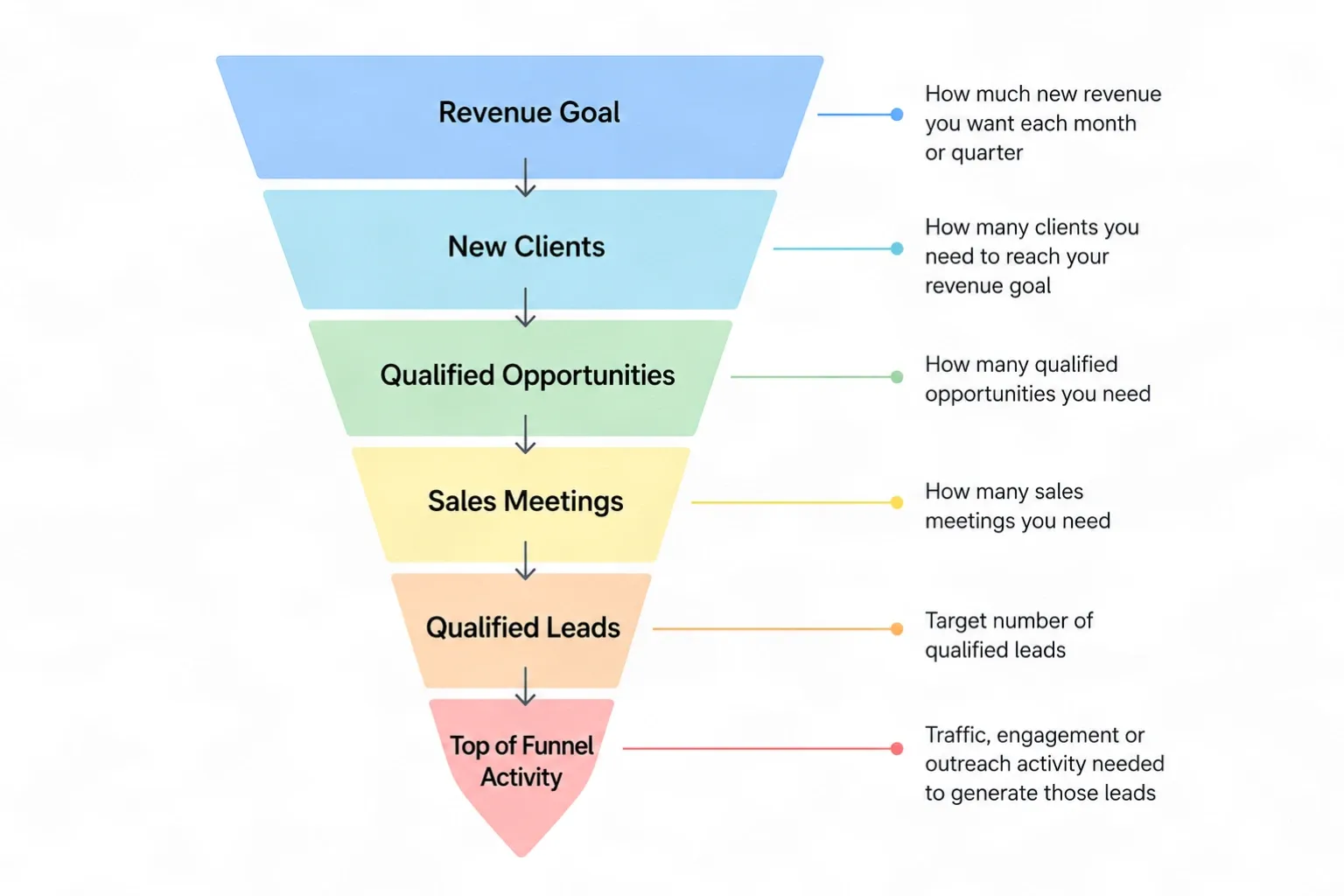
You cannot build a predictable pipeline without knowing what is happening inside it.
Create a reporting system that connects marketing activity to revenue.
- Start at the bottom: How much new revenue do you want each month or quarter?
Then calculate how many clients you need to reach that number. From there, calculate how many qualified opportunities you need, how many sales meetings you need, and the target qualified lead count.
Finally, estimate how much traffic, account engagement, or outreach activity you need to produce those leads.
Level 8: Analyze and Double Down on What Works
Once your lead generation system is running, look beyond the numbers. Track the full journey from visitor to lead, qualified lead, meeting, opportunity, and customer. This helps you identify where prospects are dropping off.
For example, if you get plenty of leads but few qualified opportunities, your targeting may be too broad. If qualified leads book meetings but do not become customers, your offer, pricing, positioning, or sales process may need work.
Compare performance by channel, audience, campaign, content, and offer. A channel that generates fewer leads may still create more revenue.
Once you find what works, do more of it. If B2B SaaS case studies on LinkedIn generate strong sales conversations, create more case studies and repurpose them into posts, emails, videos, landing pages, and sales content.
The same applies to your best customer segment. If SaaS companies bring larger contracts and stay longer, build more SaaS focused campaigns and content.
The goal is not more marketing activity. It is more qualified pipeline from the strategies that already work. Keep testing, but put more resources behind your proven winners.
Final Thoughts
Building a predictable B2B lead generation pipeline does not happen by adding more channels or spending more on ads. It starts with knowing exactly who you want to reach, creating a clear reason for them to choose you, and building a repeatable system around the channels that work best.
The key is to keep improving the system. Track where leads come from, measure which ones become opportunities, find the bottlenecks, and invest more in the strategies that create real pipeline and revenue.
At Tenet, we take a similar outcome focused approach to digital growth. Our services cover the full digital journey, from brand research and strategy to design, technology, and growth marketing. This includes SEO, PPC, content marketing, B2B marketing, conversion optimization, analytics, branding, UI UX design, website development, SaaS development, and mobile app development.
Whether you need to strengthen your positioning, build a better digital experience, generate more demand, or connect marketing activity to measurable growth, Tenet can help you build the right strategy and execute it.
Ready to build a more predictable B2B growth engine? Talk to Tenet about your goals.
Expertise Delivered Straight to Your Inbox
Expertise Delivered Straight to Your Inbox













Got an idea on your mind?
We’d love to hear about your brand, your visions, current challenges, even if you’re not sure what your next step is.
Let’s talk


