
ROI of SEO: How to Calculate ROI from Your SEO Efforts?
 By
By Share

Share

Get a quick blog summary with



When you run a Google Ads campaign, you know exactly what happens with your money. Like you spend $5000 in a month and by evening you can count the calls, form submissions, or sales that came back.
SEO works differently.
You put the same amount or more into technical fixes, fresh content, and link building, yet for the first 6 to 12 months the reports often stay flat, the phone does not ring louder, and your regular expenses for rent, salaries, and stock keep draining the account.
Business owners in this situation start wondering whether the hours and dollars are building anything real or simply disappearing into rankings that never turn into revenue. Many give up after one attempt and go back to ads because those at least show immediate activity.
Recent reports show that while Google Ads returns around $2 for every $1 spent, well-executed SEO can deliver an average of $22 per dollar once results start to build.
This article shows exactly how to measure that difference so you can decide with open eyes whether your SEO work is worth continuing or needs to change.
What is the formula to calculate ROI from SEO?
The formula itself is simple. The challenge is getting the inputs right. Here is the standard formula, written in a way that is easy to reference:
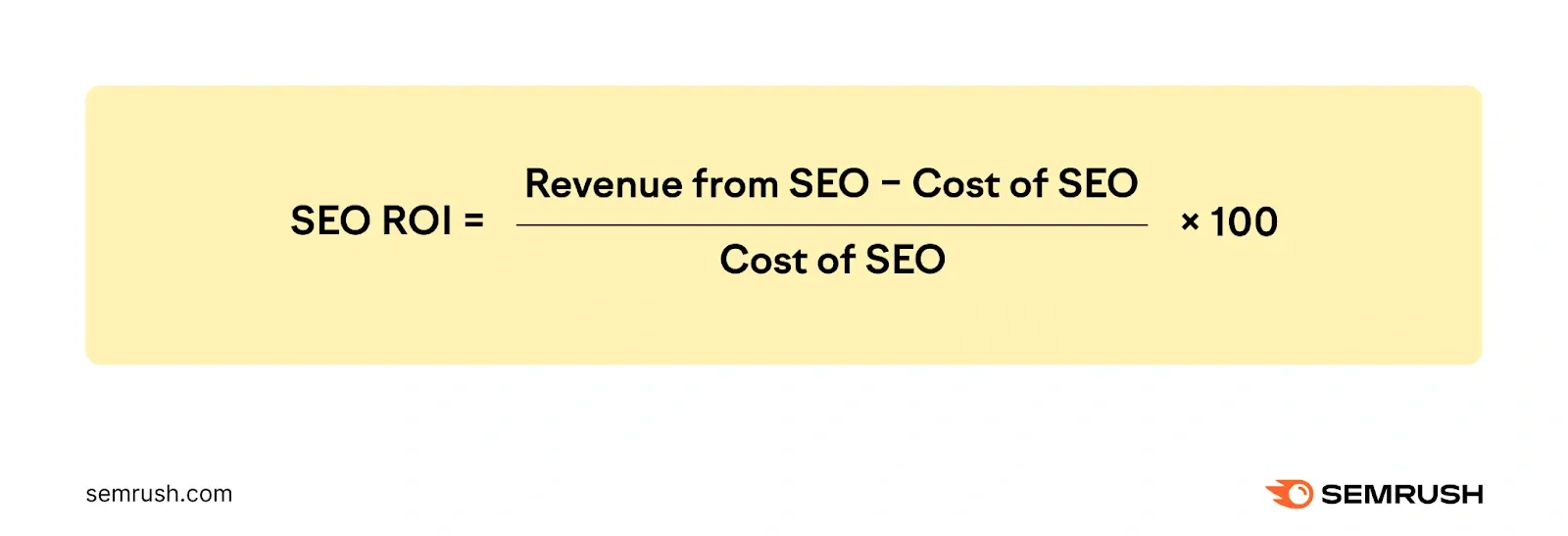
In theory, this looks straightforward. But in SEO, both “revenue” and “cost” are not always easy to define. Revenue may come from multiple visits over time, and costs are often spread across content, tools, and ongoing work rather than a single campaign.
To calculate ROI properly, you need to break SEO into a clear funnel: traffic → leads → customers → revenue.
Here’s what that looks like in a practical scenario:
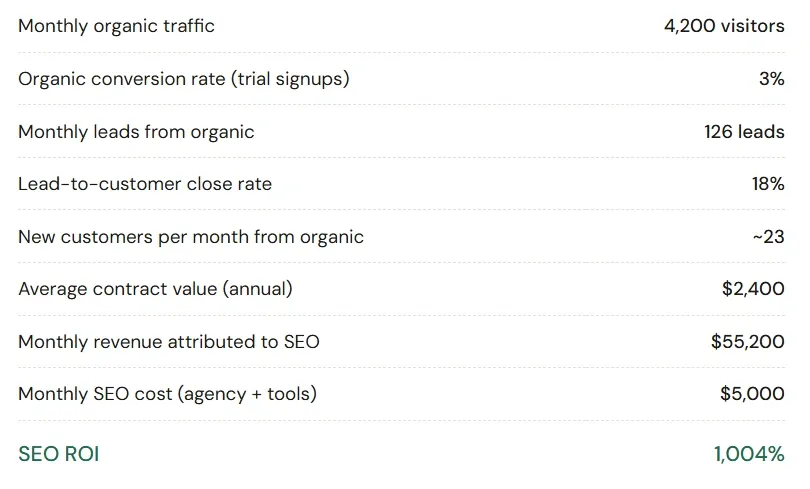
Let’s break this down.
Out of 4,200 visitors, 3% sign up for a trial, giving you 126 leads. If 18% of those convert, you get around 23 new customers in a month.
At $2,400 per customer, that’s $55,200 in revenue from organic search.
With a monthly SEO cost of $5,000, this results in a 1,004% ROI.
In simple terms, for every $1 you spend on SEO, you get about $11 back.
This is why SEO ROI is often missed. If you only look at traffic or rankings, you don’t see the full picture. The real value shows up when you connect it directly to revenue.
Want to improve your visibility across ChatGPT, Google AI Overviews, Gemini, and other AI search platforms?
Get a custom AI SEO strategy designed to help your brand appear in high intent AI generated answers and drive qualified growth.
👉 AI SEO Services For AEO and GEO Growth

How to calculate SEO ROI in a step-by-step process?
Calculating SEO Return on Investment (ROI) helps you understand if your SEO efforts are profitable. The process involves two main steps:
- Calculating the Cost of SEO (including content creation and website expenses)
- Calculating the Revenue from SEO
Once you have both values, use the formula given in the above section.
1. Calculating the Cost of SEO
To accurately calculate costs, include all expenses related to your SEO strategy over a specific period (e.g., one month, quarter, or year). This covers not just agency fees but also content creation and website-related costs.
Key cost components to include:
- SEO agency/freelancer retainers or project fees
- Content creation (writer/editor fees, graphic designers, stock images/videos)
- Website development & maintenance (hosting, domain renewal, theme/custom development, plugins, security, speed optimization tools)
- SEO tools & software subscriptions (Ahrefs, SEMrush, Google Analytics 4, Google Search Console, etc.)
- In-house team salaries (portion of time spent on SEO)
- Link building, PR, or any paid outreach
- Any other overheads (audits, training, etc.)
Step-by-step process:
- List every activity and resource used in your SEO campaign for the chosen time period.
- Assign a realistic monetary value to each item (use actual invoices, hourly rates, or prorated subscriptions).
- Add them all up to get your Total Cost of SEO.
Example (for one quarter):
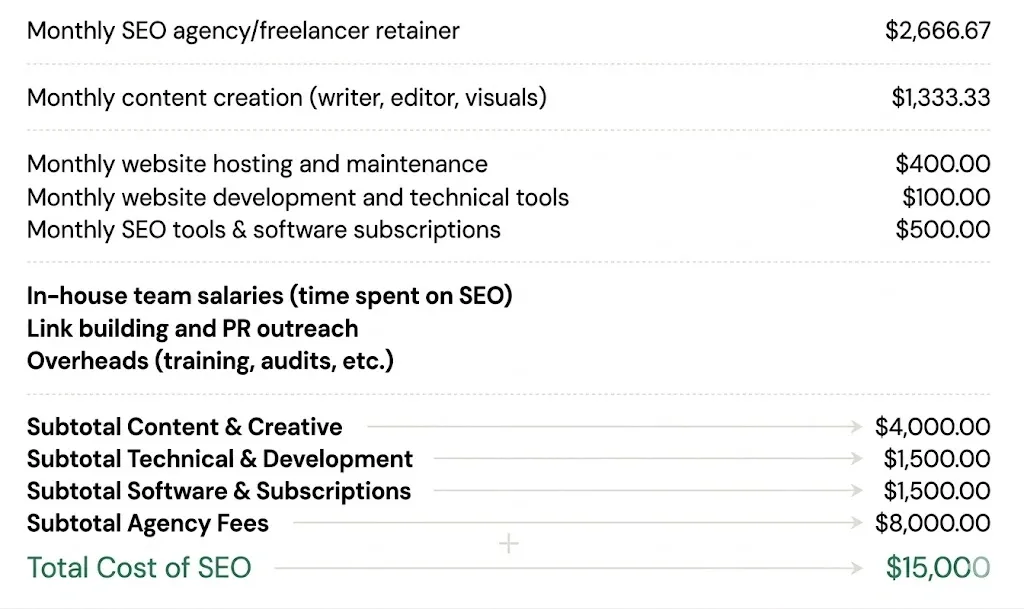
During the quarter, agency or freelancer fees amounted to $8,000. Content creation, including writing and visuals, cost $4,000. Website hosting, maintenance, and related tools added $1,500, while various SEO software subscriptions came to another $1,500.
Adding these together results in a total Cost of SEO of $15,000.
👉 Our SEO services page covers exactly what a professional SEO engagement includes so you have a clear reference for what to include in your cost breakdown.
2. Calculating Revenue from SEO
Revenue from SEO can be calculated in three main ways, depending on your business model and the data you have available. Choose the method that best matches your setup. (These are general methods and work across any niche.)
1. Direct revenue tracking (most accurate)
This is the most precise method and works best when customers can complete a purchase or transaction directly on your website.
For this approach, you need transaction tracking set up in Google Analytics 4 (GA4), including proper eCommerce or purchase event configuration.
How to do it:
Open GA4 and navigate to Reports → Acquisition → Traffic acquisition. Apply a filter for Organic Search as the session source/medium.
From here, you can view the total revenue generated, the number of purchases or transactions, the conversion rate, and the average order value specifically from organic traffic.
Formula: Revenue = Organic sessions × Conversion rate × Average order value
For example,
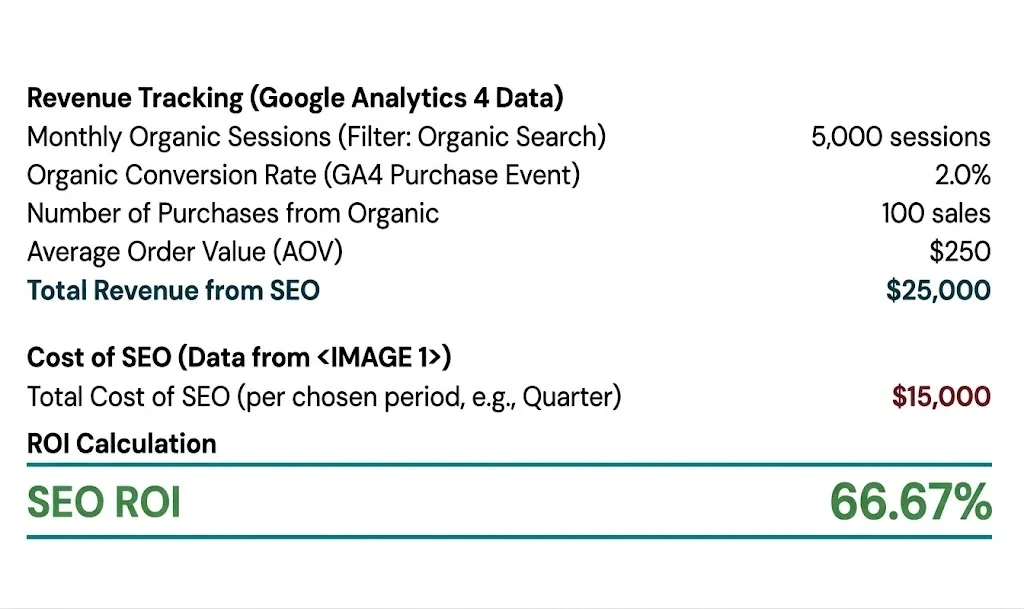
In a given period, your website received 5,000 organic sessions. The conversion rate from these sessions was 2%, resulting in 100 completed sales. Each sale had an average order value of $250.
Revenue from SEO = $25,000
ROI Calculation (using the earlier cost example of $15,000):
ROI = [($25,000 − $15,000) / $15,000] × 100% = 66.67%
This method is considered the gold standard because it relies on actual tracked transactions rather than estimates.
👉 Getting this method right depends entirely on having GA4 properly configured, which is one of the issues our CRO audit service addresses as a first step before optimizing any conversion funnel.
2. Lead generation model (estimate-based)
Many businesses do not sell products directly on their website. Instead, they generate leads that eventually convert into paying customers.
This method is highly effective for service-based businesses, agencies, SaaS companies, consultants, and B2B websites.
You will need reliable lead tracking (through form submissions, phone calls, chat inquiries, or demo bookings) and access to CRM data that shows historical close rates and average deal values.
How to do it:
First, count all the qualified leads that originated from organic search traffic.
Next, refer to your CRM or sales records to determine the average lead-to-customer close rate and the average value of a closed deal. Then apply the formula.
Formula: Revenue = Organic leads × Close rate × Average deal value
Here is an example,
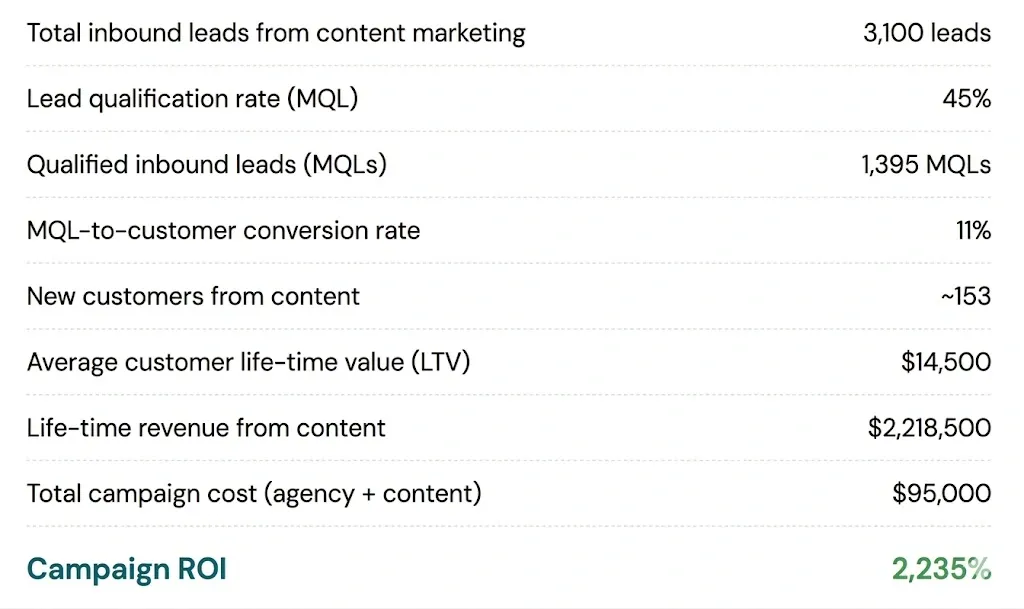
During the period, SEO generated 300 organic leads. Your historical data shows an 8% close rate, which means 24 of those leads became paying customers. The average deal value per customer was $2,000.
Revenue from SEO = $48,000
ROI Calculation (using Cost of SEO = $15,000):
ROI = [($48,000 − $15,000) / $15,000] × 100% = 220%
This method provides a realistic picture even when the actual sale happens days or weeks after the initial website visit.
👉 If your close rates are lower than expected despite strong organic traffic, the gap is usually a conversion problem rather than an SEO problem, and our conversion rate optimization services are built specifically to close that gap.
3. Goal value tracking (simple method)
When you don’t yet have full transaction tracking or detailed CRM data, the goal value method offers a practical and straightforward alternative. It can be used effectively for almost any type of website.
You need conversion events configured in GA4 (such as form submissions, newsletter signups, resource downloads, or contact button clicks) and a reasonable monetary value assigned to each type of conversion.
How to do it:
Identify the main micro-conversions that indicate user interest. Then assign a monetary value to each based on real business insights.
For instance, if your data shows that 1 out of every 10 leads eventually becomes a customer worth $1,000 on average, you can assign $100 as the value of each lead. Multiply the total number of organic conversions by this assigned value.
Formula: Revenue = Conversions × Value per conversion
For example,
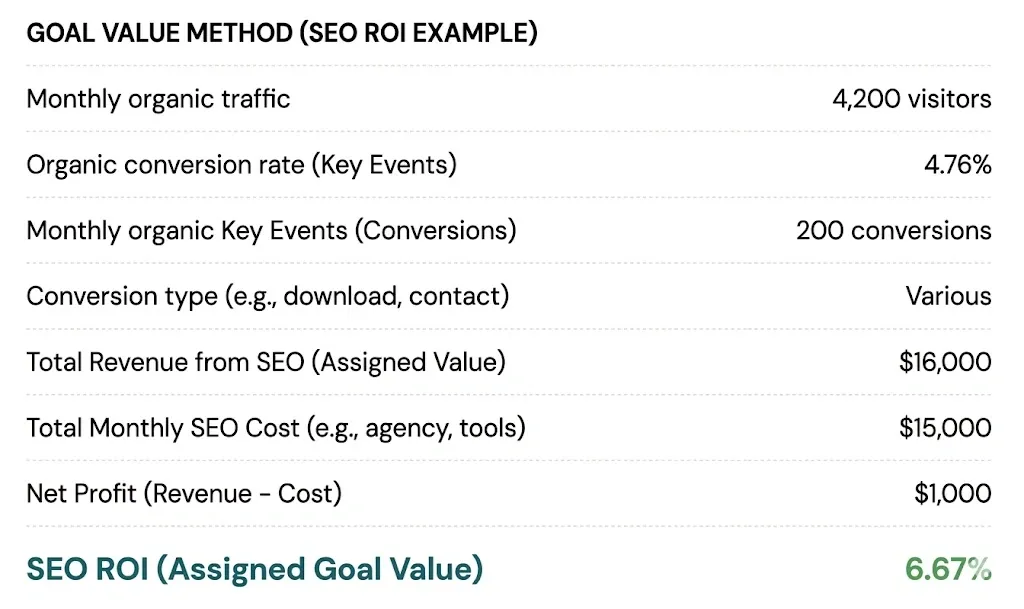
In the period, organic traffic resulted in 200 key conversions. Based on your business numbers, you assigned an average value of $80 per conversion.
Revenue from SEO = $16,000
ROI Calculation (using Cost of SEO = $15,000):
ROI = [($16,000 − $15,000) / $15,000] × 100% = 6.67%
While this method is less precise than the first two, it still gives you a useful directional understanding of SEO’s contribution when better data is not yet available. Over time, you can refine the assigned values as you collect more accurate sales information.
These three methods provide the flexibility you need to calculate SEO revenue no matter what stage your analytics setup is at.
For the best results, always isolate organic search traffic only, consider removing brand-related keywords if you want to measure pure non-branded SEO impact, and review your calculations periodically as your business grows and your data quality improves.
Why calculating ROI from SEO is challenging?
1. Results are not immediate
Unlike paid advertising like Google Ads that can generate instant traffic and sales, SEO is a long-term strategy.
It typically takes 6 to 12 months (or even longer) for new content and optimizations to rank well on Google and start driving consistent revenue.
In the early stages, you may see rising organic traffic, but actual sales or leads often lag behind. This delay makes it hard to prove quick wins and justify continued investment in SEO.
👉 Understanding what drives long-term SEO compounding is easier when you see the data behind it, and our AI SEO statistics guide includes current benchmarks on how organic performance is shifting alongside AI-driven search behavior.
2. Attribution is unclear
Customer journeys today are rarely linear. A user might first discover your site through an organic Google search, then return later via branded search, social media, email, or even a paid ad before converting.
Most analytics tools still rely on last-click attribution, which gives full credit to the final touchpoint and undervalues the important role SEO plays in building awareness and trust.
This is one of the most common SEO ROI measurement challenges.
👉 Multi-touch attribution is one of the most commonly overlooked problems in SEO measurement, and it sits at the top of the SEO mistakes that quietly drain ROI even when rankings look healthy.
3. Multiple visits before conversion
It is difficult to isolate the exact impact of your SEO efforts because many external and internal factors affect performance at the same time. Google algorithm updates, website redesigns, competitor actions, seasonal trends, or overall brand growth can all increase or decrease traffic and conversions.
Separating what revenue truly came from SEO versus these other influences remains a major hurdle.
4. Many SEO Benefits Are Hard to Quantify in Dollars
SEO delivers more than direct sales. It builds brand visibility, authority, trust, and long-term customer loyalty, benefits that eventually contribute to revenue but are tough to assign a precise monetary value.
These indirect gains often get overlooked in traditional SEO ROI calculations.
5. Tracking and Data Limitations
Not every business has advanced eCommerce tracking, CRM integration, or proper conversion setup in Google Analytics 4. Privacy changes, cookie restrictions, and users switching between devices further complicate accurate tracking of organic conversions.
Without clean data, calculating true SEO return on investment becomes even more challenging.
How long does it take to see a positive ROI from SEO?
The timeline depends on where you are starting from.
If you are starting with a new website
For a new website, SEO usually takes 4 to 6 months to show positive ROI.
In the first 2–3 months, most of the effort goes into setup, including technical fixes, content creation, and building initial authority. During this phase, returns are often negative.
By month 4, early traction starts to appear. By months 5–6, SEO typically begins to break even and turn positive.
After that, results start to compound.
Here is a graph showing SEO ROI trend for a new website over 12 months (setup → early gains → compounding growth):
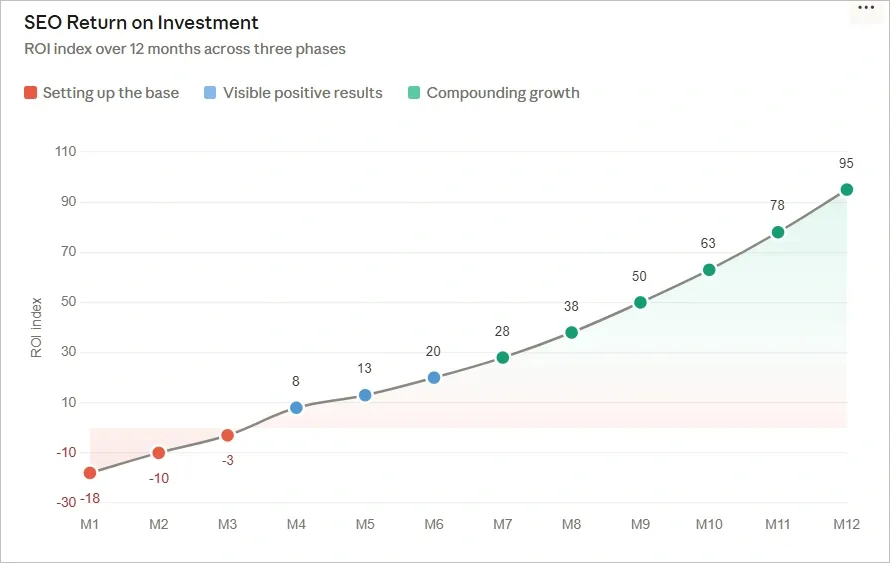
You can see in the image that SEO ROI does not start positive. Most new websites see negative returns in the first few months, break even around months 4–6, and then grow steadily as traffic and conversions increase.
If you already have an existing website
The timeline is usually shorter, but it depends on your current state:
1. Website with some traffic but poor optimization: If your site already gets traffic but is not well-optimized, you can start seeing results in 2 to 4 months. Fixing structure, content gaps, and intent alignment can unlock quick wins.
2. Website with strong SEO but inconsistent conversions: In this case, ROI improves faster. You may already have traffic, but better targeting and conversion improvements can lead to measurable gains in 1 to 3 months.
3. Website with no clear SEO strategy: Even if the site is old, results may still take 4 to 6 months, similar to a new site.
How Tenet helps you increase ROI from SEO
Tenet helps in increasing the ROI from SEO by blending technical search optimization with conversion-focused design, ensuring that increased traffic translates directly into higher revenue. They focus on transforming organic visitors into paying customers through a user-centric approach.
Looking to grow your organic traffic, improve rankings, and generate qualified leads through SEO?
Get a custom SEO strategy built around your business goals, competitors, and growth opportunities.
👉 Request a Free Custom SEO Proposal
Here is how Tenet helps increase ROI from SEO:
Data-driven strategy:
High-intent keywords are prioritized to attract traffic that is more likely to convert. Instead of starting from scratch, existing content is improved and gaps are identified through competitor analysis to increase overall traffic value.
High-performance UI/UX:
SEO performance is improved by fixing issues like slow mobile speed and complex navigation. A clearer site structure makes it easier for search engines to crawl while also keeping users engaged and reducing drop-offs.
Conversion rate optimization (CRO):
Landing pages and user flows are simplified to remove friction. This helps build trust and increases the percentage of visitors who convert, in some cases delivering up to 3–5x better returns from the same traffic.
👉 If you want to see how these numbers play out in a real business context, our CRO statistics guide has the industry benchmarks you need to set realistic conversion rate assumptions before running your calculation.
Growth-focused approach:
SEO efforts are aligned with business outcomes, not just rankings. The focus is on building a system that consistently drives qualified leads and long-term growth, including improvements in MQLs and PQLs.
Want to understand what ROI from SEO could look like for your business? Get a quick audit of your current performance and see where you’re losing potential revenue from organic traffic.
To speak with Tenet’s team, feel free to email hello@wearetenet.com or call +44 7418 379209.
Talk to Our Experts to Calculate Your SEO ROI with Confidence
Talk to Our Experts to Calculate Your SEO ROI with Confidence



























Got an idea on your mind?
We’d love to hear about your brand, your visions, current challenges, even if you’re not sure what your next step is.
Let’s talk


