
OpenAI Launches Business Hub, a Search Console for ChatGPT
 By
Share

Share
Get a quick blog summary with



OpenAI has given businesses their first real window into ChatGPT. On 10 November 2026, the company launched Businesses in ChatGPT in beta, with a dashboard called Business Hub where a business can claim its profile, keep its details current, and see how often ChatGPT mentions it and how many clicks follow.
It is being called a Search Console for ChatGPT, and the comparison is fair. Google Search Console tells a site owner how their pages appear in Google Search. Business Hub starts to do the same for ChatGPT, where 1.2 billion people now go each week with questions they used to type into Google.
We claimed Tenet's profile the same week, and the setup took minutes. Here is what Business Hub does, what it does not do yet, and what it means for any brand that wants to be found in AI search.
OpenAI has given businesses their first real window into ChatGPT. On 10 November 2026, the company launched Businesses in ChatGPT in beta, with a dashboard called Business Hub where a business can claim its profile, keep its details current, and see how often ChatGPT mentions it and how many clicks follow.
What OpenAI launched
Businesses in ChatGPT is the umbrella programme. It has three parts. Business Hub is the dashboard where a business claims its profile and manages its facts. Business Agents let eligible ecommerce and online service businesses in the United States build an AI agent that helps customers inside ChatGPT. And the business profile itself is what ChatGPT draws on when it recommends a company in an answer.
The launch was not a surprise. A screenshot shared on LinkedIn on 6 November showed a ChatGPT banner inviting businesses to claim their business, four days before OpenAI made it official. The beta went live on 10 November, and OpenAI says 1.2 billion people now use ChatGPT each week.
What Business Hub shows you
Business Hub reports aggregate counts from real conversations. The metrics OpenAI documents are mentions, website clicks, and discovery topics, with profile views where available. A mention is counted when ChatGPT references your business in an answer. A click is counted when someone follows through to your website, though the dashboard itself notes that a click does not confirm a visit or a conversion.
That is the key difference from Google Search Console. Google counts impressions and clicks on search results pages. Business Hub counts what happened inside conversations. It also brings together what Google splits across three separate systems: Search Console for search performance, Business Profile for local facts, and Merchant Center for products. OpenAI has put the profile, the product facts, and the performance data in one place.
How a business claims its profile
Claiming a profile happens inside Business Hub. ChatGPT first asks how customers usually interact with the business, at a physical location or through a website.
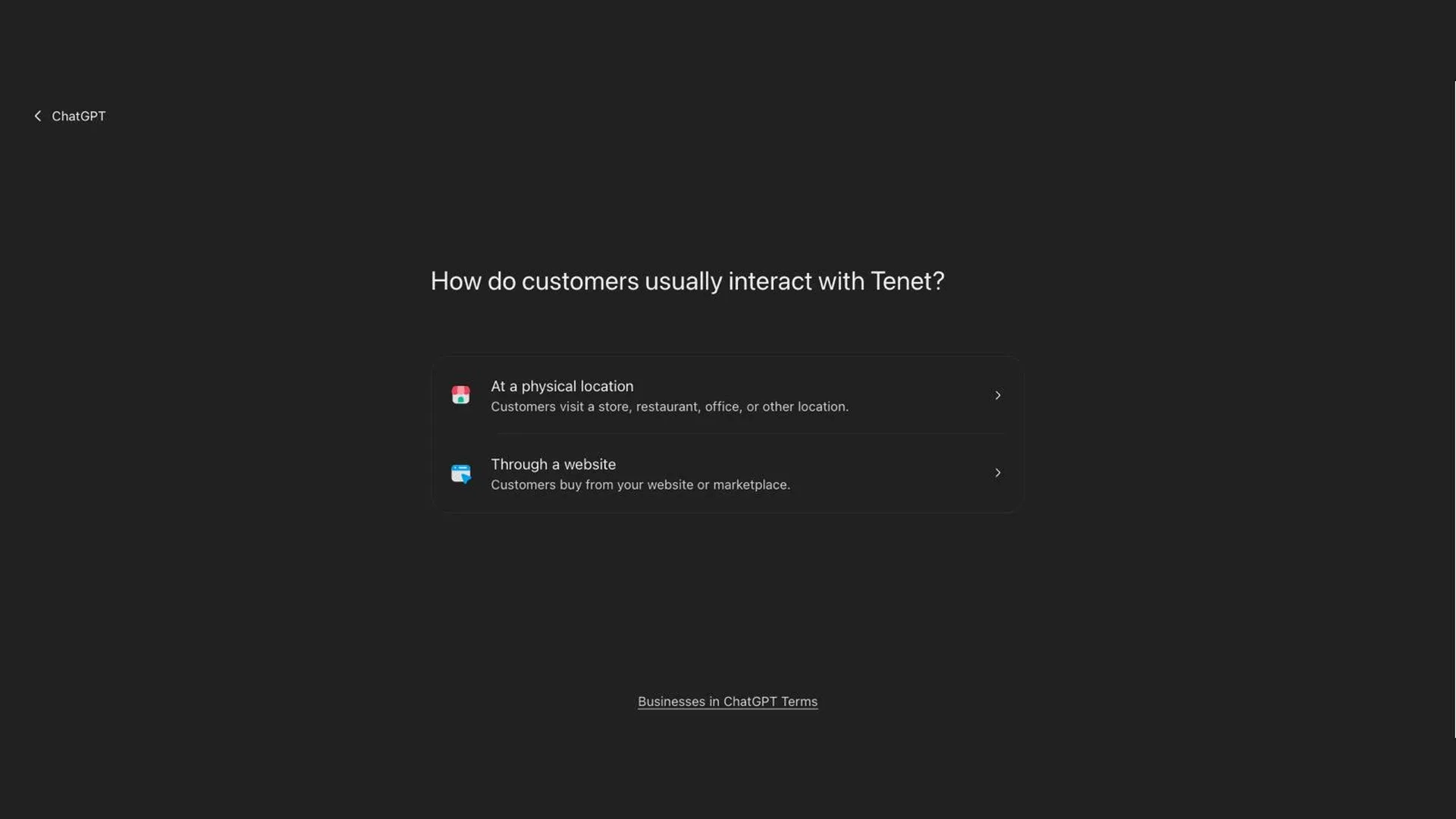
Image: the Businesses in ChatGPT setup flow, asking how customers interact with the business.
You then add the business website, and OpenAI reviews the profile before it goes live. Verification depends on the business type and location, and one route OpenAI documents is connecting a Shopify store. Local stores and restaurants can currently claim only an existing US listing.
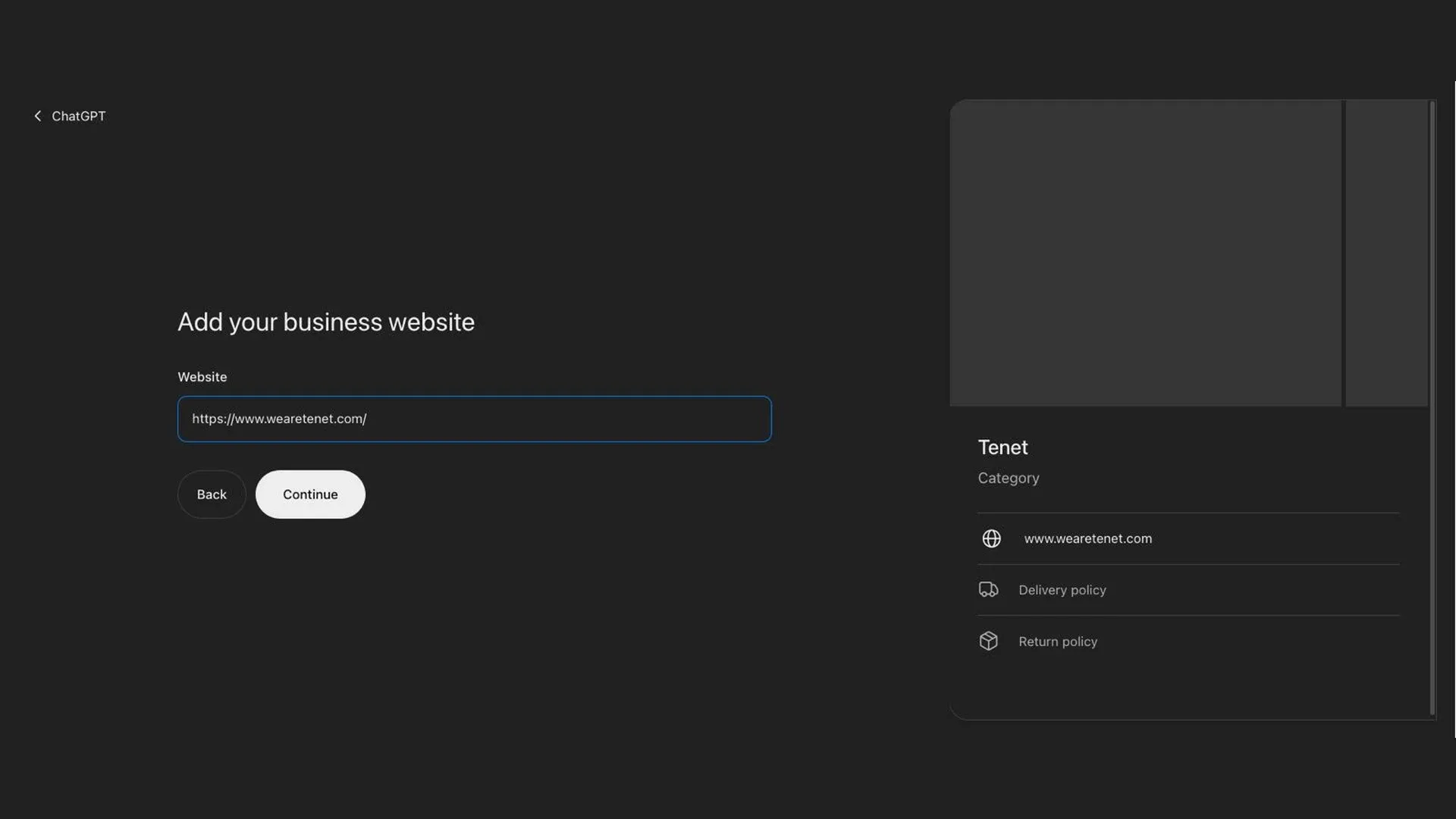
Image: adding a business website in the Business Hub setup flow.
Claiming a profile is free at launch. Benji Shomair, OpenAI's VP of monetization, did not rule out a paid model later, according to Digiday. For now, the cost of entry is a few minutes and a verified website.
Why this is a direct challenge to Google
Google Search Console has been the default measurement tool for website owners for more than fifteen years. It is where every SEO report starts. Business Hub is the first time a rival search surface has shipped its own equivalent, and it arrives at a moment when a growing share of questions are being asked in ChatGPT instead of Google.
That is what makes this a competitive move, not just a feature. OpenAI is building the measurement layer that turns AI search from a black box into a channel a business can track. Once a brand can count ChatGPT mentions and clicks in a dashboard, it can set targets, report on them, and justify spending on AI visibility in the same way it already does for Google.
What it does not do yet
Business Hub is a beta, and its reporting is narrower than a full Search Console. OpenAI does not share the prompts people typed, and it does not publish how often a question is asked. You see mentions, clicks, and discovery topics, not the exact queries behind them.
Claiming a profile also does not guarantee better placement or more sales. OpenAI has said ChatGPT will keep making its own recommendations, and a claimed profile does not buy a better answer. Business Agents are only available to eligible ecommerce and online service businesses in the United States for now, and local listings are limited to the US at launch. Metrics may be added, renamed, or reworked before a wider public release.
Why this matters
Until now, AI visibility was a black box. A brand could suspect ChatGPT was recommending its competitors, but it had no number to prove it and no dashboard to watch. Business Hub closes that gap. Mentions and clicks are now countable, which means AI search becomes a channel you can measure, report on, and invest in, rather than a curiosity you check by typing questions into ChatGPT yourself.
It also raises the stakes. If ChatGPT mentions your competitors and not you, that will now show up in a dashboard, not just in a one-off test. The brands that claim their profile early get the data first, and they get to fix wrong facts about their business before those facts shape what ChatGPT tells customers.
What this means for brands
Claim your profile now. It is free, it takes minutes, and it is the only way to correct the facts ChatGPT holds about your business. Then keep those facts current, because the profile is what the model draws on when it answers.
But a claimed profile alone will not make ChatGPT cite you. That still depends on whether your site is the clearest, most credible source for the questions people ask. That is the work of AI SEO: structuring content so large language models can find it, cite it, and summarise it accurately. If your customers are already asking ChatGPT instead of Google, our ChatGPT SEO services are built for exactly that shift, and our guide to LLM SEO explains how ranking in AI search engines actually works.
Do not drop Google Search Console. You now need both. Google still answers the majority of searches, and ChatGPT is the fastest growing second surface. The brands that win will be the ones visible in both, measured in both, and optimised for how each system chooses what to show. If you want a shortlist of specialists, our list of the best AI SEO agencies is a good place to start.
Frequently asked questions
Is Business Hub the same as Google Search Console?
No. Google Search Console shows how your pages appear in Google Search. Business Hub shows how your business appears inside ChatGPT conversations, with mentions, website clicks, and discovery topics. It is the closest equivalent for AI search, but it does not show the exact prompts people typed.
Is Business Hub free?
Yes, at launch. OpenAI has not ruled out charging later, but claiming a profile and seeing the dashboard costs nothing today.
Can any business claim a profile?
Any eligible business located where ChatGPT is available can claim its profile through Business Hub, so UK businesses do not have to wait. Eligibility depends on industry and location, and local stores and restaurants can currently claim only an existing US listing. Business Agents are only available to eligible ecommerce and online service businesses in the United States.
Does claiming a profile improve my ranking in ChatGPT?
No. OpenAI has said a claimed profile does not guarantee better placement or more sales, and ChatGPT keeps making its own recommendations. Claiming lets you correct your business facts and see your mentions and clicks, but visibility still depends on whether your content is the clearest source for the question being asked.
When did OpenAI launch Businesses in ChatGPT?
OpenAI officially launched Businesses in ChatGPT in beta on 10 November 2026. A screenshot of the feature was first shared on LinkedIn on 6 November, four days before the announcement.
Expertise Delivered Straight to Your Inbox
Expertise Delivered Straight to Your Inbox



Got an idea on your mind?
We’d love to hear about your brand, your visions, current challenges, even if you’re not sure what your next step is.
Let’s talk


