
How to Do Audience Research for SEO (5 Steps to Stand Out)
 By
By Share

Share

Get a quick blog summary with



Audience research for SEO should help you understand what your target audience needs, asks, struggles with, and wants to achieve.
Do not start by collecting keywords from SEO tools. Start by finding real conversations from real people and use those conversations to understand the topics that matter to your audience.
The process below gives you a practical way to build audience research before moving into keyword research.
TL;DR
- Don't start with SEO tools. Go read what real people are actually saying on Reddit, Quora, YouTube, forums, and reviews before you touch a keyword tool.
- Keyword tools tell you what people search for, not why they're searching. Real conversations give you that context.
- Once you understand the problems your audience actually has, use keyword research to check search volume and validate your ideas, not to build your whole strategy.
- To find those conversations, try Google searches like topic site:reddit.com, or use an audience research tool to speed things up.
- Collect the questions people ask in a simple spreadsheet (question, source, URL), then dig into the problem behind each one. AI tools can help you spot patterns, group questions by intent, and pull out the exact phrases your audience uses.
- End goal: a list connecting each question pattern to the intent behind it and the content page it should live on.
👉 Need help in planning and executing the SEO growth strategy? Explore our AI SEO Services Trusted by 60+ Brands Globally.
What Is Audience Research in SEO?
Audience research in SEO is about understanding the people you want to reach before you start picking keywords. You look at the questions they ask, the problems they face, and what they are actually trying to solve.
Instead of relying only on SEO tools, look at real conversations on Reddit, Quora, YouTube, forums, reviews, and other communities. This helps you see how people describe their problems in their own words. Once you understand what your audience cares about, you can use keyword research to check search demand, competition, and related queries.
Put simply, understand your audience first, then use keywords to find and validate search opportunities.
Why keyword research should not be the first step of your SEO journey
Keyword research is important, but it should not be where your SEO journey starts. If you open Ahrefs or Semrush first, you can easily build your strategy around whatever the tool shows you.
Instead, start by understanding your audience. Then use keyword data to validate and prioritize what you discover.
1. SEO tools do not show the full problem
Keyword tools can tell you what people search for, but they do not always tell you why they search for it. They cannot fully show the frustration, situation, concern, or goal behind a search. A real discussion on Reddit, Quora, YouTube, or a niche forum can give you much more context.
Start by finding the problems your audience talks about. Then use keyword research to find how those problems appear in search.
2. Everyone can find the same keywords
Your competitors have access to the same SEO tools you use. They can enter the same seed keywords, apply the same filters, and find many of the same opportunities. That is why relying only on keyword data can make your content strategy look very similar to everyone else's.
Real audience conversations can help you find questions and content angles that are not obvious from a standard keyword export.
3. Search volume does not always mean opportunity
A keyword with high search volume can look attractive, but that does not mean it will bring the right audience or generate business. A lower volume topic can sometimes be much more valuable if it addresses a specific problem that your business can solve.
Also, search volume data is not always reliable for local SEO. In many smaller or less searched regions, SEO tools may not have enough data, so a keyword may show very low or even zero search volume despite people actually searching for it.
So do not ask only, “How many people search for this?” Also ask, “Does this problem matter to the people we want to reach?”
Here’s how to start your audience research process for SEO?
Step 1. Find Where Your Audience Talks
Start by identifying the communities, forums, websites, and social platforms where your audience discusses your industry. Look for places where people ask questions, share experiences, discuss problems, compare solutions, and request recommendations.
We recommend starting with Quora and Reddit as a starting point to find what questions people are asking in your niche.
Search Communities With Google
Use Google search operators to search for your topic within a specific website. The basic format is: your topic site:community-domain.com
An example: productivity for founder site:quora.com
Replace the topic with your subject and the domain with a relevant community or forum, and try different variations of your topic to find a wider range of relevant discussions.
Try searches around:
- your topic site:reddit.com
- your topic site:quora.com
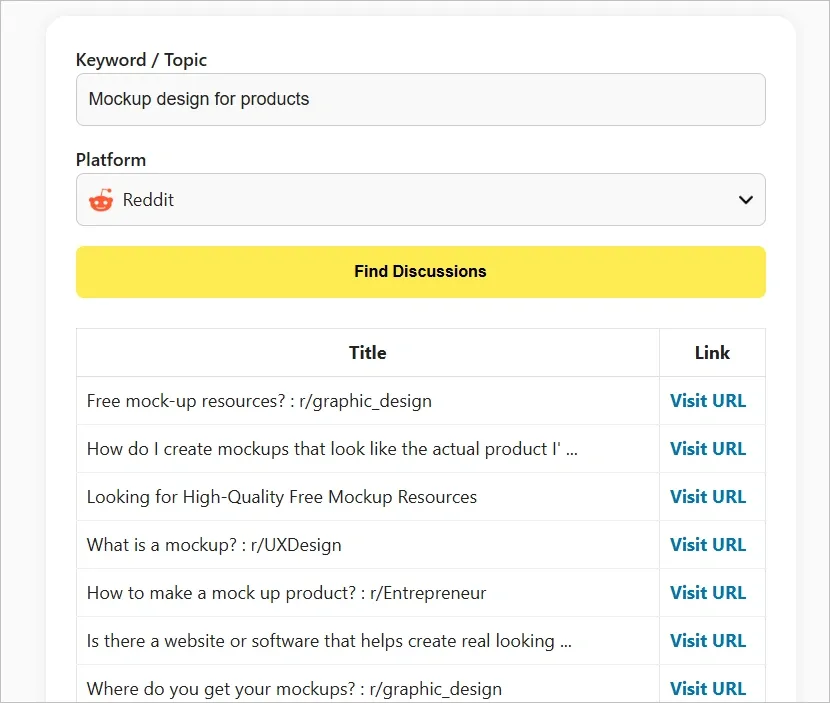
Or, use an audience research tool to find discussions faster
The audience research assistance tool helps SEOs and content writers find real questions, pain points, and discussions across platforms such as Reddit, Quora, LinkedIn, and other community sites.
You can enter your topic and use the results to discover how people discuss the subject, what problems they face, and what questions they are asking.
This can make the research process faster, especially when you want to explore several platforms without manually searching each one. You can then use the questions and discussions you find as inputs for your content research and keyword validation.
Here’s how you can quickly find useful Reddit communities with questions about your product offerings:
Step 2. Collect Real Questions From Real People
Now start collecting the questions you find. Do not focus only on questions that contain obvious keywords. Look for questions that reveal a problem, concern, decision, or information gap.
Read the discussion around each question when possible. The question itself may tell you what someone wants to know, while the answers and comments can reveal why the question matters. Then either manually or use AI to record useful questions in a spreadsheet so you can analyze them later.
How to speed up question extraction from Reddit and Quora
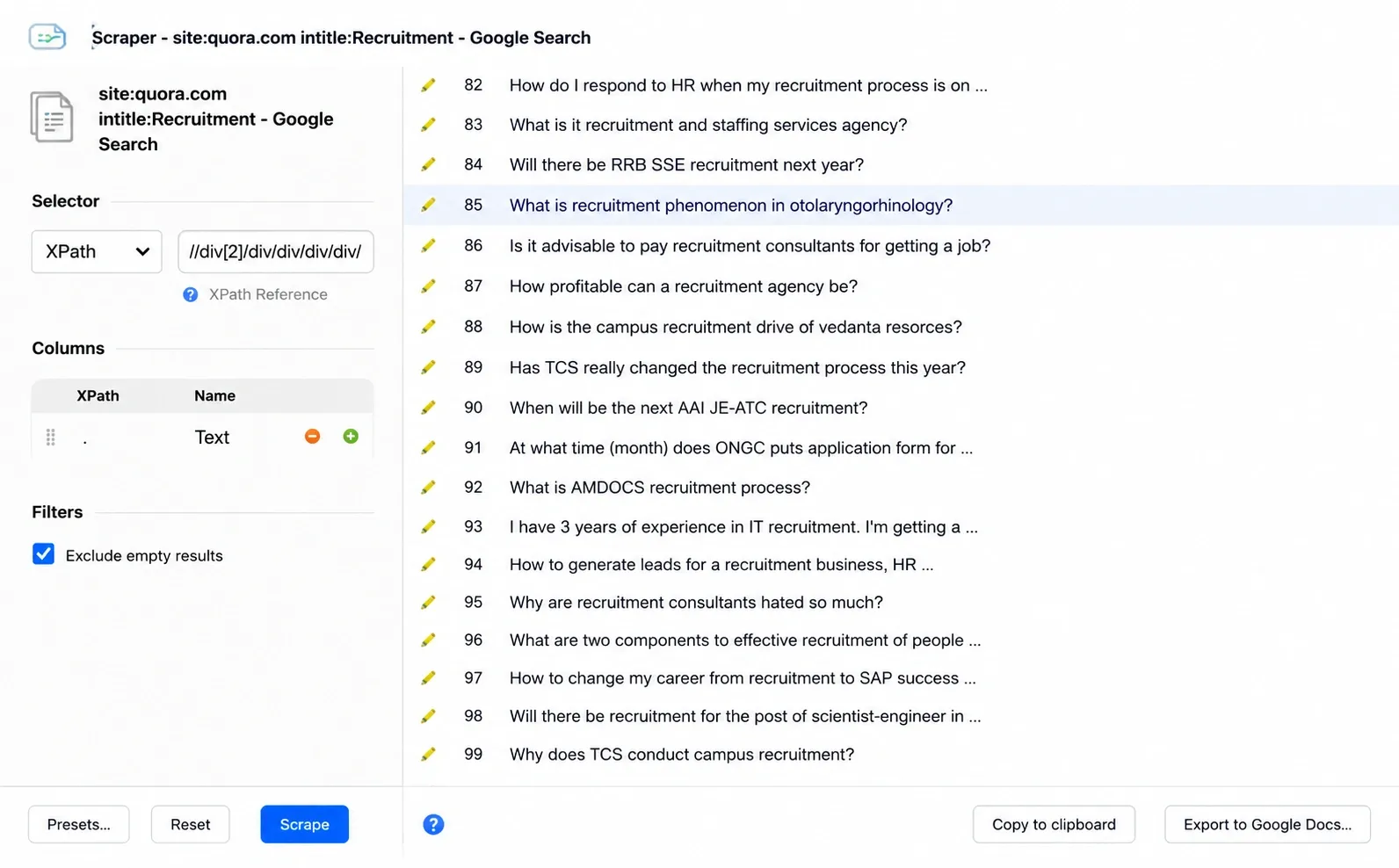
Go to Reddit or Quora and search for your topic. Scroll through the page to load as many questions as possible. Once the page has loaded enough questions, use a Scraper Chrome extension to extract them all at once instead of copying them manually.
Step 3. Create an Audience Research Spreadsheet
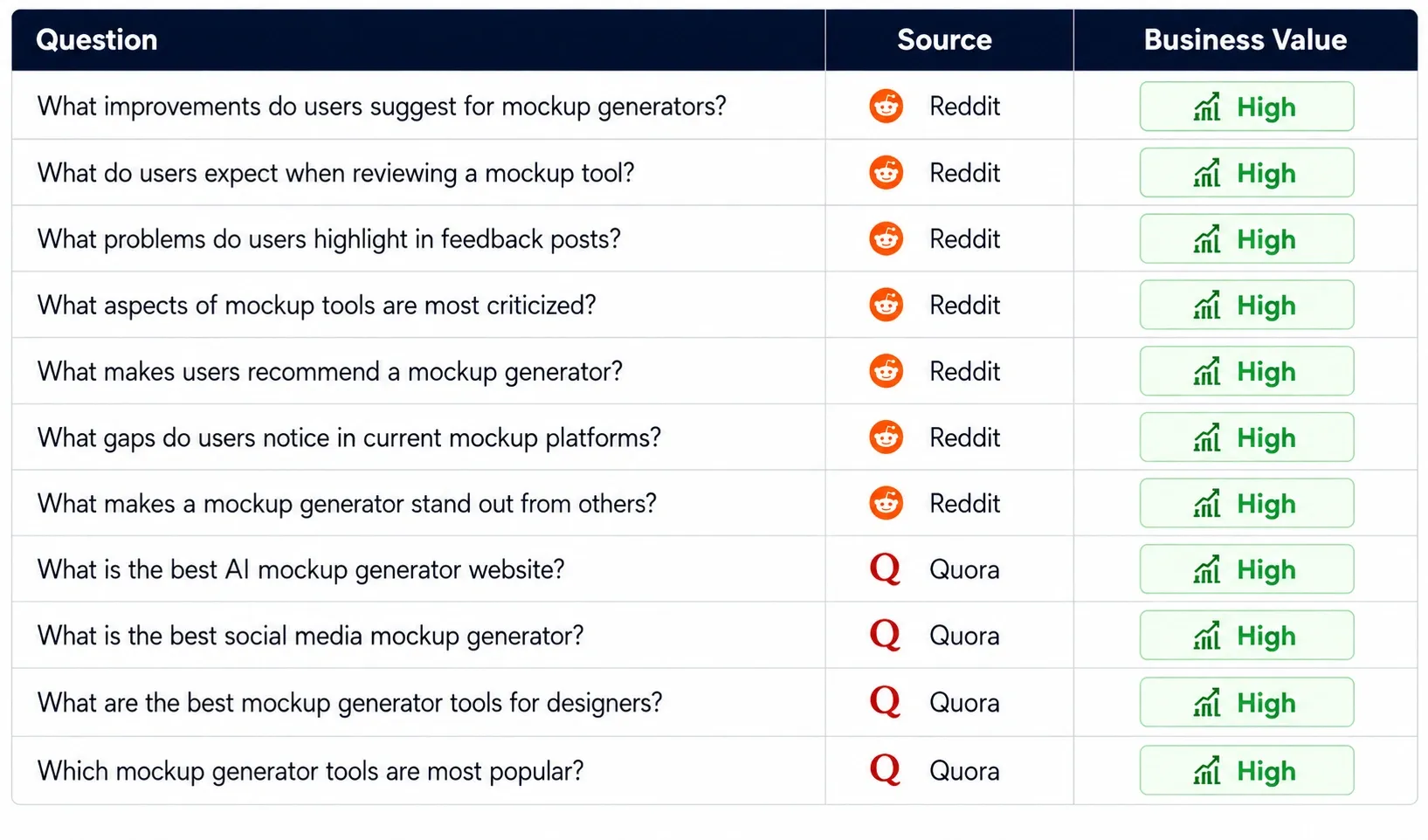
Create a simple spreadsheet to organize everything you find. Start with the question, source, and URL. You can add the problem and topic after reviewing enough questions to identify patterns.
Here’s how we have tracked audience research questions for our SEO clients:
Step 4. Identify the Problem Behind the Question
A question can reveal more than a potential keyword. Ask what problem caused the person to ask that question. Look at the situation behind the question, what the person is trying to achieve, what is stopping them, and what information they need to make progress.
You can also use ChatGPT to get an understanding of the core problem behind each question:
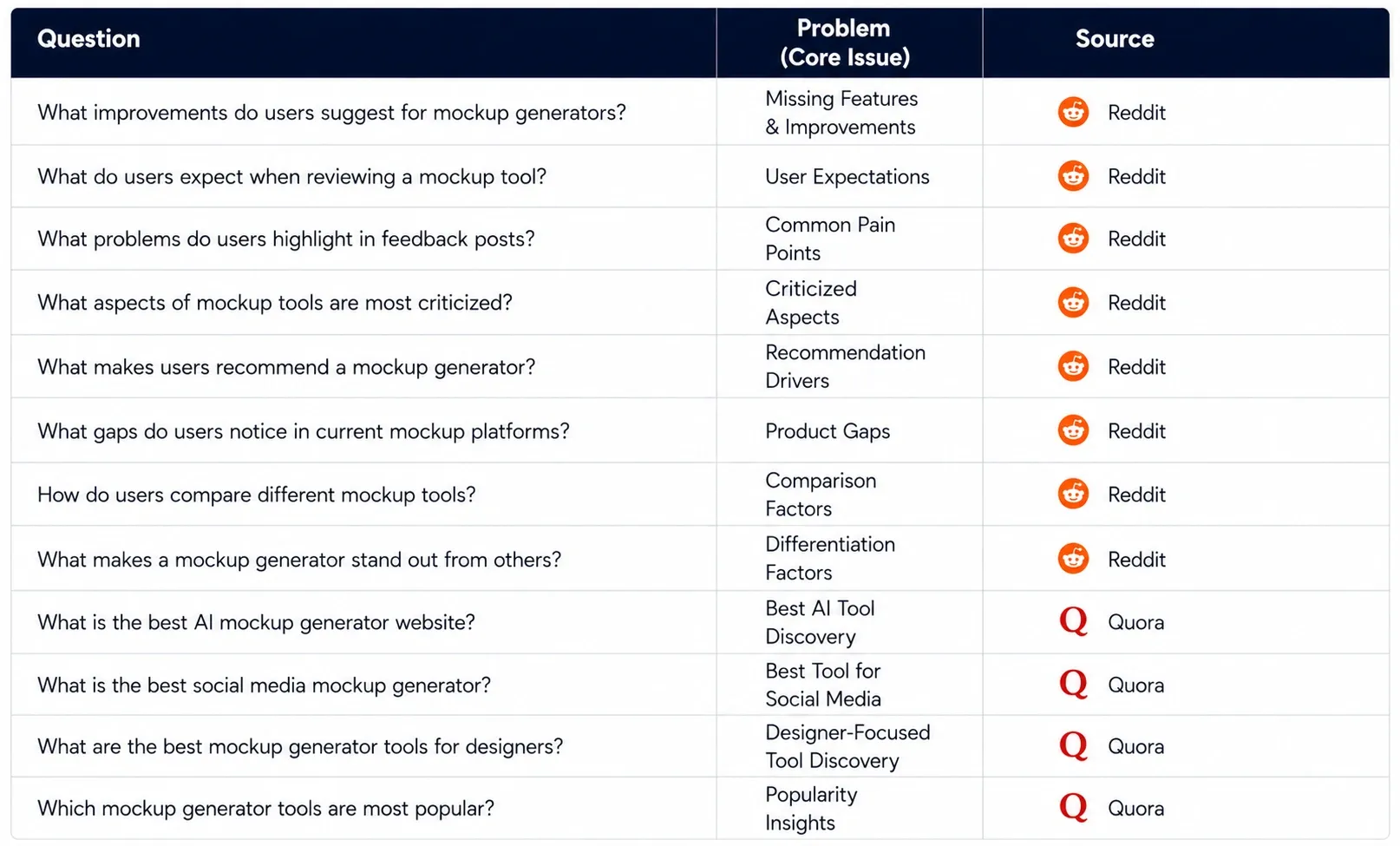
This gives you a deeper understanding of the audience and helps you create content that addresses the actual need rather than simply matching a search phrase.
👉 RELEVANT READ: LLM SEO: How to Rank Your Website in AI Search Engines
Step 5. Find patterns and audience insights from the list using AI
Run your full set of collected questions through an AI tool and ask it to group them by intent, like informational, comparison, troubleshooting, or pricing. This shows you which types of questions come up most often, so you know where your audience's attention actually is.
Next, have the AI pull out the phrasing patterns that keep repeating, things like "how to [x] without [y]" or "best [x] for [y]." These patterns turn into keyword templates you can reuse again and again to come up with new titles and content ideas, instead of starting from a blank page every time.
👉 Here’s a real audience research analysis document we have created as a sample:
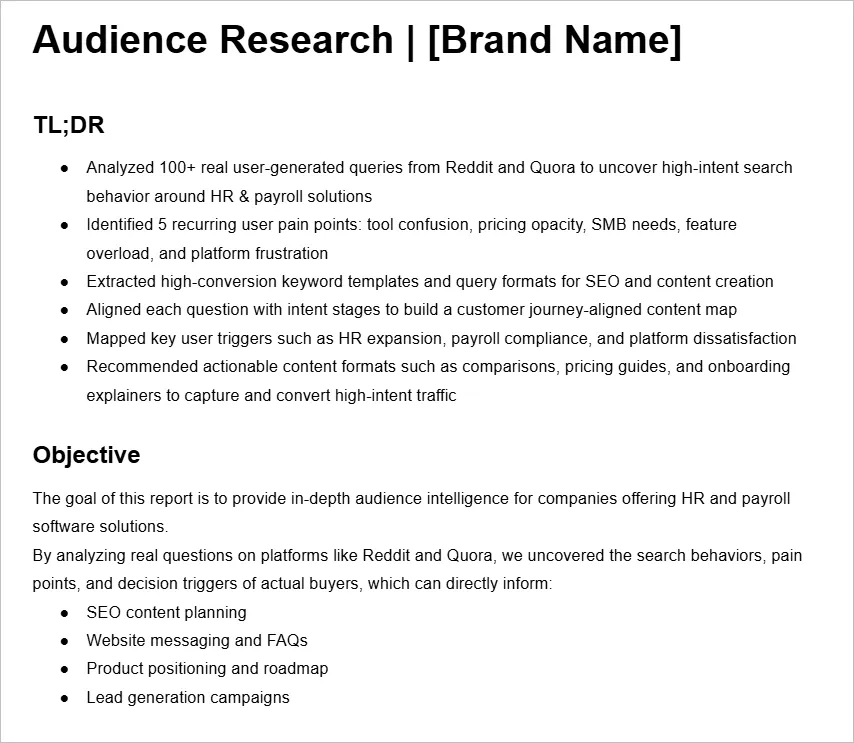
- Audience Research Analysis Document (Free Download →)
It also helps to ask the AI to flag the exact words your audience uses, since these are often different from the terms your team uses day to day. Speaking your audience's language, not your internal language, is what actually moves the needle on both search rankings and how much people connect with what you write.
Last, map each cluster of questions to a specific page or article idea. Note which ones your existing content already covers well and which ones are still wide open. What you end up with is a simple, practical list: a keyword template, the intent behind it, and the content page it should live on.
Final words
Once you start building content around what people are actually asking, instead of what a keyword tool guesses they're searching for, your content will stand out from competitors. If you'd rather not run this whole process yourself, that's where we come in.
At Tenet, we've generated 30M+ in cumulative organic traffic and $12M+ worth of leads for our clients by building content strategies on exactly this kind of research.
We help brands turn scattered Reddit threads and forum posts into an actual content and AI SEO strategy, one built to get your brand recommended when people ask ChatGPT, Perplexity, or Google AI Overviews for answers, not just ranked on page one.
If that's the direction you want to take your SEO strategy, get in touch with our team and we'll walk you through it.
👉 Request a Custom SEO Proposal from our experts
Get Expert Help Turning Audience Insights Into SEO Growth
Get Expert Help Turning Audience Insights Into SEO Growth


















Got an idea on your mind?
We’d love to hear about your brand, your visions, current challenges, even if you’re not sure what your next step is.
Let’s talk


