
AI Generated Content in 2026: What Marketers Need to Know
 By
Share

Share
Get a quick blog summary with



AI-generated content is changing how businesses create, publish, and distribute content.
From blog articles and images to videos, podcasts, and interactive tools, AI offers marketers new ways to reach audiences.
- But how much of this content do people actually consume?
- Can AI-generated content rank on Google?
- And how can businesses use AI without compromising quality?
Let’s explore the different types, real-world examples, research findings, and best practices for creating useful AI content.
What is AI-generated content?
AI-generated content refers to any material that an artificial intelligence system creates or helps create. It can include text, images, videos, audio, music, code, 3D models, and other digital formats.
Generative AI models learn patterns from large datasets and use that knowledge to produce new outputs based on user instructions, reference materials, or other inputs.
AI-generated content does not always mean that a machine creates the entire output without human involvement. A marketer may write the first draft, use AI to improve it, and then edit the final version. Another creator may generate an entire video using AI tools and review it before publishing.
Both examples involve AI-generated content, but the level of human involvement differs.
You can divide AI content production into three common approaches:
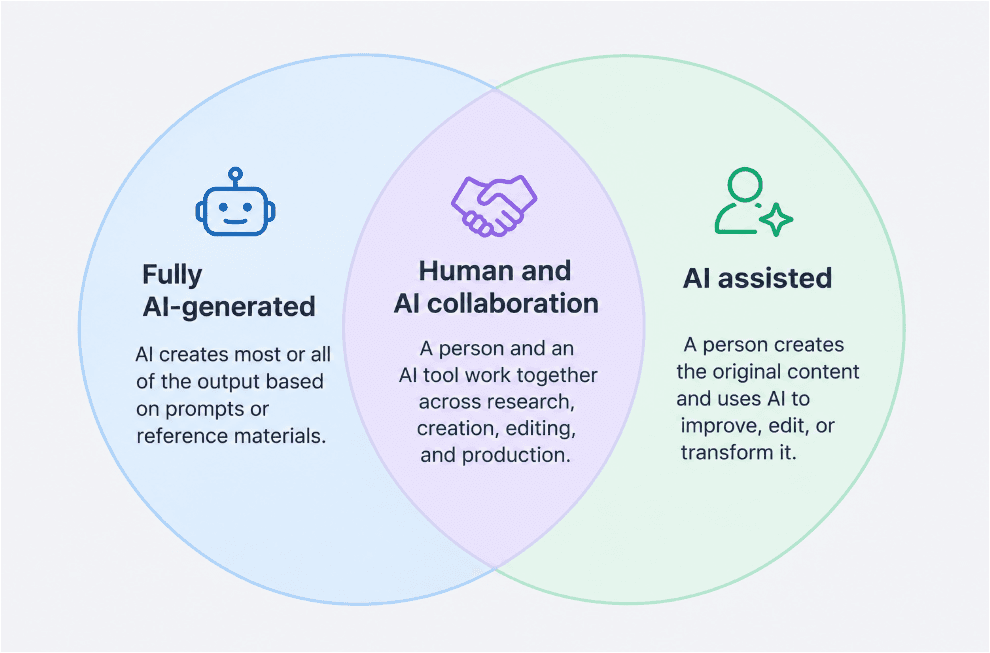
- Fully AI-generated: AI creates most or all of the output based on prompts or reference materials.
- AI-assisted: A person creates the original content and uses AI to improve, edit, or transform it.
- Human and AI collaboration: A person and an AI tool work together across research, creation, editing, and production.
If you want to scale your AI SEO and are not sure where to start? Request a free AI visibility audit, and our team will assist you.
Do people consume AI-generated content?
Yes, people already consume AI-generated content across websites, social media, streaming platforms, advertisements, and digital products. However, their willingness to consume it depends on the content format, its purpose, quality, and how much they trust its source.
One interesting example comes from Deezer, the music streaming platform.
According to Deezer's July 2026 report, the platform received around 90,000 fully AI generated tracks per day in June 2026. These tracks accounted for more than half of new music deliveries on peak days. However, they represented only around 1% to 3% of total streams.
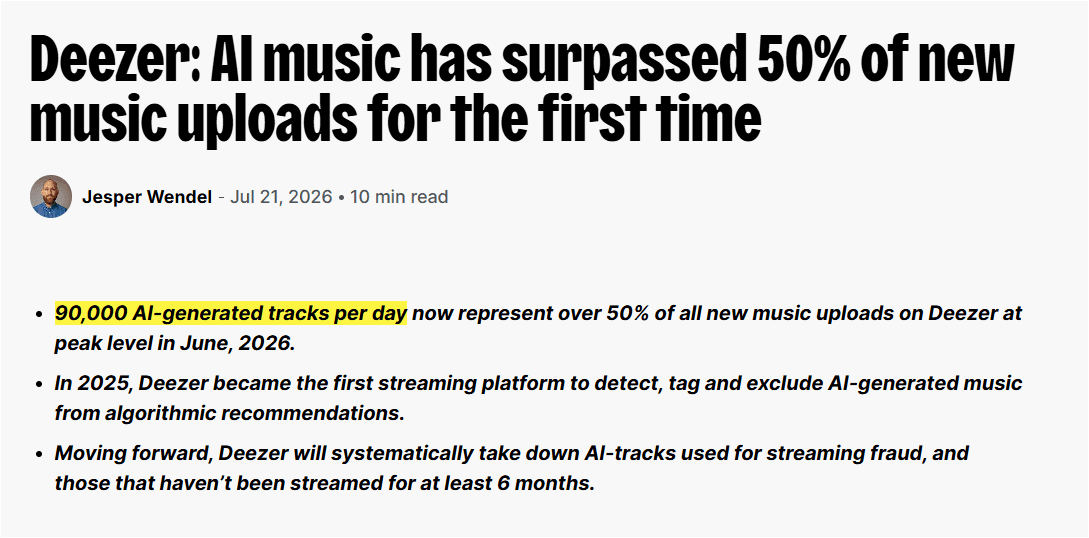
This shows an important difference between content production and content consumption. A platform can receive a large volume of AI-generated content without users consuming it at the same rate.
The same report shared findings from a survey conducted by Ipsos. In a blind test, 97% of participants could not distinguish fully AI generated songs from human made songs. At the same time, 80% wanted AI generated music to carry a clear label.
Another example comes from news consumption.
The Reuters Institute's 2025 Generative AI and News Report studied public attitudes towards news created with different levels of AI involvement. Across six countries, the research found these comfort levels:
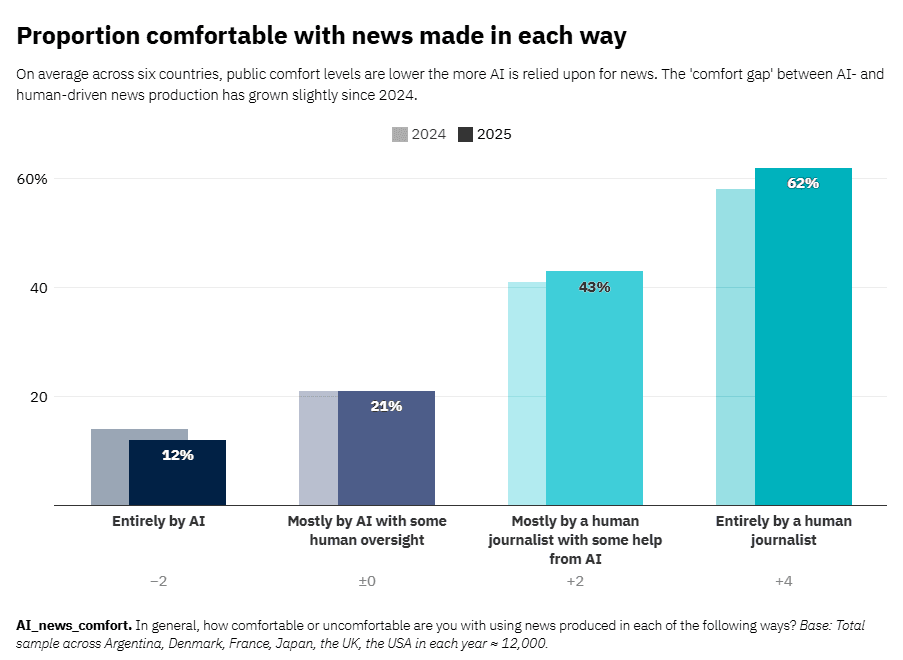
These findings highlight two important points.
First, people may consume AI-generated content without recognizing that AI created it. Second, knowing that content is AI-generated can influence how people perceive and trust it.
How people consume AI-generated content in 2026
- AI content is already part of search. 57% of people saw AI-generated answers or summaries in search in the past week. (Reuters Institute)
- Chatbot use is becoming a weekly habit. 51% use chatbots weekly, while daily use increased from 7% in 2024 to 28% in 2026. (Reuters Institute)
- People use AI more for information than news. 38% used AI to find information in the past week, compared with just 9% who used it for news. (Reuters Institute)
- AI summaries reduce clicks on search results. Users clicked regular Google results 8% of the time when an AI summary appeared, compared with 15% without one. (Pew Research Center)
- People want brands to disclose AI use. 86% believe AI generated content should be labelled, while 32% say AI use makes them trust a brand less. (Meltwater and YouGov)
- People are getting tired of low quality AI content. 56% often or very often see AI slop on social media. Half of Gen Z have unfollowed, muted, or blocked someone for posting it. (Sprout Social)
- AI videos can affect brand trust. 83% have watched a video they suspected was AI generated, and 36% say such videos reduce their trust in the brand. (Animoto)
- Knowing content is AI generated can reduce engagement. 36% of Americans are less likely to engage with content once they know AI created it. Only 14% say they become more interested. (Menlo Ventures)
- Undisclosed AI advertising can damage trust. 74% of US consumers believe brands should disclose AI use in ads, while 44% say undisclosed AI ads would reduce their trust. (Cint)
- People may prefer AI content until they know it is AI. A 2024 Bynder study found that 56% preferred the AI-written article in a blind test, but 52% felt less engaged after learning AI had created it. (MarTech)
👉 Download Our LLM SEO Checklist For AI Visibility (PDF)
What are the different types of AI-generated content?
AI can generate content in several formats. The technology is no longer limited to text and image generation. It can also create audio, video, interactive experiences, digital personalities, and 3D assets.
Here are the main types of AI-generated content and how businesses use them.
1. AI-generated text
AI-generated text is one of the most common forms of generative AI content. Tools such as ChatGPT, Claude, and Gemini can generate written material based on prompts and reference documents.
Common examples include:
- Blog articles and website content.
- Product descriptions and service pages.
- Social media posts and captions.
- Marketing emails and newsletters.
- Research summaries and reports.
- Advertising copy and landing page content.
- Scripts for podcasts and videos.
For example, an ecommerce business can use ChatGPT to create product descriptions for hundreds of products. A content marketer can also provide an existing article and ask AI to improve its readability, identify missing information, or suggest a better structure.
However, AI-generated text still needs human review. It can produce inaccurate information, generic explanations, and unsupported claims.
Here’s an example of a completely AI-written article:
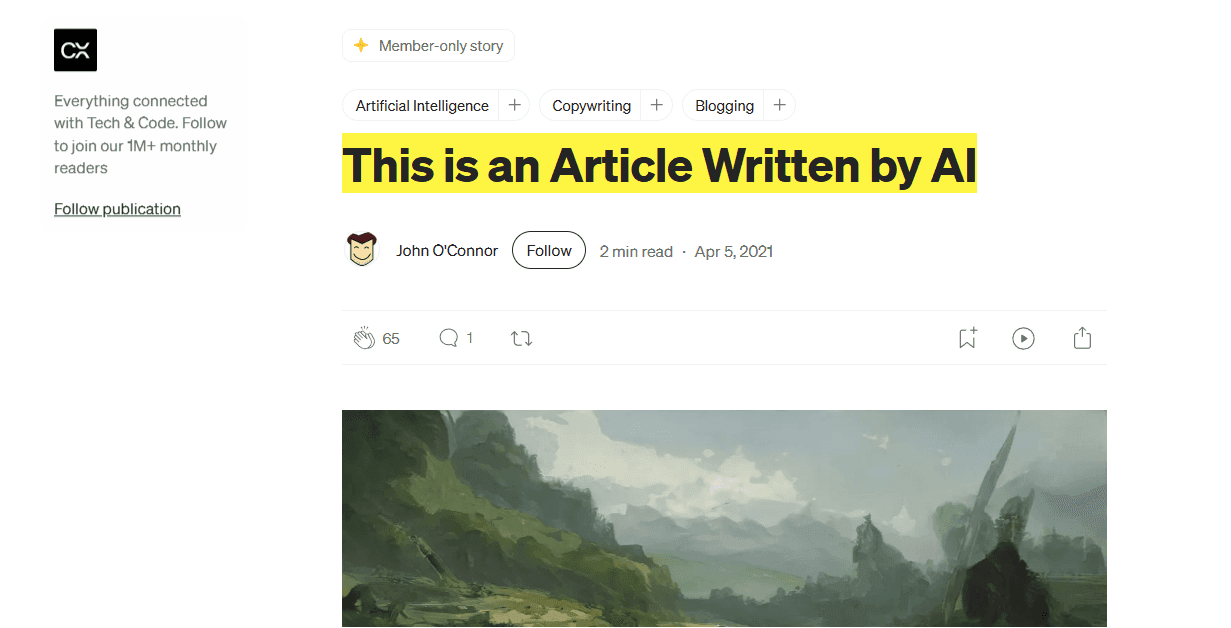
2. AI-generated images and graphics
AI image generation tools create visuals based on text prompts, reference images, or other instructions.
Tools such as Adobe Firefly, Midjourney, and even ChatGPT can generate different types of images for marketing, design, and publishing.
One example:
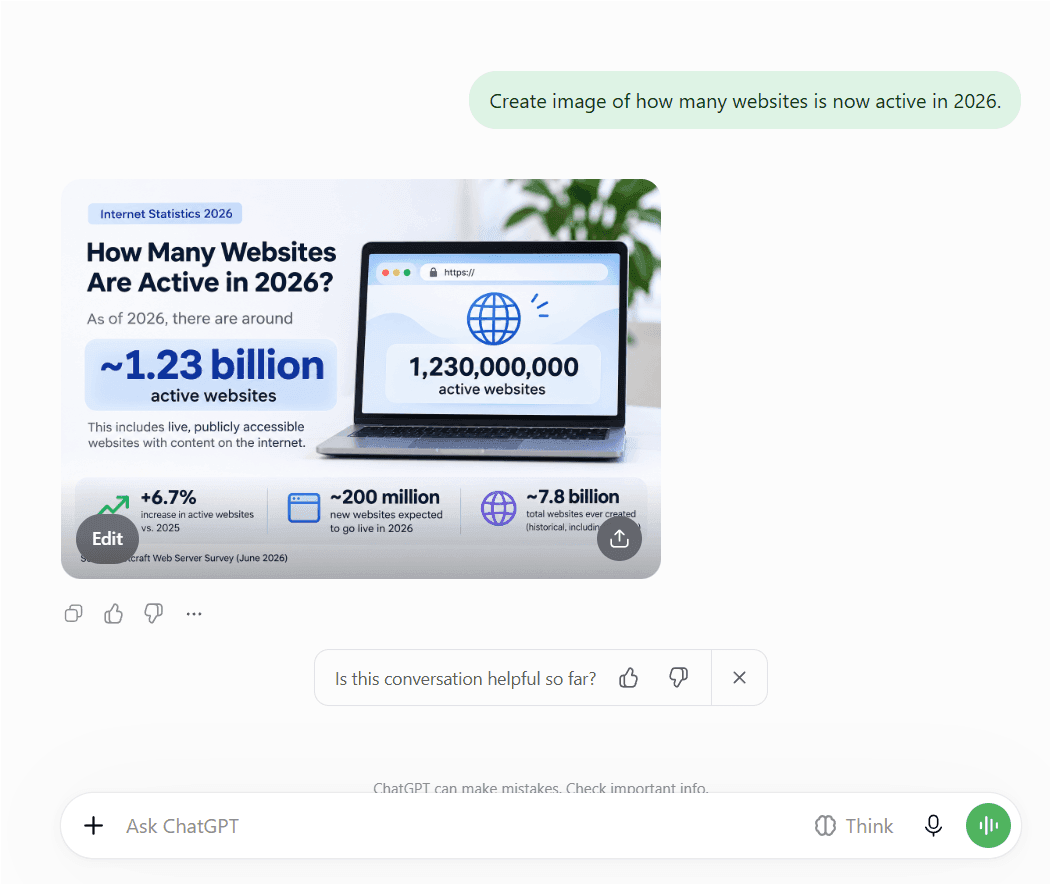
Common image types include:
- Product photography.
- Illustrations and digital artwork.
- Website banners and hero images.
- Social media creatives.
- Advertising visuals.
- Infographics and concept designs.
- Backgrounds and promotional graphics.
For example, an ecommerce brand can generate product images with different backgrounds and settings without arranging a separate photoshoot for every variation.
3. AI generated videos and animations
AI video generation tools can create videos from text prompts, images, and existing video references.
Businesses can use these tools to create marketing videos, advertisements, product demonstrations, animations, and visual explainers. In fact, a few months ago, Higgsfield AI created an entire AI action series and published it on YouTube, which received 2M+ views across the globe.
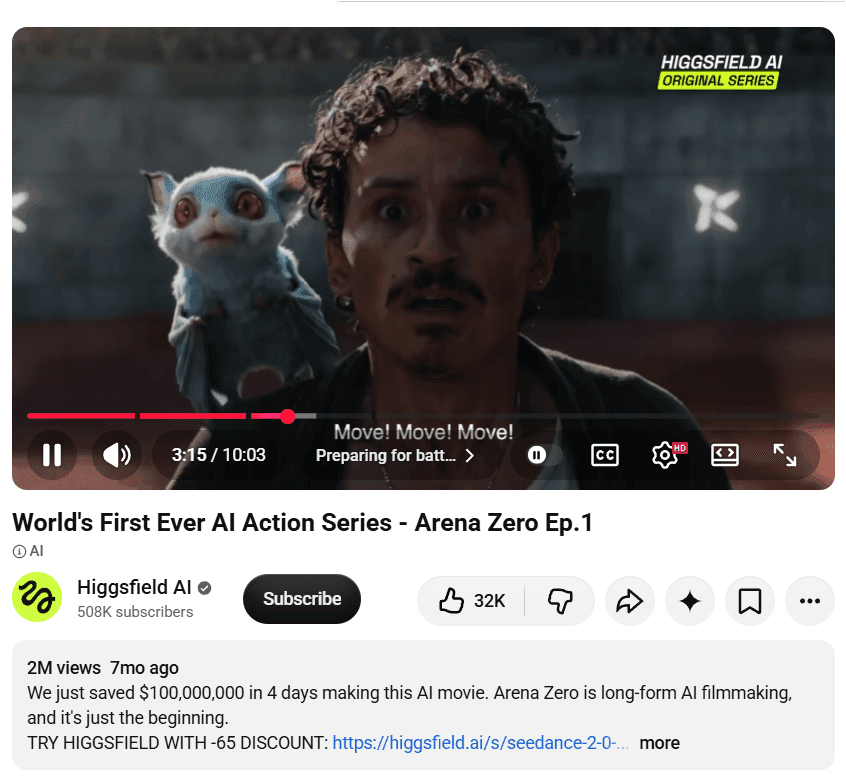
Some AI-generated video content examples include:
- Product advertisements.
- Short form social media videos.
- Explainer videos.
- Cinematic scenes.
- Animated stories.
- Virtual presenter videos.
- Product demonstrations.
For example, a marketing team can provide an image of a product and use an AI video tool to generate a short promotional clip. The team can then add a voiceover, captions, music, and branding before publishing it.
4. AI generated audio and music
AI can generate speech, music, voiceovers, sound effects, and podcast style conversations.
Tools such as ElevenLabs and Suno help creators produce synthetic voices and music. NotebookLM can turn source documents into audio discussions.
Common applications include:
- Podcast production.
- Audiobooks.
- Marketing voiceovers.
- AI generated music.
- Video narration.
- Multilingual dubbing.
- Audio summaries of research documents.
For example, a content team can upload a research report to NotebookLM and generate an Audio Overview. Instead of reading the complete report, users can listen to an AI generated discussion of its main points.
[Add screenshot: NotebookLM Studio showing the Audio Overview option and generated audio player.]
Official guide: Create an Audio Overview in NotebookLM
5. AI generated interactive content
AI can also help create content that users can interact with instead of simply reading or watching it.
This includes:
- AI chatbots.
- Interactive calculators.
- Personalized quizzes.
- Conversational research assistants.
- Interactive reports.
- Educational simulations.
- Product recommendation tools.
For example, our tech team created a bunch of helpful AI-assisted marketing tools, and the AI landing page analyzer is one of them:
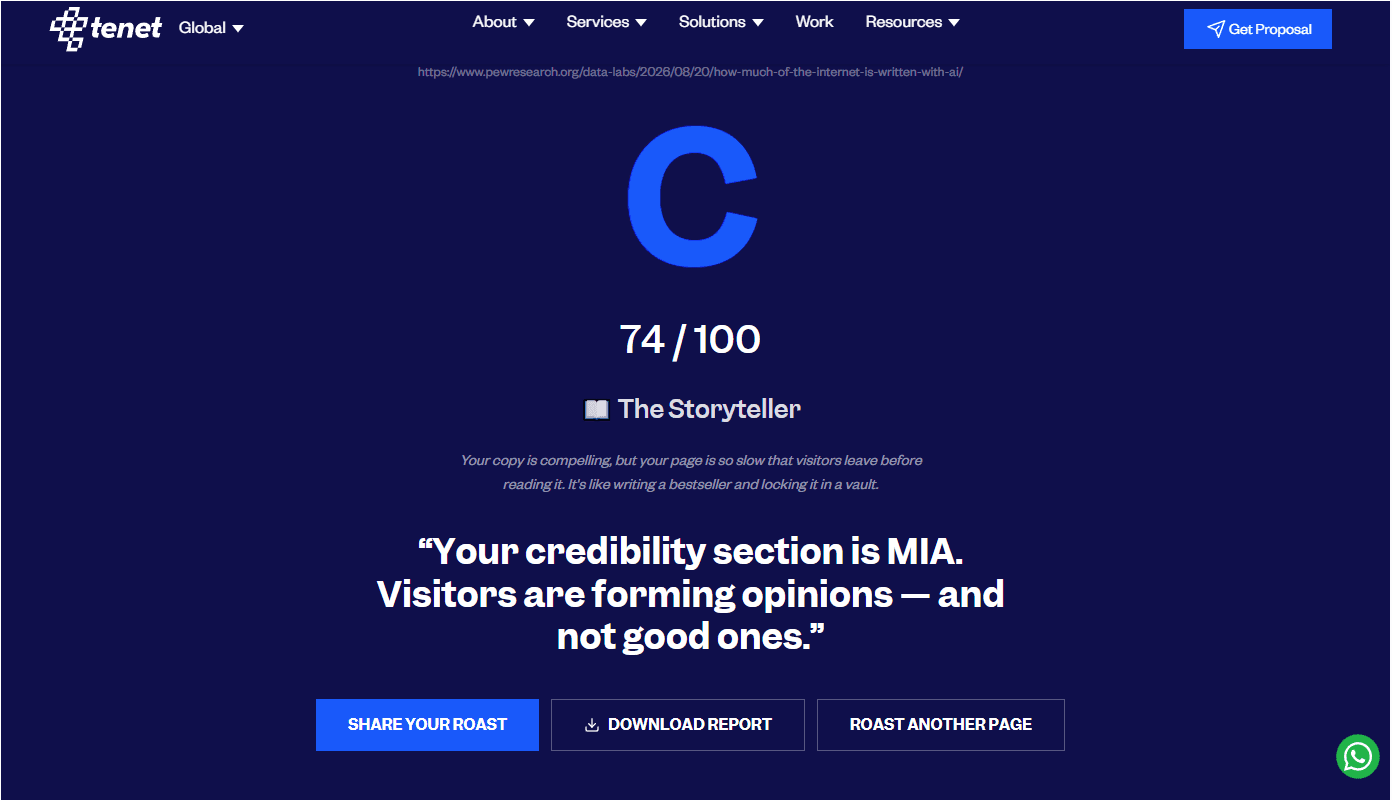
How are marketers using AI generated content?
Marketers use AI generated content to produce more assets, reduce manual work, and adapt content for different channels. They use it across the content production process, from research and ideation to writing, design, and distribution.
According to HubSpot's 2026 State of AI in Marketing report, which surveyed 1,754 marketers, 80% use AI for content creation and 75% use it for media production.
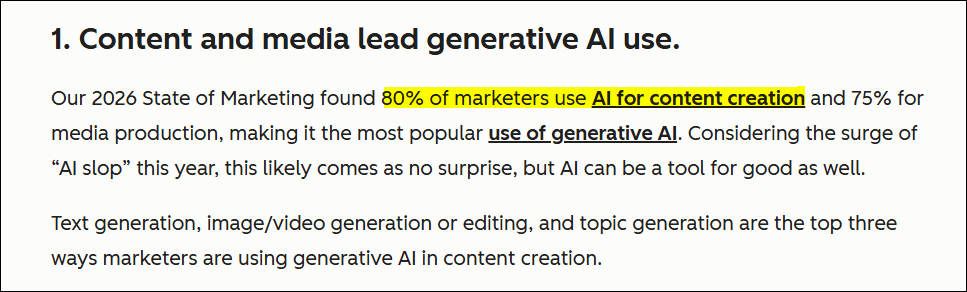
Here are some common ways marketers use AI-generated content.
1. Creating blog posts and website content
Content teams use AI tools to research topics, build outlines, prepare first drafts, write product descriptions, and improve existing articles.
For example, an SEO team can provide a target keyword, search intent, competitor pages, and reference documents to an AI tool. It can then generate a content outline or first draft for the writer to review.
However, publishing the first AI response without checking its accuracy, originality, and usefulness can lead to generic content. Writers should add expert insights, original examples, research, and brand knowledge before publishing.
2. Creating marketing images and advertisements
Marketing teams use AI image tools to create campaign visuals, social media creatives, product images, and website banners.
For example, an ecommerce brand can generate different versions of an advertisement for different customer groups. It can test different backgrounds, product settings, and visual styles without creating every asset from scratch.
3. Producing videos for marketing campaigns
AI video tools help marketers create product explainers, advertisements, social media videos, and training content.
For example, a SaaS company can turn a product feature list into a short explainer video. It can also create a virtual presenter to explain product features in different languages.
Tools such as HeyGen and Synthesia support video production with AI avatars and synthetic voices.
4. Creating social media content
Social media teams use AI to create captions, post ideas, short videos, carousels, and content variations.
For example, a brand can turn one long blog article into several LinkedIn posts, Instagram captions, and short video scripts.
The team still needs to review each version to ensure that the message fits the platform and sounds like the brand.
5. Creating podcasts and audio content
Marketers can turn reports, interviews, articles, and research documents into audio content.
For example, a company can use NotebookLM to create an audio summary of a research report. It can then share the audio with people who prefer listening to reading.
This gives brands another way to distribute existing information without creating an entirely new research asset.
6. Personalizing content for different audiences
AI helps marketers adapt content for different locations, languages, customer groups, and stages of the buying process.
For example, an insurance company can create different versions of a landing page for first time buyers, business owners, and existing customers. Each version can focus on the needs and questions of that audience.
Marketers should still check the claims, offers, and local details in every version before publishing.
7. Repurposing existing content
Marketers can use AI to convert one content asset into several formats.
For example, a research report can become:
- A blog article.
- A LinkedIn post.
- An infographic.
- A short video script.
- A podcast discussion.
- An email newsletter.
This helps teams distribute their research across more channels. However, each format should offer a useful experience rather than simply repeating the same information.
Can AI-generated content rank on Google?
Yes, AI-generated content can rank on Google. Google does not ban content simply because a business uses AI to create it.
In its February 2023 guidance on AI-generated content, Google explained that its ranking systems focus on the quality of content rather than how someone produces it.
In fact, Google mentioned that appropriate use fo AI-made content is not against the policies ro guidelines:

The Google document also states that content should be judged based on its quality, helpfulness, and accuracy rather than how it is produced.
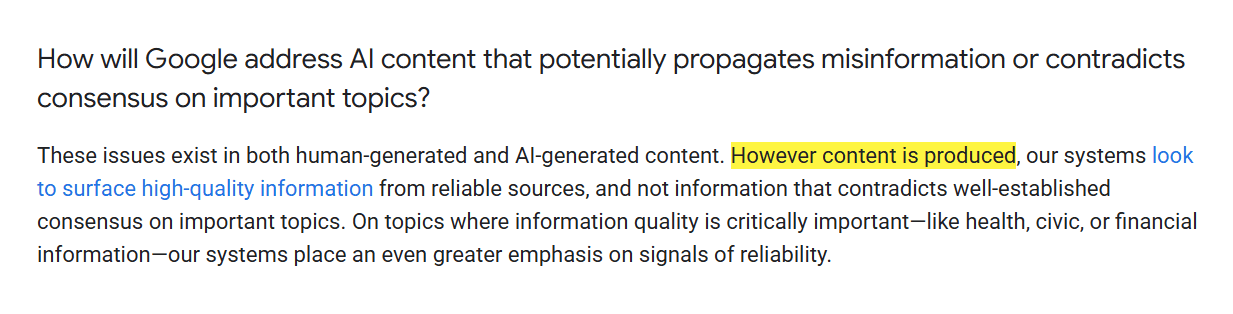
This means AI-generated content can rank if it provides useful, original, accurate, and relevant information. However, using AI to produce large amounts of low value content just to influence search rankings can violate Google's spam policies.
What do studies say about AI content rankings?
1. Semrush study: Human-written content appeared more often at the top
In its April 2026 study, Semrush analyzed 42,000 blog pages associated with 20,000 keywords.
The study used GPTZero to classify pages as human written, AI generated, or mixed. It found that human written content appeared in the number one position around 80% of the time, compared with around 9% for purely AI generated content.
The study also surveyed 224 SEO professionals. It found that 64% used a human led, AI assisted workflow, while 87% said their content was either fully human created or heavily led by humans.
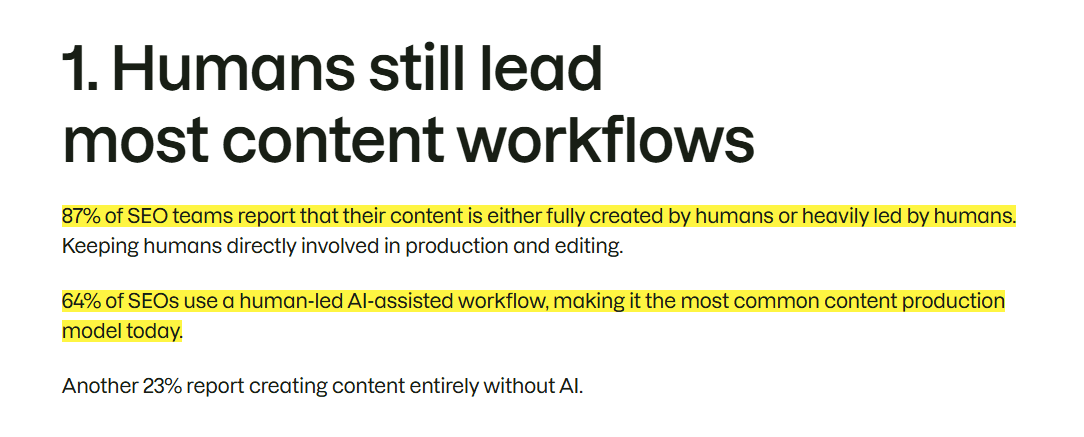
However, this research has limitations. It used an AI detection tool to classify pages, and detection tools can make mistakes. It also studied the content that appeared in search results rather than testing whether AI involvement caused a ranking change.
2. Ahrefs study: AI involvement showed almost no correlation with rankings
Ahrefs analyzed around 600,000 pages from the top 20 search results for 100,000 keywords.
The study reported a correlation of 0.011 between the estimated percentage of AI generated text and Google ranking position. This is close to zero.
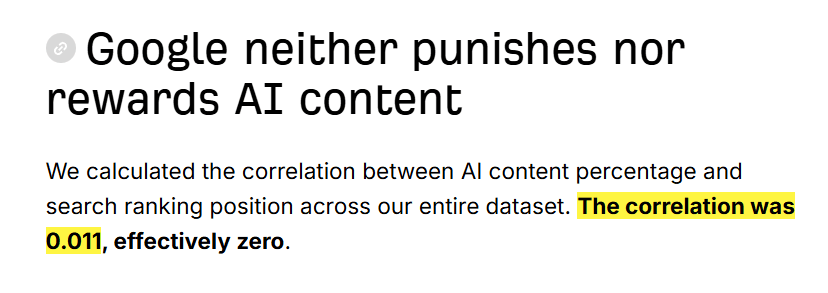
The finding suggests that the amount of AI generated text on a page does not have a clear relationship with its ranking position.
However, correlation does not prove that AI content performs equally well in every situation. The study does not show that using AI improves rankings either.
3. Reboot Online experiment: Human written pages performed better in a small test
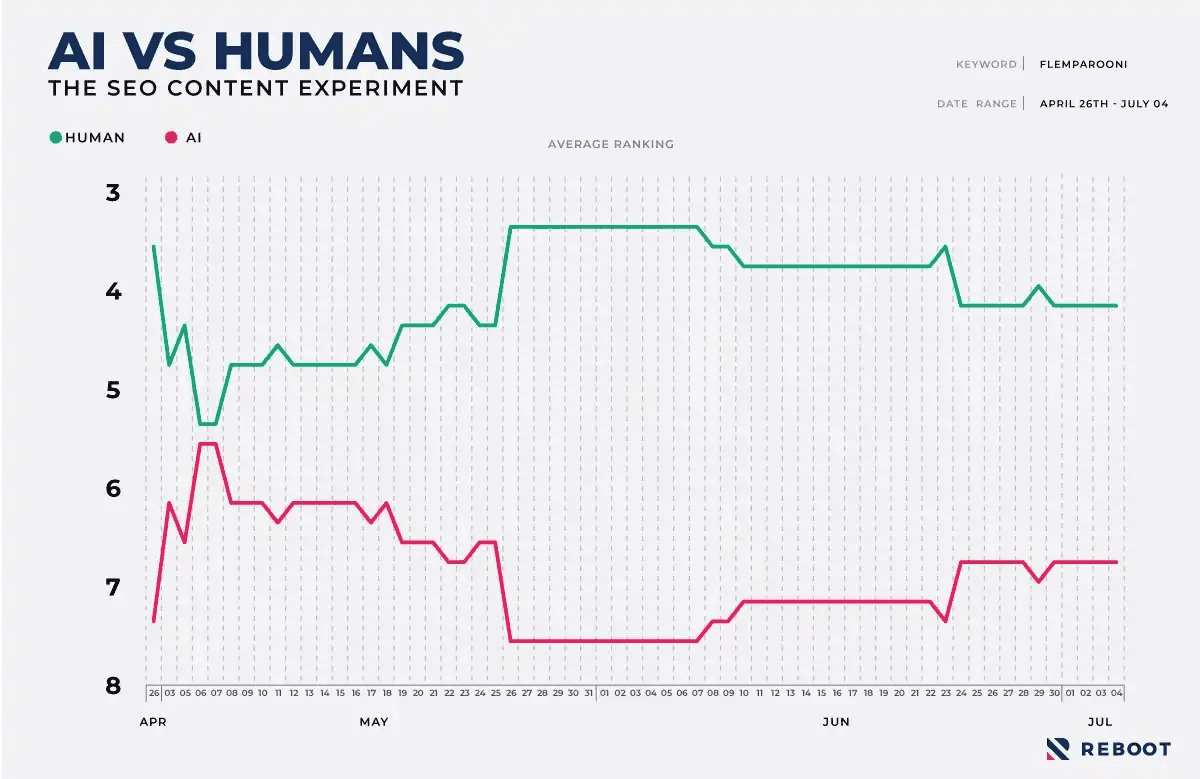
Reboot Online conducted a controlled experiment using ten new websites. Researchers published five human written pages and five pages generated with GPT 4.
The experiment used an artificial keyword to compare their rankings. The human written pages achieved an average ranking position of 4.4, while the AI generated pages averaged 6.6.
This experiment suggests that human editing and expertise may improve content performance. However, the sample was very small, and the results do not represent every website, keyword, or AI tool.
Google's guidelines for AI generated content
Google's position on AI generated content is based on a simple principle: create helpful content for people, not pages just to manipulate search rankings.
Here are the main guidelines website owners and content teams should follow.
1. Focus on content quality, not the production method
Google does not automatically treat AI generated content as spam. It evaluates whether content provides useful information and meets its quality standards.
In its official AI content guidance, Google states that appropriate use of AI and automation is not against its guidelines.
For example, a business can use AI to prepare a first draft of a service page. If its team adds accurate service details, expert input, customer examples, and useful information, the page can provide value to readers.
The problem starts when a website uses AI mainly to publish large amounts of content without adding anything useful.
2. Avoid scaled content abuse
Google's scaled content abuse policy applies to websites that create many pages mainly to manipulate search rankings rather than help users.
The policy covers content created through AI, automation, scraping, and other methods.
For example, imagine a website publishes hundreds of city pages by changing only the city name in each article. If those pages offer no local information or useful differences, they may fall under scaled content abuse.
Using AI does not make this approach acceptable. The content must provide real value to users.
3. Follow the people first content approach
Google recommends creating content that helps people achieve their goals.
Its people-first content guidance encourages website owners to focus on useful information, first hand experience, expertise, and original value.
Before publishing AI assisted content, ask:
- Does this page answer the reader's main question?
- Does it include information that other pages do not provide?
- Have we added original research, examples, or expert opinions?
- Can readers trust the information?
- Does the page offer enough value to justify its existence?
If the content only repeats information that already exists across several websites, it may not give readers a strong reason to choose your page.
4. Check accuracy and fact check AI output
AI tools can produce incorrect facts, outdated information, fake statistics, and references that do not exist.
Google's guidance on using generative AI content asks website owners to focus on accuracy, quality, and relevance.
For example, if you use AI to write an article about insurance regulations in the UAE, verify the rules through official government or regulatory sources. Do not publish a claim just because an AI tool presents it confidently.
The same review applies to titles, meta descriptions, structured data, and image alt text.
5. Provide context about how content was created when it matters
Google recommends giving readers context about how content was created when they may reasonably ask about its production.
For example, if a website publishes an AI generated image that looks like a real product photograph, it may help to explain how the image was created.
Similarly, a research article can explain how the team collected, analyzed, and reviewed its data.
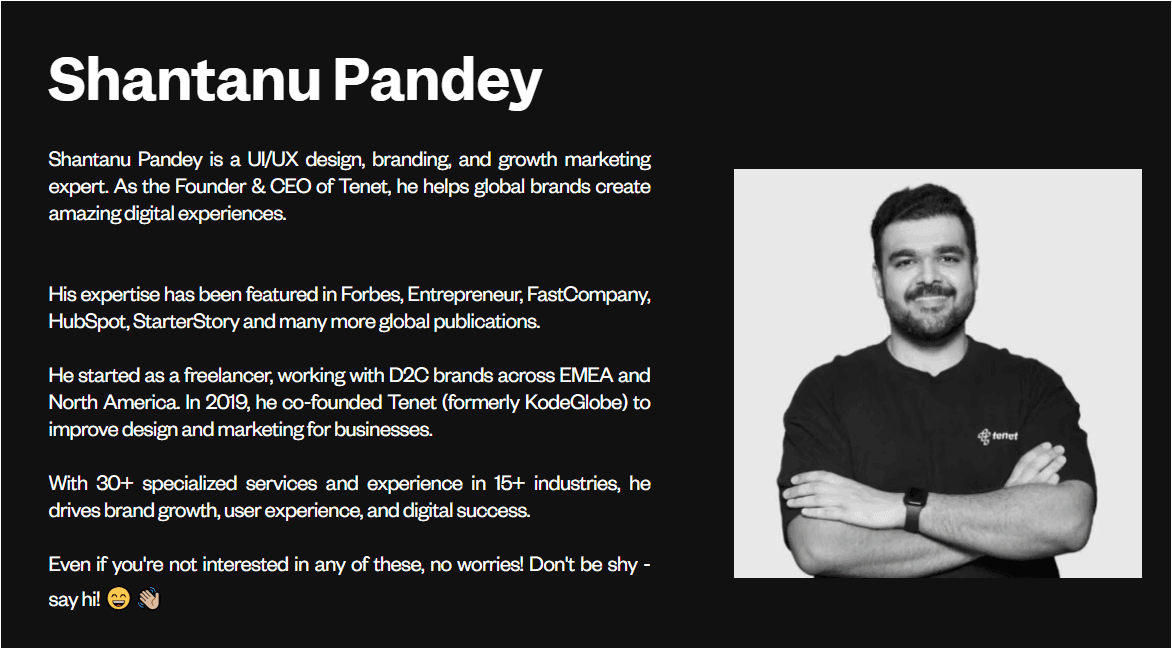
This does not mean every page needs an AI disclosure. Consider whether the information would help readers understand or trust the content. You should also use accurate author details. Do not create fake author profiles, credentials, or expert identities to make AI-generated content appear more trustworthy.
This is why we have dedicated author profiles of our expert reviewers and editors:

How to create an AI-generated content workflow that matches or exceeds human quality?
Creating quality AI content requires more than writing a good prompt. You need a structured workflow that combines reliable research, human input, practical examples, and expert reviews.
Here is a 5-step process you can follow to create useful, accurate, and engaging AI generated content.
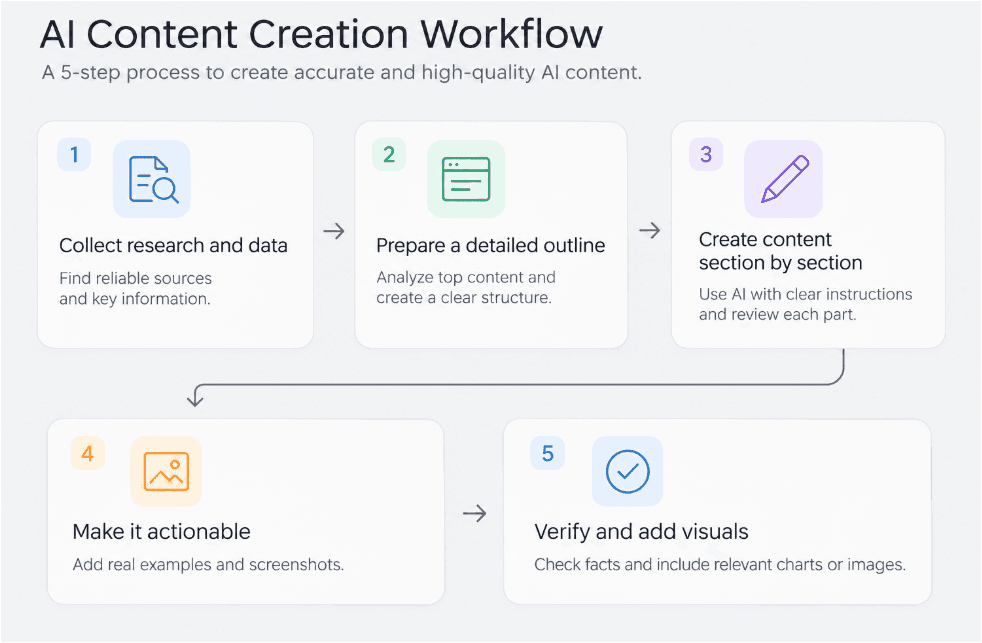
Step 1. Collect research, data, and reliable sources
Start by collecting the information you need before asking AI to write anything. The quality of your content depends heavily on the quality of your reference material.
Find relevant information from sources such as:
- Industry research reports and market studies.
- Academic research papers and published studies.
- Government websites and official reports.
- Industry experts and subject matter specialists.
- Company websites and product documentation.
- Customer interviews and first hand business data.
- Relevant discussions on Reddit, Quora, and industry forums.
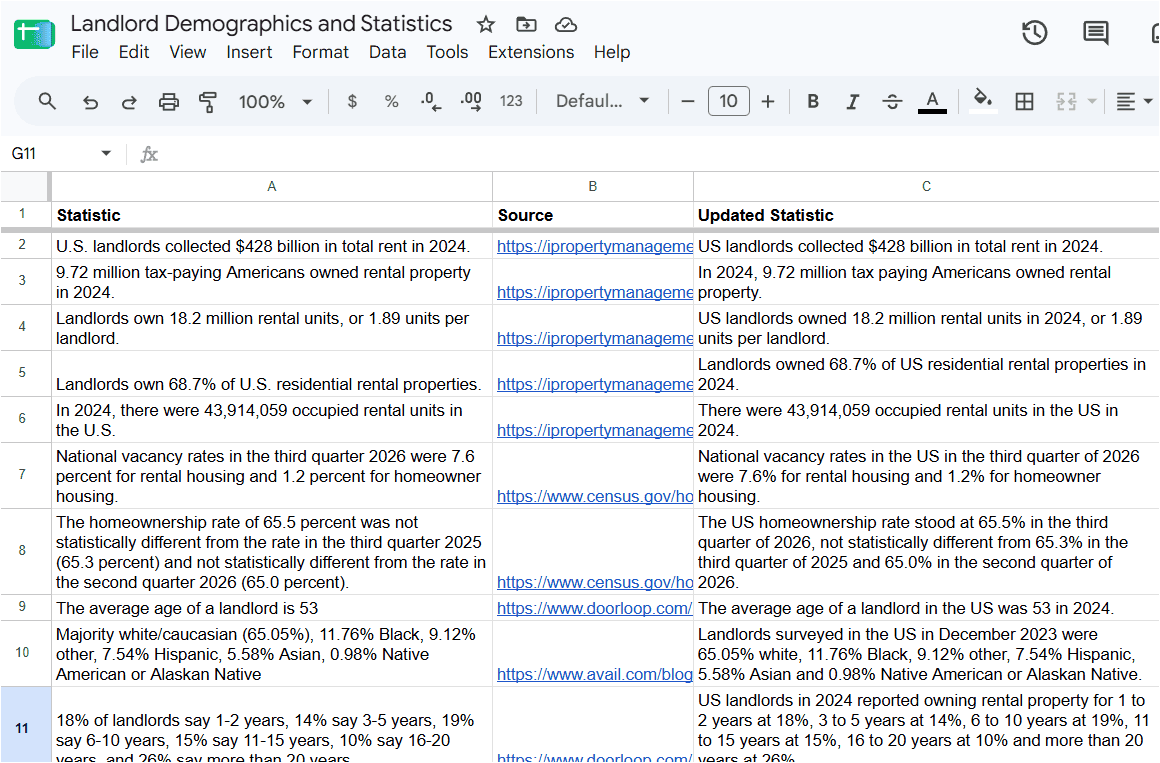
Save the source URLs along with important statistics, findings, and supporting information. You can also collect research documents in PDF or DOCX format and upload them to your AI tool.
For example, if you are writing about AI generated content, collect Google's official guidelines, industry surveys, research papers on AI adoption, and studies on how people consume AI generated content.
Here’s an example of a list of research findings and statistics generated by an AI agent for our articles before we start writing expert led content.
Step 2. Prepare a detailed content outline
Once your research is ready, prepare an outline that covers the topic from the reader's perspective.
You can approach this in two ways:
- Analyse top ranking pages: Review the content of pages ranking for your target keyword. Identify their headings, key topics, examples, and missing information. Use this analysis to build an outline that covers the search intent while adding useful information that competing pages may have missed.
- Manually provide reference content: Feed AI the content documents, research notes, or outlines of selected top ranking pages. Ask it to analyse the information and suggest a logical content structure.
Your outline should include the main sections, supporting topics, important questions, relevant data points, and examples to cover.
Do not simply copy the structure of competing pages. Use your research to identify opportunities to explain the topic better and add original insights.
Step 3. Create content one section at a time
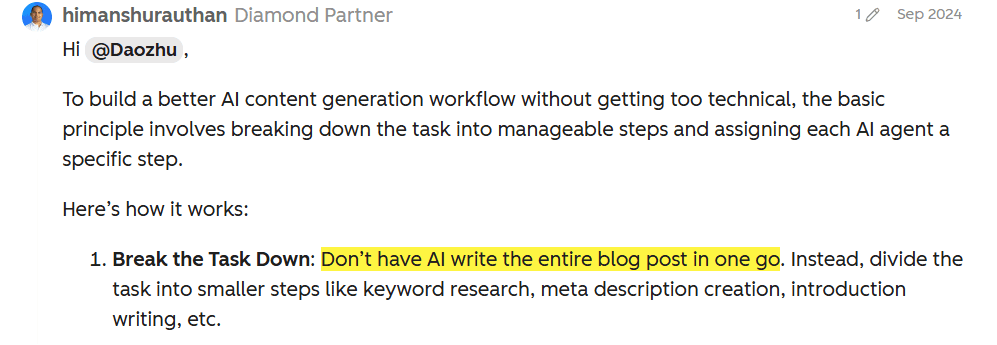
Instead of asking AI to generate an entire article in one prompt, create content one section at a time. Start with the first section and provide AI with the relevant research, source documents, and writing instructions. Review the output before moving to the next section.
Here’s similar advice given by a HubSpot community member:
For each section, make sure AI understands:
- What the section needs to explain.
- Which research documents and sources to use.
- What examples or statistics to include.
- What information to avoid repeating.
- The expected tone and writing style.
- How much detail the section needs.
This approach gives you better control over the content. You can also correct gaps, add missing information, and refine the writing before moving forward.
Once all sections are ready, review the complete article to ensure a logical flow and remove repeated explanations.
Step 4. Make the content actionable with real examples
This is where you can add value that generic AI generated content often misses.
Do not limit your content to explanations that readers can find on hundreds of other websites. Show them how to apply the information in real situations.
For example:
- Add real screenshots instead of relying only on stock images.
- Perform the tasks you describe and show the actual process.
- Include product demonstrations and practical examples.
- Share original case studies and business experiences.
- Add expert opinions and insights from people working in the industry.
- Show the problems you faced and how you solved them.
For example, if you are writing about website speed optimization, do not just list ways to improve website speed. Run an actual website speed test, share the screenshots, identify the issues, and demonstrate how you fixed them.
This requires real effort from your content team. However, it gives readers practical information instead of another generic article.
Step 5. Verify facts and create supporting visuals
Before publishing, get the content reviewed by subject matter experts. Ask them to check factual claims, statistics, technical explanations, and industry specific information.
Do not rely on AI to verify its own output. Cross check important claims against the original research sources and official documents.
You should also create relevant images, charts, and infographics using the datasets collected during research.
For example, if your research includes survey data on AI adoption, turn those findings into a chart or infographic. Make sure the numbers match the original dataset.
When creating visuals, follow your brand's design guidelines, including:
- Brand colours and fonts.
- Image dimensions and formats.
- Chart and infographic styles.
- Logo placement.
- Visual consistency across the website.
Finally, review the complete article for readability, accuracy, repeated information, and brand voice.
Tip: If your article includes statistics or research data that change monthly or quarterly, set up a scheduled AI check to find the latest figures. Review the updates and replace outdated statistics in your content with the latest verified data.
🤔 Remember: AI should help your team research, organise, and create content faster. Your research, practical experience, original data, and expert knowledge are what make that content valuable to readers.
💡 FURTHER SEO RESOURCES:
- https://www.wearetenet.com/blog/seo-for-new-websites
- https://www.wearetenet.com/blog/how-long-does-seo-take
- https://www.wearetenet.com/blog/llm-seo-optimization
Final thoughts
AI has changed how businesses create and distribute content.
From blog articles and marketing images to videos, podcasts, and interactive tools, marketers now have more ways to reach and engage their audiences.
However, creating content faster does not automatically make it better. As more businesses adopt AI, publishing generic content will become less valuable. The real difference will come from the quality of research, original insights, practical experience, and expertise behind the content.
You do not need to avoid AI to maintain content quality. Instead, use it to speed up research, organise information, create drafts, and explore new content formats.
Let your team focus on adding real examples, testing ideas, sharing expert opinions, and checking facts.
Have questions? Connect with me on LinkedIn.
Expertise Delivered Straight to Your Inbox
Expertise Delivered Straight to Your Inbox
















Got an idea on your mind?
We’d love to hear about your brand, your visions, current challenges, even if you’re not sure what your next step is.
Let’s talk


