
Your 90-Day Plan for Doing SEO for New Websites
 By
By Share

Share
Get a quick blog summary with



For a new website, we divide our SEO campaigns into three clear phases. Each phase has a specific goal, from building the technical foundation and identifying early opportunities to expanding search visibility, strengthening authority, and generating qualified leads.
This approach gives a new website a structured path for organic growth instead of trying to do everything at once.
With 70+ SEO projects delivered and $350K in monthly traffic value generated through our content, these are the three phases we use to structure SEO campaigns for new websites.
In this guide, we’ll break down each phase, what to focus on, and the key KPIs to track as your website grows.
What does SEO for a new website mean?
SEO for a new website does not necessarily mean the website itself is newly launched. In this context, it means a website with little or no SEO history, where no structured SEO work has been done before.
The website may have been live for months or even years, but if it has not had a focused SEO strategy, it can still be treated as a new SEO project. The starting point is usually limited rankings, little organic visibility, and no established SEO growth process.
👉 Learn how we helped brands scale their SEO growth with our proven SEO services. Request to get a free proposal in the next 24 hours.
Here’s the 90-day SEO growth plan for a new website:
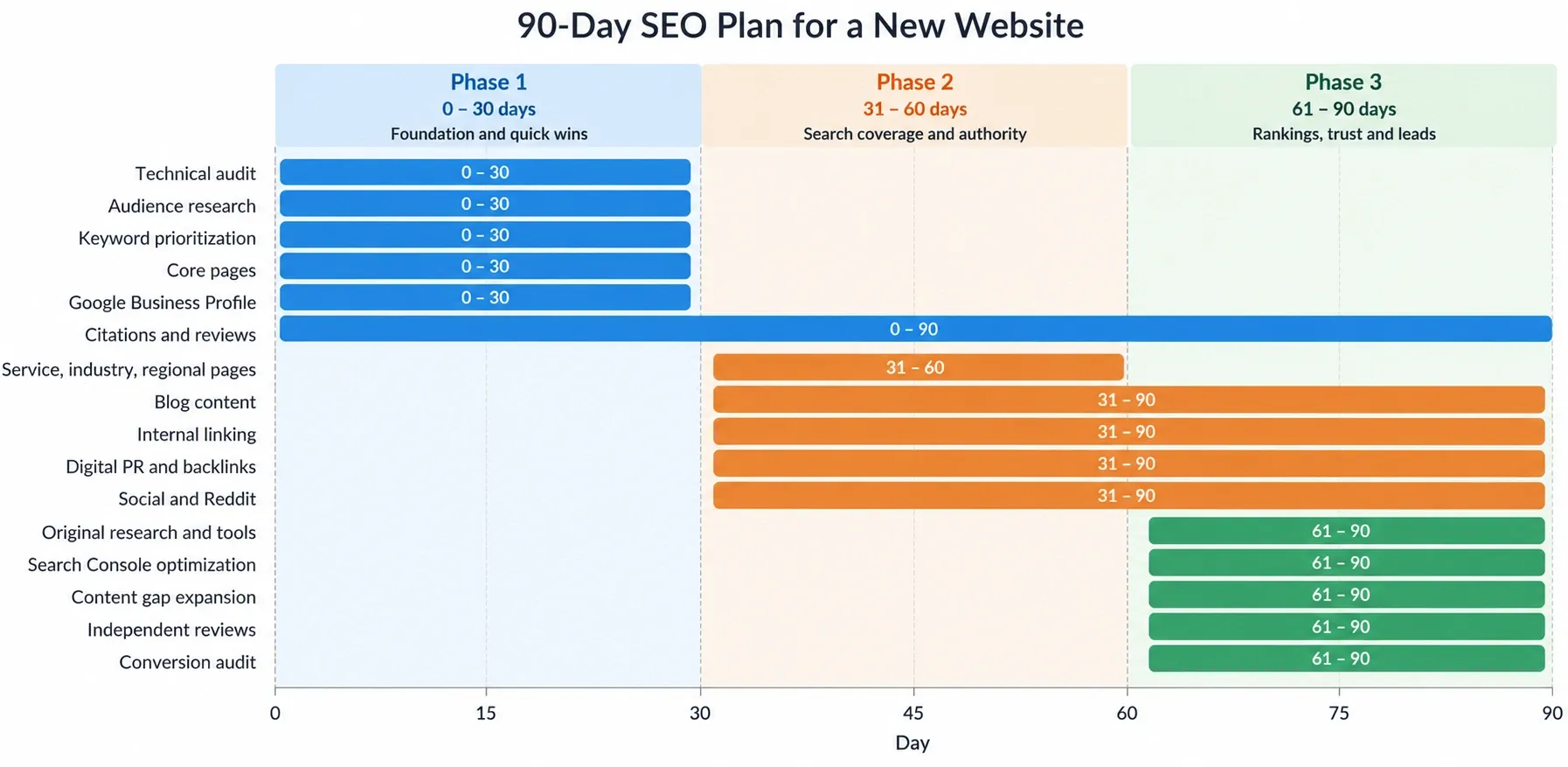
Phase 1: Build the SEO foundation and find quick wins
The first month of SEO for a new website should focus on getting the foundation right. Before publishing dozens of articles or building backlinks, make sure the website can be crawled, indexed, and understood by search engines.
1. Start with a technical SEO audit
A new website should be technically sound before you invest heavily in content and link building. A technical SEO audit helps find issues that can stop search engines from crawling, indexing, and properly understanding your pages. It should also check the website experience across mobile, speed, URLs, and internal links.
Here are some of the most important technical checks to consider:
- Can Google crawl all important pages? Check for crawl blocks, broken pages, JavaScript issues, and other barriers that could prevent search engines from accessing important content.
- Are all important pages indexed? Check Google Search Console for pages that are excluded, marked as noindex, discovered but not indexed, or indexed when they should not be.
- Is the website's URL structure clean and consistent? Check for duplicate URLs, unnecessary parameters, inconsistent trailing slashes, and other URL variations that can create duplicate or confusing pages.
- Are redirects and canonical tags working correctly? Check for redirect chains, redirect loops, incorrect redirects, and canonical tags that point to the wrong, redirected, or non indexable URLs.
- Is the XML sitemap correct? Make sure it contains only important indexable URLs, excludes redirects and error pages, and is submitted correctly in Google Search Console.
- Is the robots.txt file configured correctly? Check that it does not accidentally block important pages, directories, resources, or sections that search engines need to access.
- Are there broken links and error pages? Find internal links pointing to 404 pages, server errors, redirected URLs, or other broken destinations and fix them.
2. Research the audience before choosing keywords
Do not start SEO keyword research by opening Ahrefs, Semrush, or another keyword tool. Start by finding out what real people are asking, what problems they are trying to solve, and how they describe those problems. This helps you build content around real customer needs instead of simply targeting high-volume keywords.
Start by identifying the communities where your audience is active. Search Google using queries such as your topic site:reddit.com and your topic site:quora.com. Also check relevant forums, YouTube comments, reviews, and industry communities. This can uncover questions, concerns, comparisons, and content opportunities that may not appear in a standard keyword research report.
This way, you get a clearer picture of what your audience actually needs and can find content topics and keyword patterns that competitors may have missed.
👉 Here’s our step-by-step guide on doing audience research for SEO
3. Prioritize keywords by business value
A new website should not prioritize keywords based on search volume alone. Use traffic potential, ranking difficulty, and business value together to decide which keywords deserve attention first. This helps avoid targeting keywords that may bring traffic but have little value for the business.
Use the keyword priority analysis approach:
- Assess traffic potential: Review search volume and the overall potential of the keyword to bring relevant organic traffic.
- Check ranking difficulty: Review the actual SERP instead of relying only on a keyword difficulty score. Look at the authority and topical relevance of ranking pages, their optimization, and how closely they match the search intent.
- Assess business value: Give higher priority to keywords that closely relate to the products or services and have a clear potential to generate leads or conversions.
- Score each factor: Classify traffic potential, ranking difficulty, and business value as high, medium, or low to make the keyword list easier to compare.
- Create a priority list: Compare the three factors together instead of choosing keywords based on one metric. A keyword with moderate traffic but high business value and realistic ranking difficulty may deserve priority over a high volume keyword.
- Map priority keywords to pages: Use the final priority list to decide which keywords should be targeted through service pages, product pages, location pages, or informational content.
4. Create and optimize important website pages
Before scaling SEO content, make sure the website has all the essential pages that help users understand, trust, and contact the business.
These pages provide important information about the business and help users verify that the company is legitimate and relevant to their needs. They also give search engines more context about the business, its services, people, location, and brand.
Here’s how to plan your important pages:
- Create all essential pages and make sure they are linked from the main navigation or footer where appropriate.
- Make the homepage clearly explain what the business does, who it serves, its key services, and the main action visitors should take.
- Build detailed About, Team, Reviews, and Why Choose Us pages to establish brand information and trust.
- Add clear business details, contact information, locations, and enquiry options on relevant pages.
- Link these pages internally from relevant service and content pages.
- Review privacy, terms, and other legal pages to make sure they are present, accessible, and linked appropriately.
5. Optimize the Google Business Profile
A Google Business Profile helps a local business appear in Google Search and Google Maps. For a new website, the profile should be claimed and verified early, then completed with accurate and consistent business information.
Here’s how to create and optimize your Google Business Profile:
- Claim and verify the profile: Find the existing Google Business Profile and claim it if one already exists. If there is no profile, create one and complete Google's verification process.
- Choose the right categories: Select the most relevant primary category and add suitable secondary categories that accurately describe the business.
- Complete the business information: Add the correct business name, address, phone number, website, opening hours, service areas, and other required details. Keep this information consistent with the website and other business listings.
- Add and optimize services: Add the main services or products offered by the business and provide clear descriptions where the profile allows them.
- Add useful business photos: Upload relevant, high quality photos of the business, team, products, services, location, or completed work to make the profile more useful to potential customers.
- Complete the profile and monitor it: Fill in all relevant profile sections, review the profile regularly, respond to customer reviews, and update information whenever the business changes.
6. Build relevant local citations
Local citations are online listings that mention the business and its key details, such as its name, address, phone number, website, services, and location. These can include:
- Local directories
- Industry websites
- Business profiles
- Third-party review sites
- Local publications
Citations help create a consistent online presence for a local business and give search engines more sources to understand and verify the business. They also help build the business entity across the web by consistently describing what the business does, which services it provides, where it operates, and how customers can contact it.
What to do:
- Find where competitors are listed: Pick one competitor and search Google for [competitor name] -site:[competitor URL]. This removes the competitor's own website from the results and can reveal directories, industry websites, profiles, and other pages where the competitor is mentioned.
- Repeat the research: Run the same search for your top three to four competitors. Collect the relevant listing websites in a spreadsheet and remove duplicates.
- Identify citation opportunities: Separate the results into local directories, industry directories, business profiles, review websites, local publications, and other relevant platforms. Prioritize websites that are relevant to your location or industry.
- Create or claim the listings: Get the business listed on the relevant platforms. If a profile already exists, claim it instead of creating another one.
- Keep business information consistent: Use the same business name, address, phone number, website URL, and other core details across listings. Avoid creating variations of the business name or address.
- Get initial genuine customer reviews: Ask existing customers to leave honest reviews on relevant third party platforms and Google. Do not buy or create fake reviews. Respond to genuine reviews and keep building the review profile over time.
Phase 2: Expand search coverage and build authority
Once the foundation is in place, the second phase focuses on expanding the website's search coverage and making the brand more visible across Google, industry websites, social platforms, communities, and third-party sources.
1. Scale service and commercial pages
Once the core pages are ready, start expanding the website based on the keyword and competitor research from Phase 1. The goal is not to create as many pages as possible. Each new page should target a clear search need and have a clear reason to exist.
For product based businesses, look beyond standard product pages. Look for opportunities around specific industries, customer types, and product use cases. If people are searching for a product for a particular industry or use case, create a dedicated page when you can provide genuinely useful information for that audience.
For service businesses, look for regional and industry specific opportunities. A service may need separate pages for different cities, regions, or industries when the search intent, customer needs, or service offering changes.
2. Improve internal linking to priority pages
As you add more pages, make sure your important pages do not get buried in the site structure. Your homepage and main header navigation should link to your highest priority service, product, category, or commercial pages.
This gives these pages stronger internal prominence and helps pass internal PageRank through the website.
Your blog content should also support your commercial pages. When a blog article discusses a problem that one of your services solves, link to that service page naturally. Go back to older articles regularly and add links to important pages that were created later.
3. Scale citations, reviews, and digital PR
Continue the citation and third party profile work started in Phase 1, but start building a much wider presence for the brand. Look for relevant directories, industry websites, review platforms, local publications, and other websites where your audience is likely to find or trust a business.
Start a digital PR process to get the brand mentioned in relevant publications. This can include press releases, expert contributions, media coverage, industry stories, and relevant listicles.
At the same time, start editorial backlink outreach. Find websites that publish content in your industry and offer something genuinely useful, such as expert insights, original research, useful guides, data, or other resources.
Do not focus only on getting links. Reviews, citations, editorial mentions, and consistent information across third party websites also give search engines and AI systems more information about the brand. A wider and more consistent presence can increase the number of sources that describe and validate the business.
4. Build a stronger social media and community presence
Social media should not be treated as a separate activity from SEO. One of the goals should be to increase awareness of the brand and encourage more people to search for it by name.
Use a multimedia approach instead of publishing the same type of post everywhere. Turn useful website content into short videos, carousels, images, expert posts, customer examples, FAQs, and other formats that fit each platform.
Keep the brand active on the channels where the target audience actually spends time. Track branded searches in Google Search Console to see whether searches for the brand and its products or services are increasing over time.
5. Build a genuine Reddit presence
Reddit can help you understand your audience and build brand visibility, but it should not become another channel for dropping promotional links.
Find relevant subreddits where people are asking questions related to your industry. Read the discussions, understand the problem, and provide a useful answer based on your actual expertise.
Mention your brand only when it naturally fits the question and genuinely helps the person. Avoid adding a brand mention or link to every response. The aim is to become a useful contributor rather than another account promoting a business.
💡 Relevant SEO resources:
- SEO Ranking Drop: Know What Caused Your Site’s Traffic Drop
- SEO Client Reports: What SEO Agency Should Report to Clients
- ROI of SEO: How to Calculate ROI from Your SEO Efforts?
Phase 3: Optimize for rankings, trust, and lead generation
By Phase 3, the website should have enough search data to understand which pages and topics are gaining traction. The focus now shifts from simply creating more pages to improving the pages that are already showing potential, building stronger brand signals, and turning organic traffic into leads.
1. Create original research and linkable assets
Once the website has established its core content, start creating assets that offer something other websites cannot easily reproduce. These assets can become sources for digital PR, editorial outreach, backlinks, social content, and community discussions.
Focus on topics that are closely related to the business and have a clear audience need.
Some useful formats include:
- Original industry statistics and statistical roundup articles
- Original research based on surveys, customer data, or industry datasets
- Industry reports and trend reports
- Free calculators and interactive tools
- Embeddable tools that solve a specific problem in the niche
- Original studies and comparison data
- Templates, checklists, and downloadable resources
- Industry benchmarks and useful datasets
The key is to create something that people would genuinely reference, share, or link to. A tool or original data study can often create more link and PR opportunities than another general blog article.
2. Optimize service pages using the last 60 days of Search Console data
By this stage, important service pages should have collected enough impressions to show how Google is interpreting them. Use the last 60 days of Google Search Console data to find queries where these pages are already appearing but could perform better.
Look beyond the primary keyword. A service page may be receiving impressions for related searches, specific use cases, locations, or questions that were not included in the original keyword map.
Review each priority service page for:
- Queries generating impressions but few clicks
- Queries where the page ranks around positions 5 to 20
- Related terms that are missing from the page
- Search intents the current content does not fully address
- Title tags and meta descriptions with low click through rates
- Sections that could be expanded based on actual search queries
- Internal linking opportunities from newer content
- Conversion elements that need improvement
Use this data to update the page rather than blindly adding more keywords. The goal is to make the page a better match for the searches where Google is already testing it.
3. Expand content based on keyword and competitor gaps
Continue expanding the content strategy using the keyword priority analysis from Phase 1 and the ranking data collected in Phases 1 and 2.
Look for new keyword opportunities that have appeared in Search Console, topics competitors have started ranking for, and questions that repeatedly appear in audience research.
Prioritize gaps that have clear business value and a realistic ranking opportunity. Also revisit existing articles before creating new ones. If an existing article can be expanded to cover a related search intent, improving that page may make more sense than publishing another similar article.
4. Scale social media and community mentions
By this stage, social media and community activity should move beyond simply sharing new blog posts. The goal is to make the brand more visible and familiar to the people who matter to the business.
Use different content formats across relevant platforms, including videos, expert opinions, customer examples, data points, research findings, product demonstrations, and useful educational content.
Continue participating in relevant communities such as Reddit and industry forums. Answer questions genuinely and share useful information. Mention the brand only when it naturally fits the discussion.
Track branded searches in Google Search Console alongside direct traffic and other brand visibility indicators. The broader goal is to create more awareness and demand for the brand, not just generate social engagement.
5. Build independent reviews and third-party mentions
Do not rely only on reviews published on your own website. Look for independent sources where customers, creators, industry experts, and publishers can talk about the brand or its products.
This can include:
- YouTube reviews
- Independent product or service reviews
- Industry articles
- Comparison websites
- Third party review platforms
- Google Business Profile reviews
- Expert discussions
- Customer case studies published on independent websites
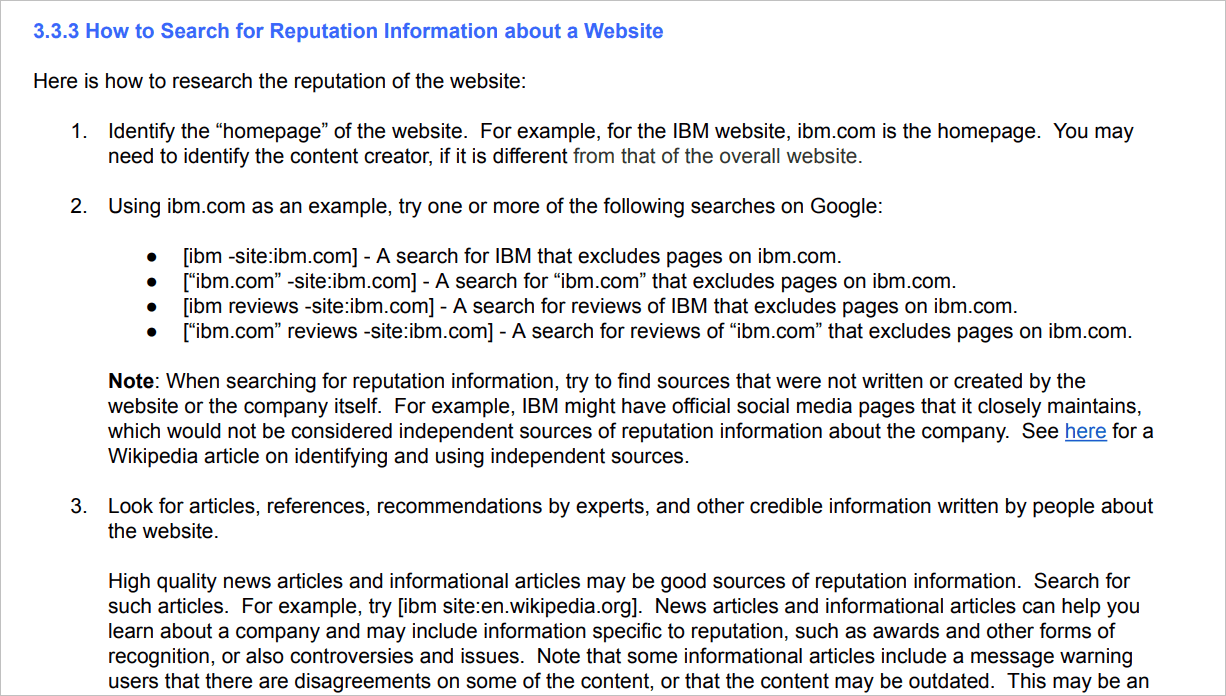
Google's Search Quality Rater Guidelines place importance on researching a website or business's reputation, so building a genuine reputation across independent sources is useful for establishing trust.
6. Conduct a conversion audit of commercial pages
At this stage, the goal of SEO should increasingly shift from generating traffic to generating qualified leads. Review the pages that receive organic traffic and ask whether they make it easy for visitors to take the next step.
Start with the highest priority service and commercial pages, then review blog articles that receive meaningful organic traffic.
Check areas such as:
- Is the main offer clear within the first few seconds?
- Is the CTA easy to find?
- Does the page explain why someone should choose the business?
- Are there enough trust signals?
- Are reviews, case studies, certifications, or client logos visible where relevant?
- Is the enquiry form simple enough to complete?
- Are there unnecessary steps between landing on the page and making an enquiry?
- Does the blog article naturally guide relevant visitors toward a related service?
- Are mobile visitors getting the same clear conversion path?
- Which pages receive traffic but generate few or no leads?
Download your 90-Day SEO plan
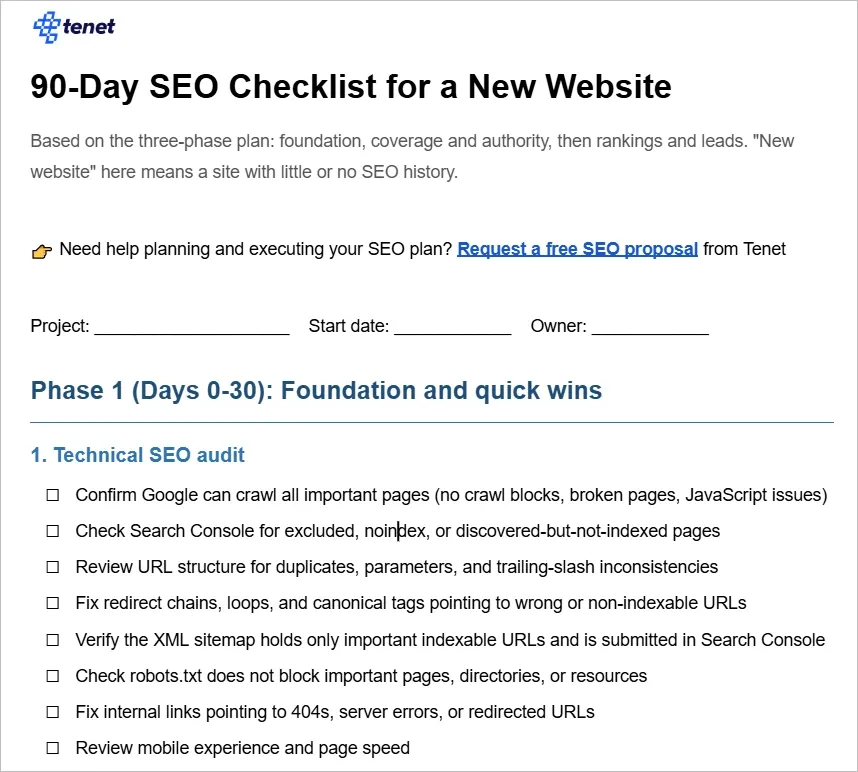
Use this checklist to run SEO for a new website over 90 days, working through three phases: foundation and quick wins, search coverage and authority, then rankings, trust, and leads.
Tick off each task as you go and track the KPIs listed at the end of every phase.
How Tenet’s SEO team can help you plan and execute the 90 day SEO plan
A 90 day SEO plan needs more than a list of keywords and content topics. Tenet’s SEO team brings together technical SEO, keyword research, content strategy, on-page optimization, authority building, digital PR, and conversion optimization to execute each phase based on your website’s starting point and growth goals.
Explore our SEO case studies where we have scaled traffic and leads for dozens of new websites.
We track the right KPIs at each stage, identify what is working, and adjust the strategy based on actual search and conversion data. With 70+ SEO projects delivered, 30M+ cumulative organic traffic generated, and $12M+ in leads generated for clients, our focus is on building sustainable organic growth, not just rankings.
If you’re starting SEO with little or no existing SEO history, Tenet can help you build and execute the right 90 day roadmap from the ground up.
- 👉 Understand our proven AI visibility approach behind our AI SEO services.
- Request a Custom SEO Proposal
Get Expert Help Turning Audience Insights Into SEO Growth
Get Expert Help Turning Audience Insights Into SEO Growth











Got an idea on your mind?
We’d love to hear about your brand, your visions, current challenges, even if you’re not sure what your next step is.
Let’s talk


