
How is Enterprise UX Different from Other UX Domains?
 By
By Share

Share

Get a quick blog summary with



Enterprise UX focuses on complex, role-driven workflows and efficiency, while consumer/startup UX targets simple tasks and delight.
Enterprise tools serve known professional users in data-heavy domains (finance, HR, healthcare) under strict constraints (security, legacy systems), so design emphasizes productivity, error reduction, and consistency over visual polish.
By contrast, consumer and startup UX aim for broad appeal, instant usability, and engagement.
**Before We Start**
Enterprise UX works best when your product has a strong design foundation. Before we explain how enterprise UX differs from consumer or startup UX, it helps to understand why good design matters.
At Tenet, we help companies create UI and UX that improve workflow speed, reduce errors, and support teams that rely on complex digital tools every day. Our work focuses on clarity, structure, and real business impact. We design products that feel easier to use, help employees complete long tasks faster, and create consistency across all modules and screens.
Get a free project proposal for our UI UX design services (450+ successful projects completed).

1. Enterprise UX supports long workflows, while other UX domains focus on quick tasks
Enterprise applications support long, multi-stage processes across departments. One person might enter data, another reviews it, and a third finalizes it. Designers must map these complex flows so users can pause and resume tasks without losing progress.
In other domains (consumer apps, startups, creative tools), users expect quick “micro” tasks and instant results. If a simple app fails in a few seconds, users abandon it. In enterprise UX, every click must move work forward; in consumer UX, minimal steps and immediate feedback are key.
2. Efficiency and Reliability Become the Top Priority for Enterprise UX
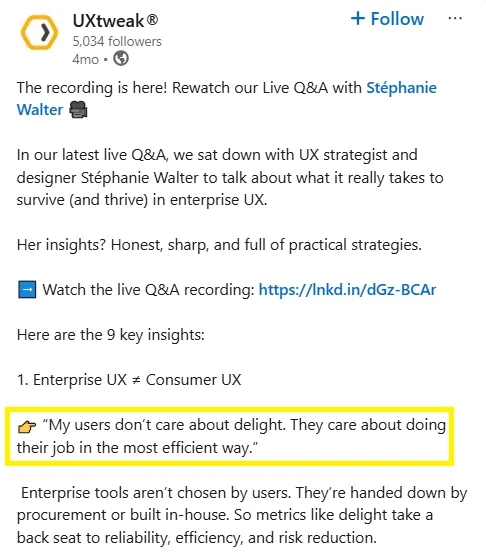
Enterprise users often don’t use products for fun; they use them to do their jobs. They care that the software works reliably and saves time, not that it is “delightful”.
As UX strategist and designer Stephanie Walter put it, “My users don’t care about delight. They care about doing their job in the most efficient way”.
Flashy visuals or long tutorials can be skipped if users can quickly complete tasks.
In consumer or startup products, by contrast, UX often aims to charm users and keep them engaged. Metrics like clicks, “wow” moments, and emotional appeal dominate there, whereas in enterprise, metrics focus on time savings and error reduction.
3. Enterprise UX designs for specialized roles, while other UX domains target broad audiences
Enterprise UX design tools are built for known job roles (e.g., HR specialist, warehouse manager, nurse) rather than the general market. Each role may need its own dashboard, permissions, and workflow. Designers must understand detailed business data and let roles drive the information architecture.
In contrast, consumer or startup products cater to broad, unpredictable audiences. For example, a social app may use one persona or a few broad segments.
Enterprise UX often integrates lots of fields, reports, and tables; consumer UX focuses on simple forms and minimal screens. Enterprise success is measured by productivity, accuracy, and compliance, not just by user enjoyment.
4. Enterprise UX manages many stakeholders, while other UX domains move with smaller teams
Enterprise projects involve many stakeholders, including product managers, IT, compliance, finance, and operations, each with distinct priorities. A simple interface change might need approval from security, branding, and usability teams. Designers must navigate internal politics and balance business goals.
A UX beginner shared a valuable insight on the key challenges of Enterprise UX.
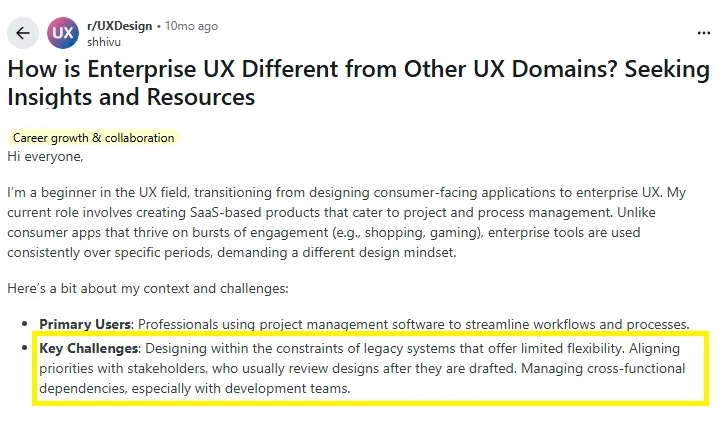
Startups or consumer projects usually have smaller teams and faster decisions. For example, large “whale” clients in B2B can sway feature roadmaps, leading to compromises that satisfy one big buyer but confuse others.
Enterprise UX practitioners learn to build consensus and document requirements heavily, whereas consumer UX often moves ahead with fewer layers of approval.
5. Enterprise UX works within legacy constraints, while other UX domains enjoy more flexibility
Enterprise products often run on decades-old systems, follow strict industry regulations, and integrate with internal databases. This creates rigid constraints: designers cannot overhaul data models or ignore compliance fields.
Enterprise UX must handle these technical and legal limits, even if it complicates the UI.
Consumer and startup apps generally start fresh and face fewer legacy issues. They have the flexibility to innovate without worrying about compatibility with old systems or complex security rules.
6. Enterprise UX measures productivity impact, while other UX domains measure engagement
Success looks different in enterprise UX. Key performance indicators include time-on-task, error rates, support tickets, and overall workflow speed. A tiny UX improvement that saves minutes per employee can justify the project, since it scales over hundreds or thousands of users.
In contrast, consumer UX is judged on downloads, session length, retention, and satisfaction ratings. A poor interface in a consumer app might just lose a user, but a flaw in enterprise software can cause real business loss (wasted time, costly mistakes).
7. Enterprise UX collects slow, limited feedback, while other UX domains test and iterate fast
Enterprise user research often involves internal users who are willing but busy. Feedback comes slowly through support reports, management reviews, or scheduled tests. Companies update enterprise apps on long release cycles, so designers see real user reactions months later.
In consumer or startup projects, designers get rapid feedback from app analytics and user testing. A new feature in a consumer app might be tested with thousands of users or tweaked via A/B tests; changes in enterprise tools often require formal pilots or executive sign-off.
💡 Further resources:
- Enterprise UX Design Principles With Real Examples
- Digital Product Design Examples to Get Inspired By
- Web Design Trends That Will Redefine User Experience
How Tenet Delivers Impact Across Enterprise UX and Consumer UX
At Tenet, we serve enterprise design for real outcomes. When we work on enterprise UX, we map complex workflows, study role-based needs, and align with stakeholders to remove friction in high-impact processes. We focus on accuracy, speed, and consistency because these products run entire operations.
When we design for consumer and startup UX, we shift toward clarity, emotion, and conversion. We craft clean flows, strong visuals, and responsive experiences that keep users engaged and ready to act.
In both domains, our process at Tenet stays the same: deep research, clear strategy, and design that improves performance. This is why brands across healthcare, retail, finance, and SaaS trust us to deliver experiences that work at scale.
👉 Contact our team for details
Need help with a UX design audit? Get a free proposal from our experts
Need help with a UX design audit? Get a free proposal from our experts









Got an idea on your mind?
We’d love to hear about your brand, your visions, current challenges, even if you’re not sure what your next step is.
Let’s talk


