
Should You Outsource UI UX Design or Build an In House Team
 By
By Share

Share
Get a quick blog summary with



In companies, UI/UX design is outsourced more often than it is kept in-house. This happens because demand for design is uneven. It rises during launches, redesigns, and major changes, then drops once things stabilize.
Most teams do not need a designer every day. They need one intensely for short periods.
Outsourcing lets teams move fast and keep costs predictable, while in-house designers make sense after finding product-market fit and steady growth.
How design work enters the workflow
Design work usually starts after a problem appears. A feature feels confusing. Conversion drops. Users complain. A new flow needs clarity.
Teams then pause development, bring in design help, fix the issue, and move forward. After that, design activity slows again.
This pattern repeats. It is not continuous.
Because of this, many teams treat design as a service they pull in when needed, not a role that runs constantly in the background.
How UI/UX work actually behaves inside companies
UI/UX work usually comes in phases. A company needs design during a launch, a redesign, or a feature update. Once that phase ends, design demand slows down.
This uneven demand is the main reason companies outsource. Outsourcing matches how design work appears in reality. In-house hiring assumes steady demand, which is often not true early on.
When outsourcing UI/UX team is the right choice
Outsourcing works best when design work is not constant.
This includes situations where:
- Design work comes in phases
- Screens change often
- The product direction is still evolving
- Design supports development but does not drive it
In these cases, designers work from shared context such as wireframes, product notes, and feedback. They deliver output without needing daily involvement in product decisions. Once the task ends, the engagement ends. You can avoid paying for idle time.
This is why outsourcing dominates early and mid-stage products. It suits products that are still changing and teams that want speed without long-term commitment.
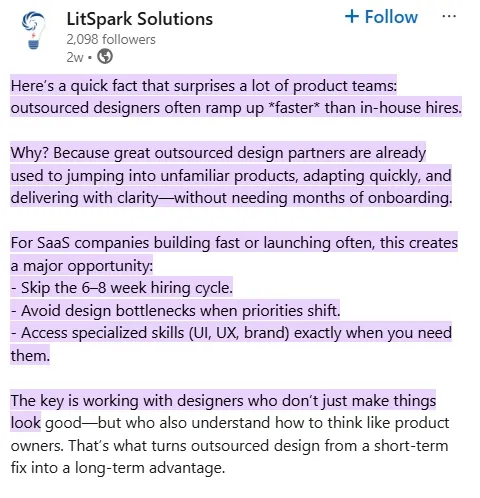
A LinkedIn post notes that outsourced designers “often ramp up faster than in-house hires” and let startups avoid hiring delays.
Where outsourcing starts creating friction
Outsourcing becomes inefficient when design decisions affect what gets built next. At that point, design is no longer reacting to changes. It starts shaping them.
When design input is required during planning, tradeoff discussions, and backlog prioritization, an outsourced setup starts slowing teams down. Context has to be explained repeatedly, design intent must be restated, and decisions are delayed while feedback travels back and forth.
As design moves closer to decision-making, the cost is no longer about money. The cost shows up as slower alignment, longer feedback loops, and missed timing. Outsourcing struggles in this phase because the designer is not embedded in the team’s daily work and discussions.
When companies build their in-house UI/UX team
Companies hire in-house designers when design decisions become unavoidable.
This usually happens when:
- Product direction stabilizes and the team is no longer testing major pivots or ideas.
- UX affects roadmap choices and design decisions influence what gets built next.
- Design input is needed every sprint to review flows, update screens, and unblock development.
- Consistency across features matters and the product needs one clear design system and voice.
An in-house designer sits inside planning meetings, reviews, and discussions. They absorb context naturally rather than by reading documents. This reduces coordination cost over time and improves consistency across the product.
At this stage, design is part of how the product evolves, not just how it looks.
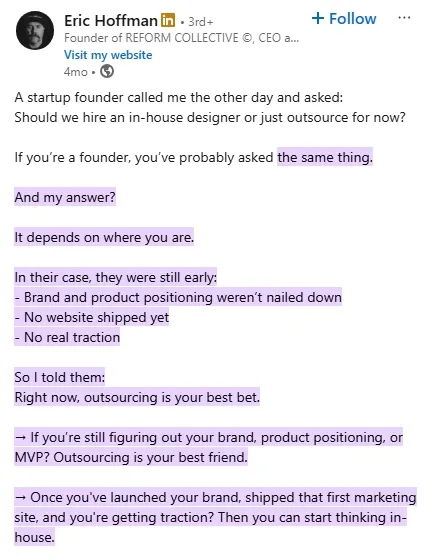
One founder on LinkedIn advised moving “from zero to full design team” only after the brand is built and first users are onboard.
UI and UX are treated differently in practice
Many companies do not treat UI and UX as one role.
UI work focuses on visual clarity and interaction polish. It can be outsourced effectively with clear requirements.
UX work focuses on journeys, logic, and long-term experience. It requires constant internal context and close collaboration.
Because of this, many companies outsource UI execution while keeping UX decisions with founders or product leaders until they hire in-house.
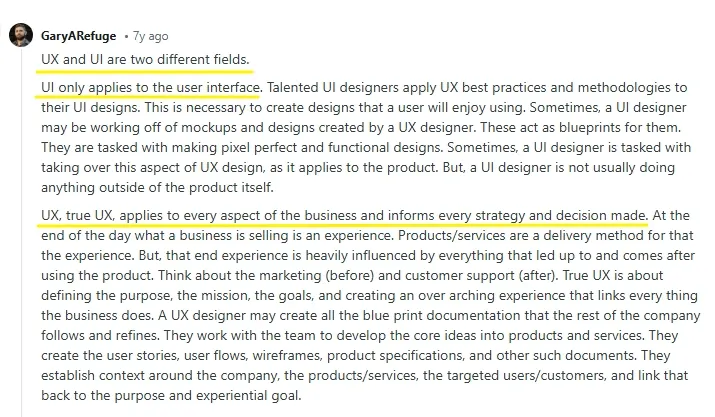
An expert on Reddit clearly states the difference between UI and UX designers.
Explore: 12 UI UX Design Principles For Mobile Apps (+ Examples)
Cost behavior explains the pattern.
Outsourcing costs scale with usage. When work stops, cost stops. Outsourcing is usually cheaper in the short term. Freelance UI/UX designers charge about $25–$100 per hour for smaller projects. Design agencies charge more like $100–$250 per hour for larger projects.
In-house design is a fixed cost. Salary, tools, and overhead exist even when design demand slows. An in-house designer costs roughly $90K–$130K per year in salary (around $40–$65/hr after overhead)
When design work is uneven, fixed cost creates waste. When design work is constant, outsourcing creates coordination overhead. Companies switch hiring models when this balance flips.
Emotional attachment is not a deciding factor.
Companies do not hire designers in-house because of emotion. They do it to reduce repeated explanations, shorten feedback loops, and protect long-term consistency.
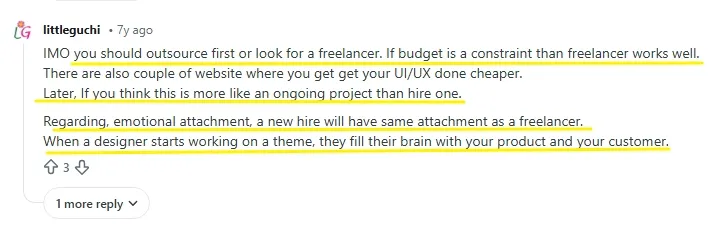
One Reddit expert says you can outsource UI/UX and then hire an expert later. Emotional attachment won't be a constraint.
Explore: How Much Do UI/UX Design Services Cost?
When to hire In-house and outsourcing UI/UX designer? The direct answer
- Outsource UI/UX design when work is intermittent and execution focused.
- Hire in-house when work is continuous and shapes product decisions.
That is the practical boundary most companies follow.
Quick answer at a glance
For most startups, outsourcing UI/UX is best in the beginning (fast turnaround, low fixed costs), while hiring in-house makes sense later (deep product knowledge, continuous improvement). The right choice depends on product-market fit, budget, team size, and your product's maturity.

How Tenet helps startups and enterprises outsource UI UX design
Tenet helps startups and enterprises outsource UI UX design in a way that matches how design work actually happens inside teams. Many products need design in short, intense phases rather than every day. Tenet steps in during launches, redesigns, feature updates, and growth spikes, then steps out once execution is complete. This allows teams to move fast without carrying long term hiring costs.
For startups, Tenet supports early-stage and mid stage products where direction is still evolving. Teams get strong UI execution and practical UX guidance using shared context like product notes, wireframes, and user feedback. This keeps momentum high while avoiding the overhead of hiring before product market fit.
For enterprises, Tenet works as an extension of internal teams. When internal designers are stretched or timelines are tight, Tenet adds experienced UI and UX capacity without slowing decisions. The focus stays on usability, consistency, and measurable outcomes such as higher conversions and longer session times.
👉 Get a free proposal by contacting our team. Email: hello@wearetenet.com
Need fast, effective UI/UX without hiring full-time employees? Talk to Tenet and scale design.
Need fast, effective UI/UX without hiring full-time employees? Talk to Tenet and scale design.











Got an idea on your mind?
We’d love to hear about your brand, your visions, current challenges, even if you’re not sure what your next step is.
Let’s talk


