
$5K vs $50K Web Design Services: What Are the Differences?
 By
By Share

Share
Get a quick blog summary with



A $5,000 website and a $50,000 website can look similar at first. Both can be modern, responsive, and visually appealing. The difference is not just in the design.
It is in how they are built, who builds them, and how deeply the work supports your business goals. Here is what truly separates them.
1. From Quick Execution to Strategic Discovery and Planning
A $5,000 project often begins right after a short conversation. You share a few references, and the designer starts building pages. The work is driven by assumptions rather than evidence.
A $50,000 project begins with a structured discovery phase. The team studies your users, business goals, and competition. They run stakeholder interviews, analyze analytics data, and build customer journey maps. Information architecture, navigation flow, and conversion logic are carefully planned before design even begins.
This level of groundwork removes guesswork and ensures the site serves both the user and the business.
2. From One Generalist to a Team of Specialists
A small-budget project is usually handled by one person who designs, writes, codes, and tests everything. This can produce acceptable results for a small brochure site, but it limits the depth of expertise.
A $50,000 website is produced by a cross-functional team. A project manager ensures communication stays organized. UX researchers focus on user behavior and data-backed insights. UI designers craft the visual experience. Front-end and back-end developers handle structure and functionality. Content strategists, SEO experts, and QA testers refine the details.
Each role adds precision and accountability to the process, leading to a product that performs better and scales easily.
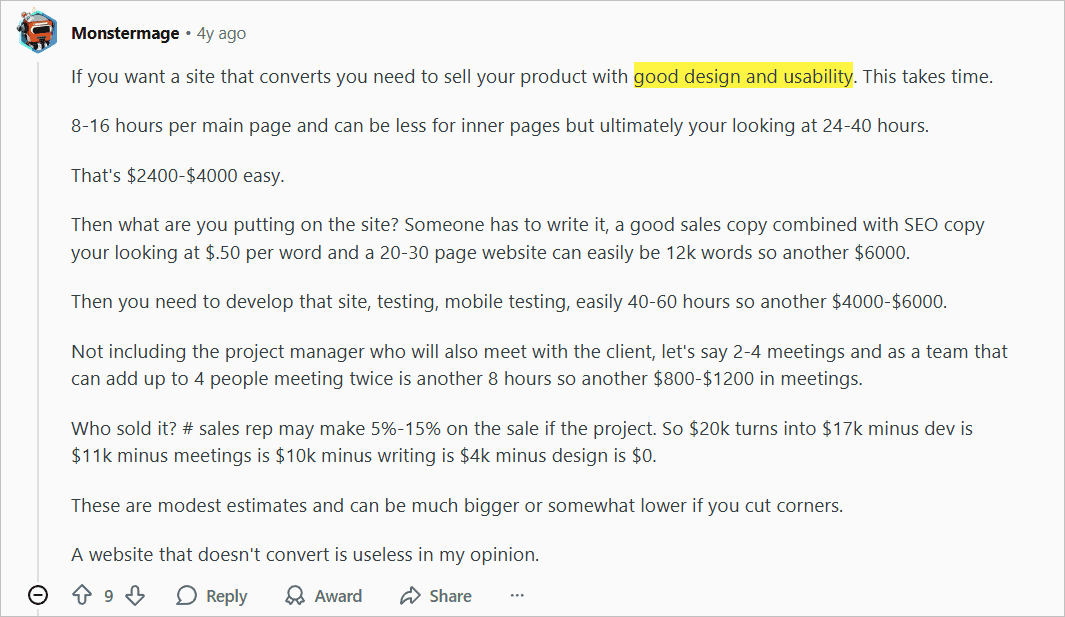
Here’s a detailed cost breakdown shared by a Reddit user that you can use as an overview reference:
3. From Prebuilt Themes to Custom Design Systems
A low-cost website often relies on a theme purchased from a marketplace. The designer edits colors, images, and fonts to fit your brand. The framework stays the same. This approach limits flexibility and can cause problems when you want to expand or modify features later.
In a high-value project, every element is designed and coded from scratch. The agency creates a design system that defines components, typography, grids, and spacing. The system becomes a digital language that can be reused across products, pages, and future campaigns.
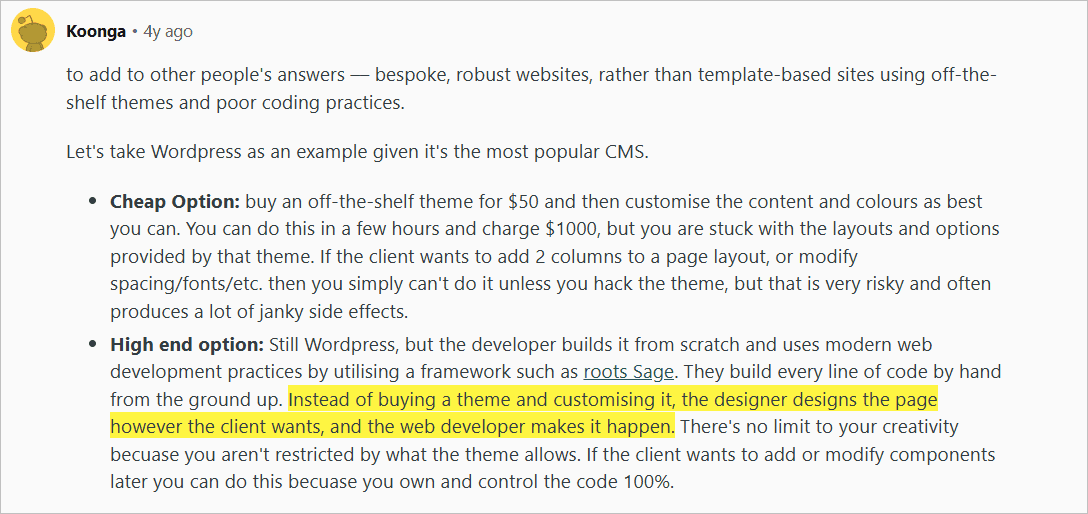
Here’s what “custom” really means in practical web design terms, as explained by a Reddit user:
4. From Fast Delivery to Structured and Tested Execution
A smaller project moves quickly from idea to launch. There are usually one or two rounds of edits, and the site goes live without deep testing.
A high-value project follows a defined structure that includes wireframes, prototypes, user testing, visual design, accessibility review, and performance optimization. Each stage is validated before moving to the next. The result is not just a finished design but a digital experience that is stable, intuitive, and technically sound.
5. From Aesthetic Design to Performance and Scalability
A lower-cost website often looks attractive at launch but begins to show limitations over time. It may load slowly, fail to meet accessibility guidelines, or struggle with high traffic.
A higher-budget project is engineered for performance. The team measures Core Web Vitals, optimizes code, implements caching, and ensures fast load times. Accessibility compliance, structured data, and mobile-first responsiveness are built in from the start. Scalability and security are planned before development begins.
6. From Fragmented Feedback to Organized Collaboration
Cheaper projects usually rely on scattered communication through messages or emails. Feedback can get lost, leading to delays and misunderstandings.
Premium projects use a structured collaboration system. Feedback is centralized through shared tools. A project manager filters and consolidates comments before each review. The agency manages internal and client-side stakeholders, keeping everyone aligned. Every decision is documented and traceable.
7. From One-Time Delivery to Continuous Partnership
A $5,000 project ends when the website goes live. Any further improvements or maintenance require new agreements.
A $50,000 project includes an ongoing partnership. The agency continues to measure performance, track user behavior, and refine design and content. Analytics inform future iterations, keeping the site effective and relevant as business goals evolve.
8. From Simple Builds to Enterprise-Level Complexity
A low-cost website suits businesses with straightforward needs and few approval layers. There are limited compliance, accessibility, or integration requirements.
Larger organizations require sites that integrate with CRM systems, handle API connections, comply with accessibility and data privacy laws, and align with internal brand governance. Each of these layers adds technical and managerial complexity. Managing them demands experience, coordination, and attention to legal and operational detail.
9. From Time-Based Pricing to Value-Based Investment
In a smaller project, pricing is based on hours and tasks. The discussion revolves around deliverables.
In a larger project, pricing reflects the business value created. A website that shapes brand perception, drives conversions, and automates workflows generates measurable returns. The cost represents the strategic importance of the outcome rather than the time spent building it.
10. Custom Features, Stakeholders, and Integrations Drive Costs
Custom functionality drives the biggest cost jump. A $5K site uses a pre-built theme with plugins. A $50K site needs custom-built features that don't exist in any plugin.
The other cost driver is complexity and stakeholders. Cheap sites have one person making decisions. Expensive sites have multiple departments, approval processes, and revision cycles that triple the timeline.
Also, integration requirements. Connecting to existing CRM systems, custom APIs, third-party platforms, and legacy databases adds serious development time. A standalone site is simple. A site that needs to talk to five other systems requires actual engineering, not just design work.
11. Expensive Sites Assume Risk and Boost Revenue
The primary difference between $5000 and $50000 in the price of a website is the difference in risk and responsibility associated with a project at each price level.
At the low end of the pricing spectrum, you are purchasing visual design (pages) and overall polish, whereas at the high end of that price spectrum, you are purchasing the entire strategic scope of the project, the conversion logic, the technical performance, and, ultimately, the accountability of the designer for the projects revenue impact.
My experience with projects costing $50000 generally includes conducting user research, developing a Conversion Rate Optimization (CRO) plan, setting up analytics capabilities, creating an SEO-safe architecture, providing accessibility options, and conducting extensive Quality Assurance (QA) testing across multiple devices and edge cases.
For example, one of my ecommerce clients transitioned from a $7000 redesign to a $45000 rebuild and achieved a 22% increase in conversion rates as a direct result of the fact that the site was designed around the buyer's behaviours rather than purely aesthetic considerations.
In other words, the actual difference in cost associated with a website is determined by whether that website is treated as a marketing asset or simply as a digital brochure.
💡 Further resources:
- Web accessibility statistics
- 11 Common Web Design Mistakes & How To Fix Them
- How to design a brand identity from scratch
At Tenet, We Are Not the Cheapest; We Are the Most Thorough
At Tenet, we do not compete on price. We compete on process, depth, and measurable business impact.
Our work begins with discovery. We analyze user behavior, conduct stakeholder interviews, and study your competitive landscape. These insights shape user journeys, wireframes, and content strategy. Every decision is based on data and validated through usability testing.
This is why clients such as G42 Healthcare, Angles, ASDAV, and IROS trust us to design and build digital experiences that perform — not just look good.
Access our previous work and case studies. If you value precision, research-led design, and long-term partnership, we would love to collaborate.
Boost your brand and conversions — Claim your free web design quote
Boost your brand and conversions — Claim your free web design quote










Got an idea on your mind?
We’d love to hear about your brand, your visions, current challenges, even if you’re not sure what your next step is.
Let’s talk


