
How Do Large Companies Set Up Their Website Development?
 By
By Share

Share
Get a quick blog summary with



Large companies build websites through structured systems, not one-off tasks. Their process focuses on planning, controlled development and predictable releases.
Every step is designed to protect stability, support scale, and keep teams aligned.
This quick guide explains how these companies organise their workflows, from early architecture through deployment to ongoing improvement.
They start with a clear technical foundation.
Large companies plan the full structure before writing code. They decide on hosting, runtime, data rules and security. This plan guides scale, stability and system integration. It also sets clear limits on what the website should and should not do. With defined goals, access rules and performance needs, teams stay aligned and avoid features that break the long-term direction.
Sayam Jain, a marketing professional, shares on LinkedIn that strong websites come from strong planning, including the structure, the data rules, and the workflows. A good developer guides the company and warns them about ideas that may fail. This mindset is the same in large companies. They focus on long-term stability, not quick fixes.


Product and design teams shape the user experience
Once the foundation is in place, product teams define the main journeys that users will follow on the website. They identify the actions that drive business results. They also plan how different parts of the site connect. This ensures the flow stays simple and logical.
Design teams then create prototypes and interface layouts. They test these layouts with internal and external users. They refine them until the experience is clear and easy to use. Engineers join these discussions early to confirm that the designs align with the technical plan and do not introduce unnecessary complexity.
Developers work in a controlled code environment.
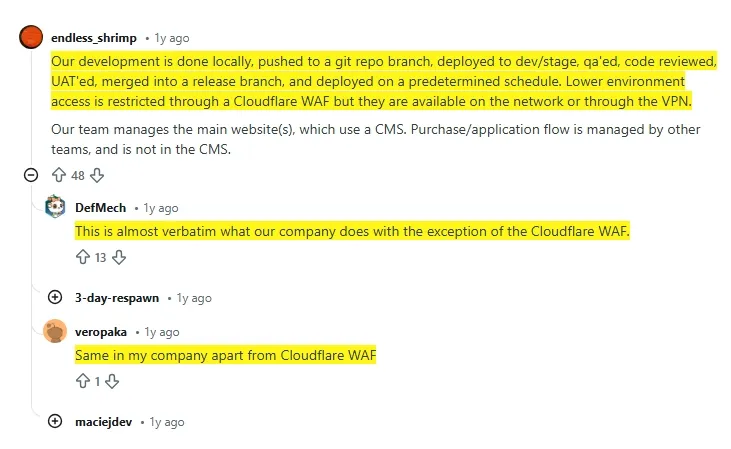
Large companies do not let developers touch the live site. All development happens on local machines. Every change sits inside a dedicated branch in Git. It keeps work isolated and traceable.
Developers test their code locally before sharing it. Once ready, they push it to the central repository and open a review request. Senior developers and peers check the logic, quality and security of the change. This review stage protects the codebase and ensures the change aligns with the project's long-term direction.
Experts share this same experience on Reddit about developing a site locally.
This process removes surprises. It also allows new developers to join the team without affecting the website's stability.
Large Sites Scale With Microservices, Distributed Databases
Large corporation websites do not work as a complete software package that does everything; they are divided into microservices, each completing a different task. An example would be one microservice that shows product pages; another microservice that processes payments, and another microservice that allows users to log into the website.
This separation of jobs allows large corporations to add to their website much more easily, as they can just add to one microservice when that microservice has a lot of use without slowing down the other microservices. By having each job completed in a separate microservice, the companies can also fix/update each microservice by itself without having to take down the entire website.
Large companies utilize distributed databases instead of having all data in a single database to accommodate large quantities of users and their extensive amount of data.
This way, large websites can maintain fast performance and security levels because the data is spread out over many servers, even if one of the servers were to fail.
Multiple testing environments keep the site safe.
Multiple testing environments keep the site safe. Enterprises use separate environments that copy the live site, allowing teams to test updates under controlled conditions. Development handles early integration, while staging mirrors production for full user journeys.
Some companies also run environments for performance and security tests. These setups stay behind secure access to prevent leaks.
By the time changes reach production, they have passed several layers of testing, which reduces the risk of public failures.
Automated pipelines handle builds and deployments.
Automated pipelines handle builds and deployments. Large companies never deploy updates by hand. The pipeline builds the code, runs tests on every push and blocks the release if anything fails. It checks unit tests, integration, security and dependencies.
After approval, it deploys the update to the correct environment. This automation keeps releases consistent and allows quick rollbacks when issues appear.
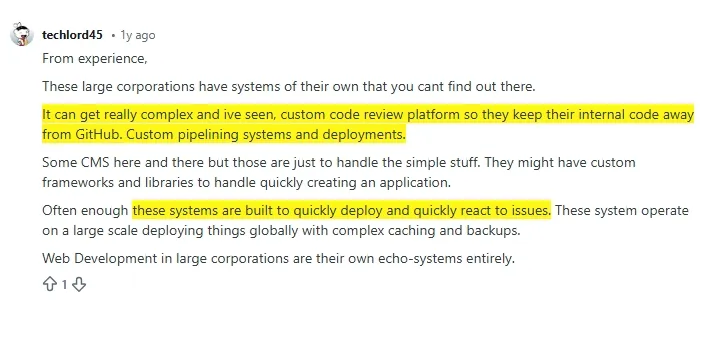
An expert on Reddit says these pipelines often run on custom internal systems. Some companies use private code-review platforms and in-house deployment tools to keep code secure and respond to issues faster.
Content and core features run on separate tracks.
Not all website updates require engineering work. Marketing teams often need to update pages, publish resources or run campaigns. Large companies give them a content management system. This system lets them change content without touching the code.
Core features such as login, checkout and account tools stay with engineering. This division protects the parts of the site that interact with user data or payment flows. It also lets marketing move faster without waiting for developer support.
Data protection stays central to the workflow.
Enterprises manage sensitive data. Because of this, they never use the production database on developer machines. They work with masked or synthetic data during development. Only a small number of authorized people can access real data, and even then, only in secure environments, reducing legal risk and maintaining user trust.
DevOps ensures the site stays available.
Once the site is live, DevOps teams handle monitoring, scaling and uptime. They use tools that track response times, errors, memory usage and traffic patterns. They fix issues before users notice anything. They also manage global caching and content delivery networks.
DevOps teams run backups and recovery plans. They also manage access to servers. This prevents unauthorized changes and protects the infrastructure.
A controlled cycle drives continuous improvement.
Large companies do not wait for a major redesign to improve the website. They work in small cycles. Each cycle includes planning, development, testing, and release. This keeps the site modern without major disruptions. When a full redesign is needed, they run it as a separate project with its own checks and timeline.
This predictable cycle is why enterprise websites scale smoothly as the company grows.
Further resources:
- How to Build a Design System for Your Company?
- How to Measure UX in Enterprise Applications (Step by Step)
- How Long Does it Take You to Develop a Website?
How Tenet Helps Large Companies Set Up Their Website Development
Tenet helps large companies set up website development with a structured and research-driven approach. We begin by defining user needs, business goals and the technical framework required for long-term stability.
Our design and engineering teams work together to create clear interfaces, secure architecture and smooth integrations with systems such as CRM, ERP and e-commerce.
With experience across corporate, government and retail projects, we focus on building websites that stay consistent, scalable and easy to maintain.
If you need support in planning or improving your website development process, you can speak with us anytime.
.
Build a scalable enterprise website. Talk to our experts for a free consultation.
Build a scalable enterprise website. Talk to our experts for a free consultation.


























Got an idea on your mind?
We’d love to hear about your brand, your visions, current challenges, even if you’re not sure what your next step is.
Let’s talk


