
Web Design Brief: What to Include Before Hiring an Agency
 By
By Share

Share
Get a quick blog summary with



Every week, our team speaks with businesses planning a website redesign or a completely new website. Despite operating in different industries, many face the same challenge: they don't have a clear web design brief.
Without documented goals, functionality requirements, user journeys, content needs, and project expectations, even the most experienced agency can only make assumptions when preparing a proposal.
Having delivered 450+ projects for clients across 15+ countries, we've seen firsthand how a well-defined brief leads to better decisions, more accurate estimates, and smoother website projects.
This guide explains what a web design brief is, why it matters, and the key information you should include before approaching a web design agency.
What is a web design brief?
A web design brief is a document that outlines what your website needs to do and what it will take to build it.
It typically includes business goals, target audience, required pages, functionality, integrations, content requirements, design preferences, SEO considerations, timelines, and budget.
Here is a screenshot showing what a web design brief looks like:
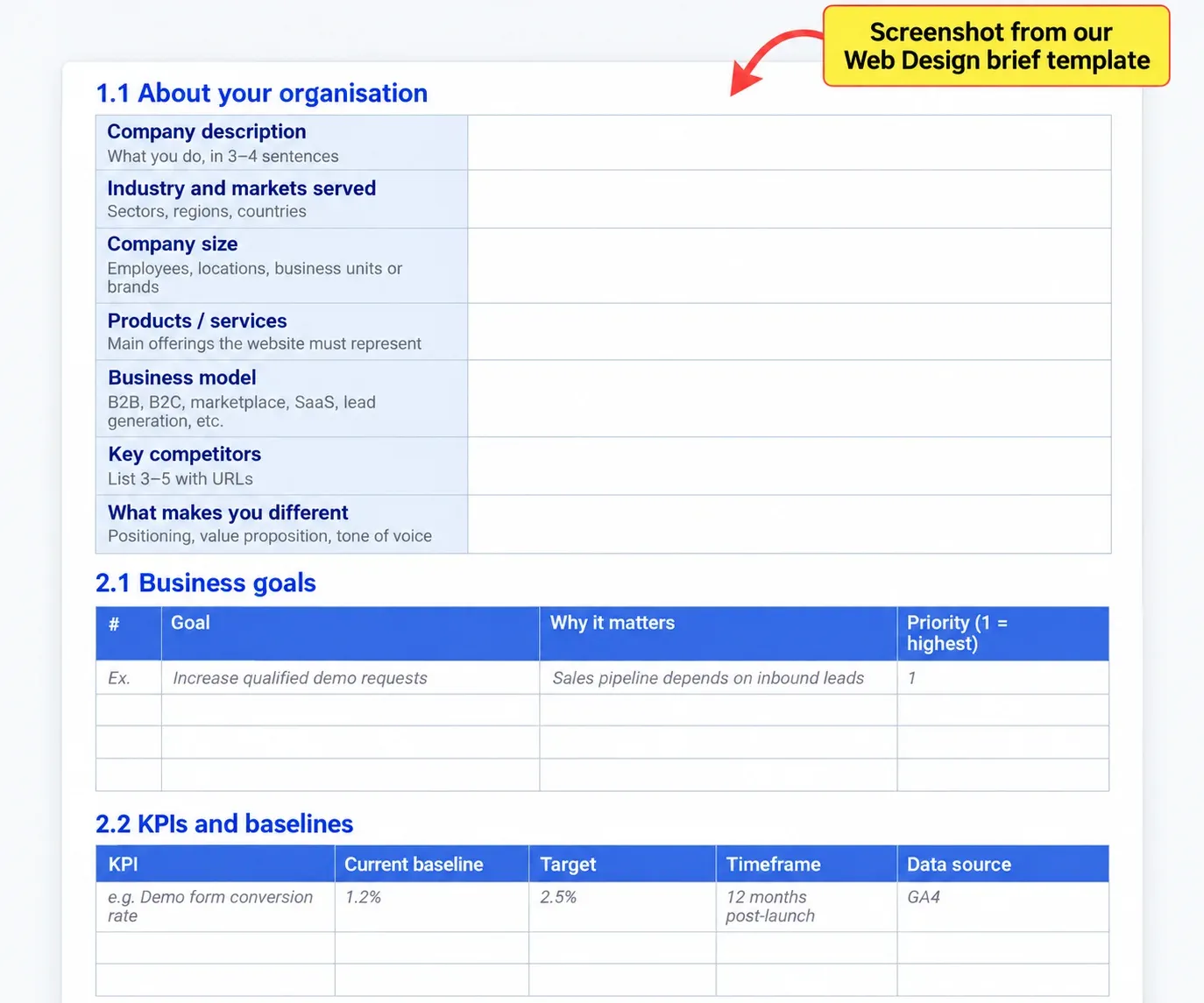
Design teams, developers, and agencies use this information to define the project scope, estimate costs, plan timelines, and understand project requirements before work begins.
Without a clear brief, agencies are forced to make assumptions when preparing proposals, which can lead to inaccurate quotes, scope changes, and unexpected project delays.
👉 Need help developing or redesigning your website? Request a free proposal at Tenet
Why do you need a clear web design brief before hiring an agency?
1. Helps agencies understand what you're actually trying to build
A website redesign can mean very different things depending on the business. The website's role, target audience, technical requirements, and growth objectives all influence how the project should be approached.
For example, two businesses might approach an agency with the same request: "We need a new website."
A SaaS company may want to increase demo bookings and integrate HubSpot, while a manufacturer may need a product catalogue, distributor locator, and support for multiple regions. Although both projects start with the same request, the requirements, scope, timeline, and budget can be completely different.
👉 Explore our website design services and get a free proposal
2. Helps you avoid paying for requirements discovered later
When agencies prepare a proposal, they're estimating the project based on the information available at that time. If important requirements are missing from the brief, they're unlikely to be reflected in the original scope or cost estimate.
For example, a company may request a website redesign and later mention that content needs to be migrated from hundreds of existing pages, integrated with a CRM, or managed across multiple languages. These aren't small additions.
3. Creates a clearer basis for timelines and budgets
Many businesses ask agencies for timelines and budgets before defining what the website actually needs to include. However, requirements have a direct impact on both cost and delivery time.
For example, two businesses may both need a 20-page website.
One may already have approved content, brand guidelines, and a finalized sitemap. The other may need help with content creation, SEO planning, multilingual support, and integrations with existing systems. Despite having the same number of pages, the projects are unlikely to require the same budget or timeline.
4. Improves the quality of agency recommendations
Businesses often approach agencies with a preferred platform already in mind. For example, a company may request WordPress because that's what its current website uses.
But that recommendation can change once the full requirements are known. A website that needs multilingual content, CRM integration, approval workflows, and support for multiple content teams has very different requirements from a standard marketing website.
A web design brief helps agencies identify these requirements before recommending a platform, website structure, or feature set.
5. Aligns internal stakeholders before the project starts
Stakeholder alignment is often treated as an internal exercise, but it has a direct impact on the website project itself.
If leadership, marketing, sales, and product teams have different expectations of what the website should accomplish, those differences eventually surface during content reviews, design approvals, and feature discussions. By that stage, changes are usually more difficult and more expensive to accommodate.
6. Creates a smoother project handoff from planning to execution
A website project typically involves multiple teams, including strategists, designers, developers, content specialists, SEO teams, and project managers.
When requirements only exist in meeting notes or email threads, important details can be missed as the project moves from discovery and planning into design and development. This often leads to clarification requests, rework, and delays that could have been avoided earlier.
👉 Relevant resources on UI/UX:
- Web Design Mistakes to Avoid
- Latest Web Design Trends
- How Long Does It Take to Build a Website?
- Website Redesign Examples and Lessons
- Progressive Web App (PWA) Design Strategies
- Website Navigation Best Practices
What should a web design brief include?
1. What the website needs to achieve
Before discussing design, functionality, or technology, define what the website is expected to accomplish. This could include generating qualified leads, increasing online sales, supporting recruitment, improving customer self-service, or strengthening brand credibility.
These objectives influence decisions throughout the project, from site structure and content strategy to conversion paths and feature requirements. Without clearly defined goals, it's difficult for agencies to determine what should be prioritized and how success will be measured after launch.
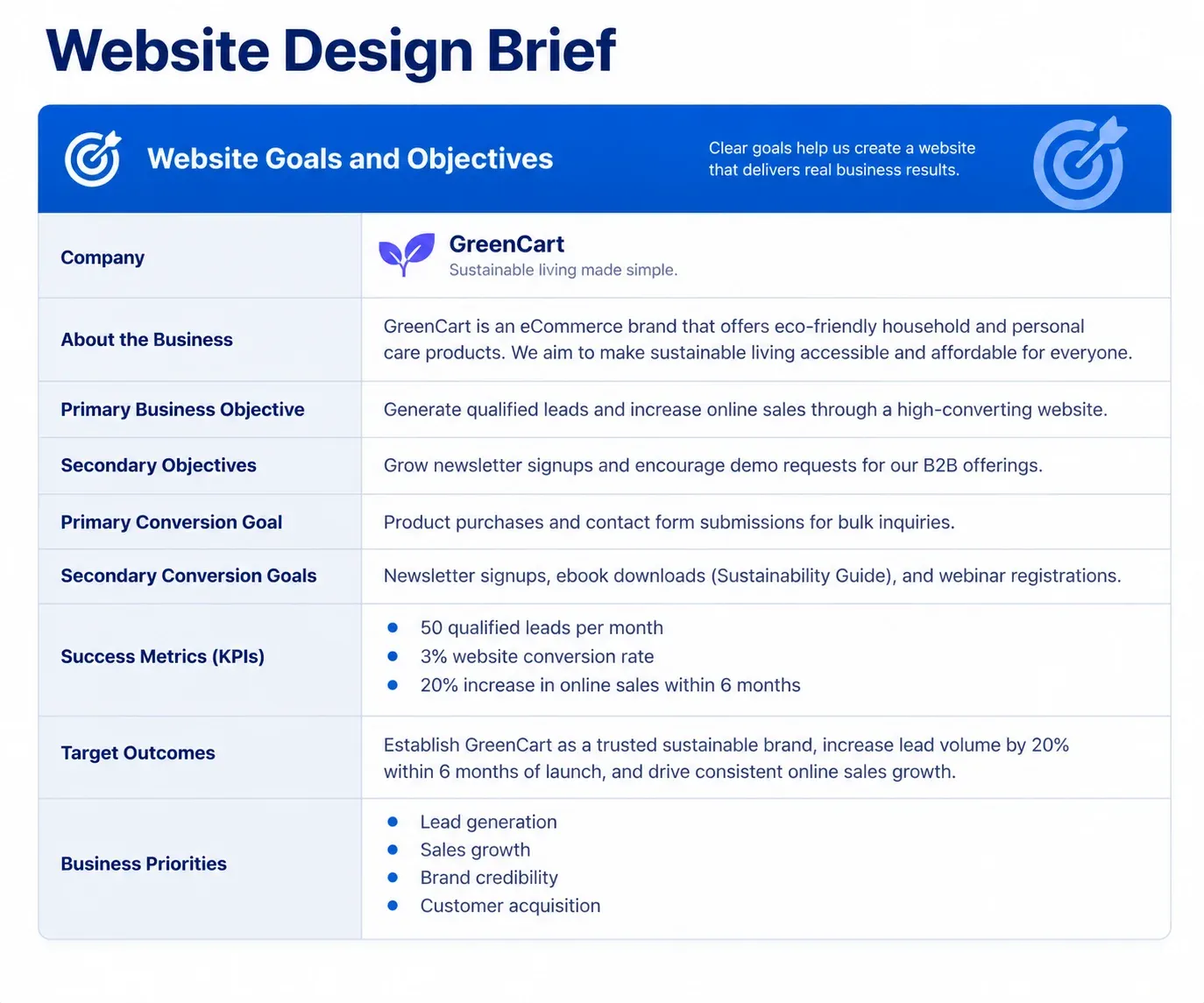
Here is an example of how website goals, conversion objectives, KPIs, and success metrics can be documented within a web design brief.
2. Who the website is being built for
A website designed for everyone usually ends up serving no one particularly well. Before planning content, navigation, or user journeys, it's important to define who the website is intended for.
This includes the primary audience the website is trying to reach, as well as any secondary audiences that may have different goals, questions, or expectations. Understanding who will use the website helps agencies make informed decisions about messaging, content structure, functionality, and conversion paths.
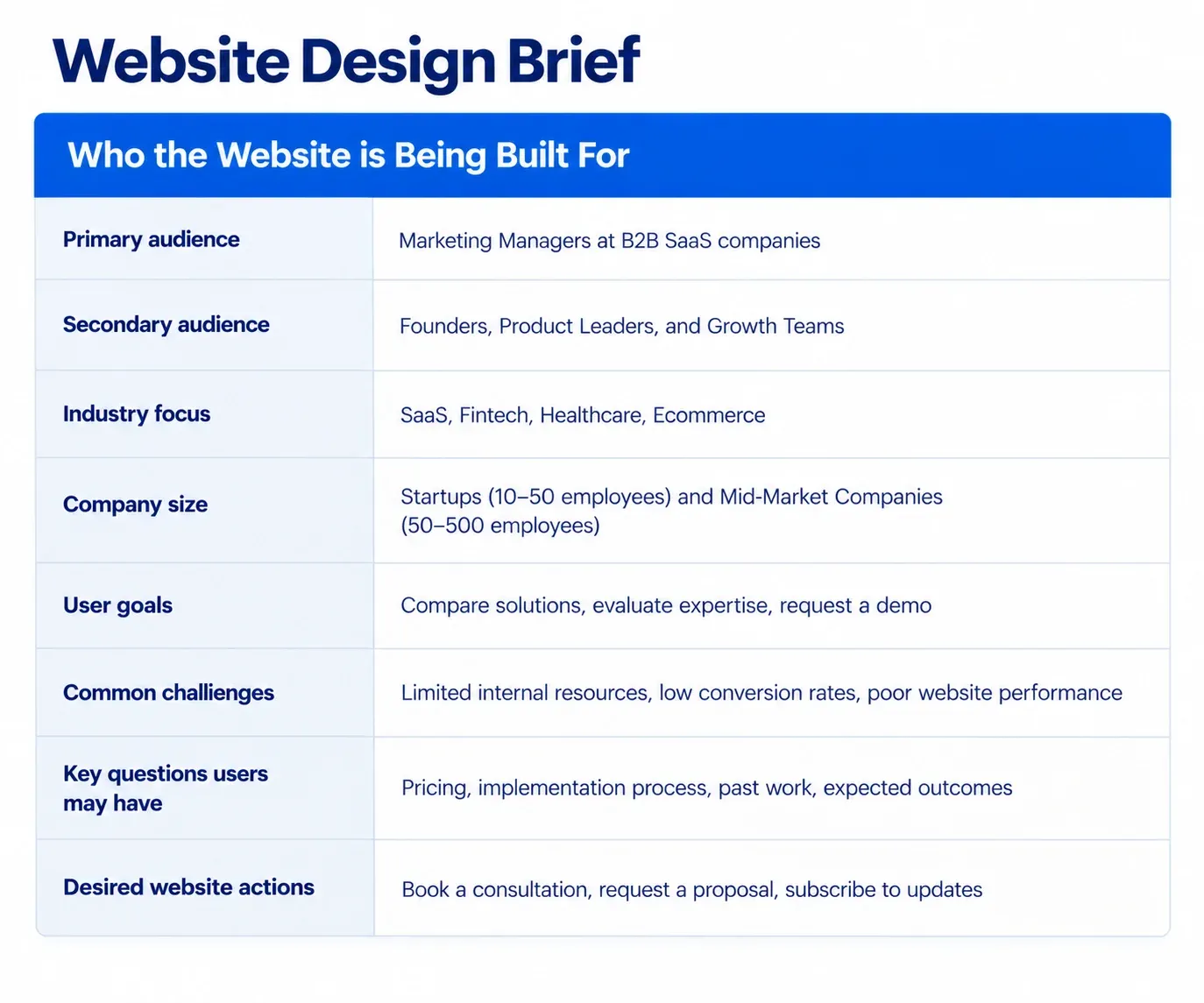
This example shows how businesses can define their target audience, user goals, common challenges, and desired website actions in the brief.
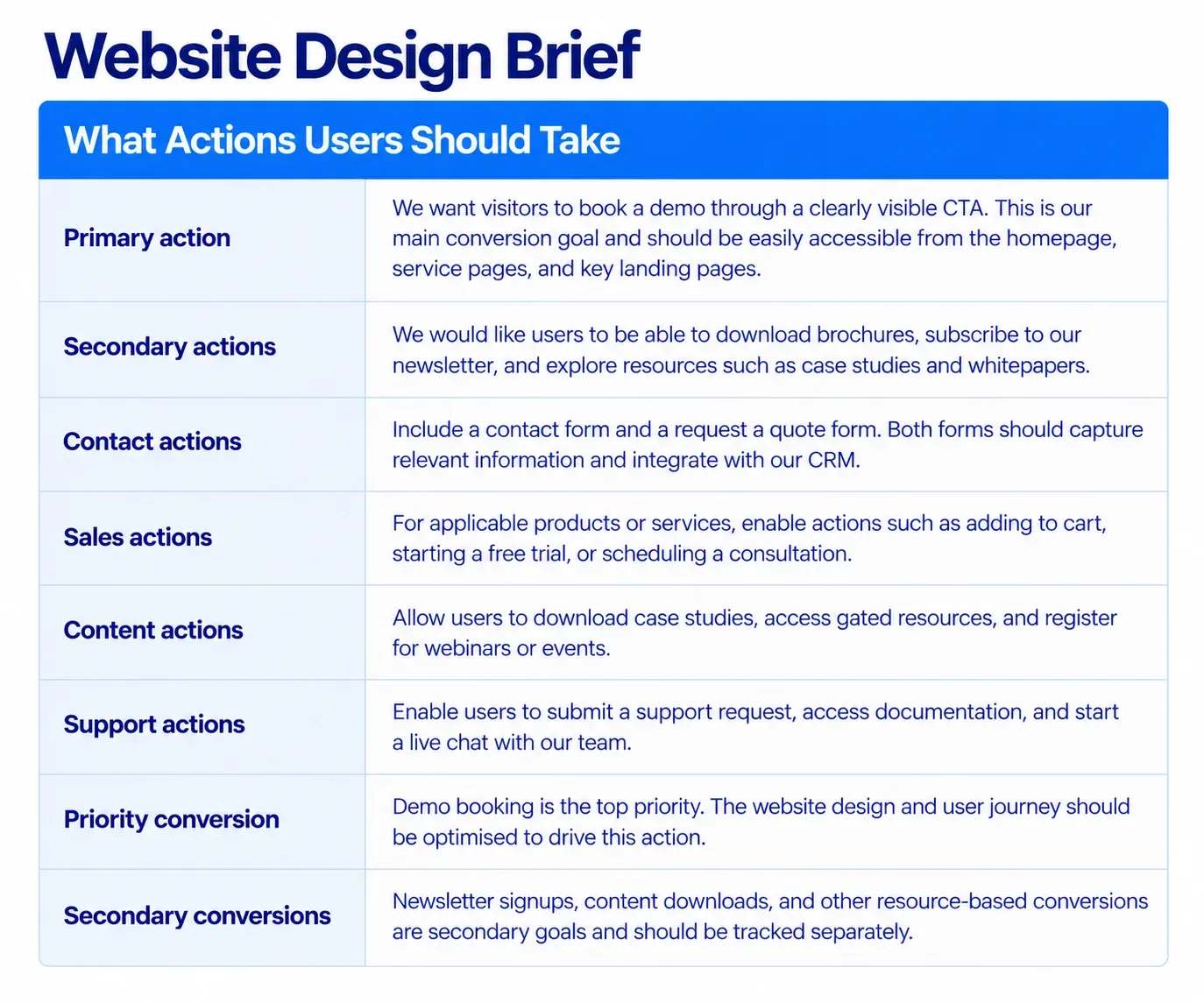
3. What actions users should take
Every website should guide visitors toward a specific action. Without clearly defined actions, it's difficult to determine what pages are needed, where calls-to-action should appear, and how success will be measured.
The actions users take will vary depending on the website's purpose. For some businesses, the goal may be generating enquiries or demo requests, while others may focus on online sales, content downloads, newsletter signups, or customer support interactions.
Defining these actions early helps agencies design user journeys around business outcomes rather than assumptions.
Here is an example of how primary and secondary conversion actions can be documented to guide website structure and user journeys.
4. Pages and content that need to be included
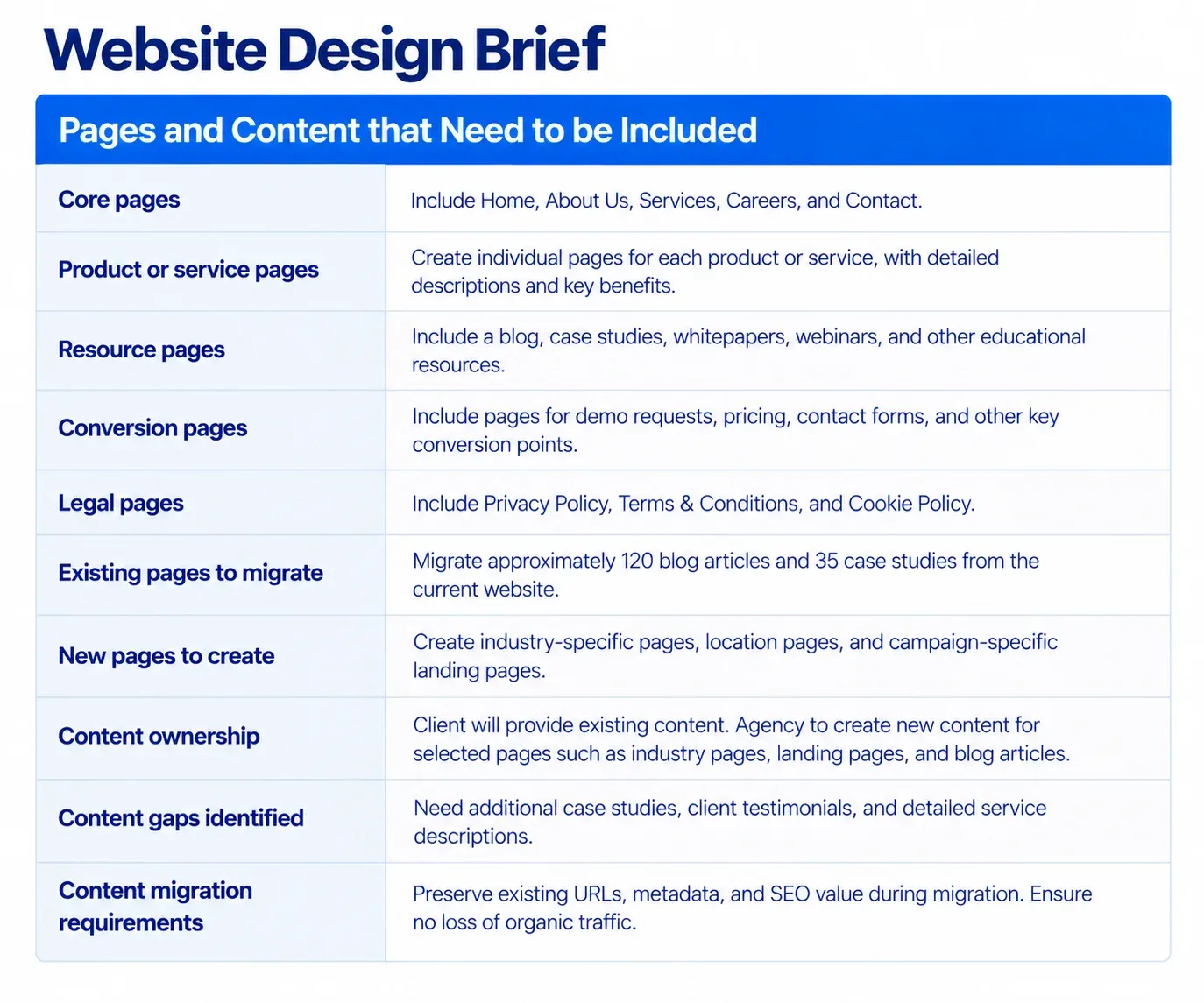
One of the fastest ways for a website project to expand beyond its original scope is when page and content requirements are discovered midway through the process. Listing the pages that need to be created, redesigned, migrated, or updated gives agencies a clearer understanding of the project's size and content requirements from the outset.
It also helps identify content gaps, dependencies, and areas where additional support may be needed, such as copywriting, SEO content creation, photography, or content migration.
This section of the brief outlines the pages, content requirements, migration needs, and content ownership responsibilities for the project.
5. Features and integrations required at launch
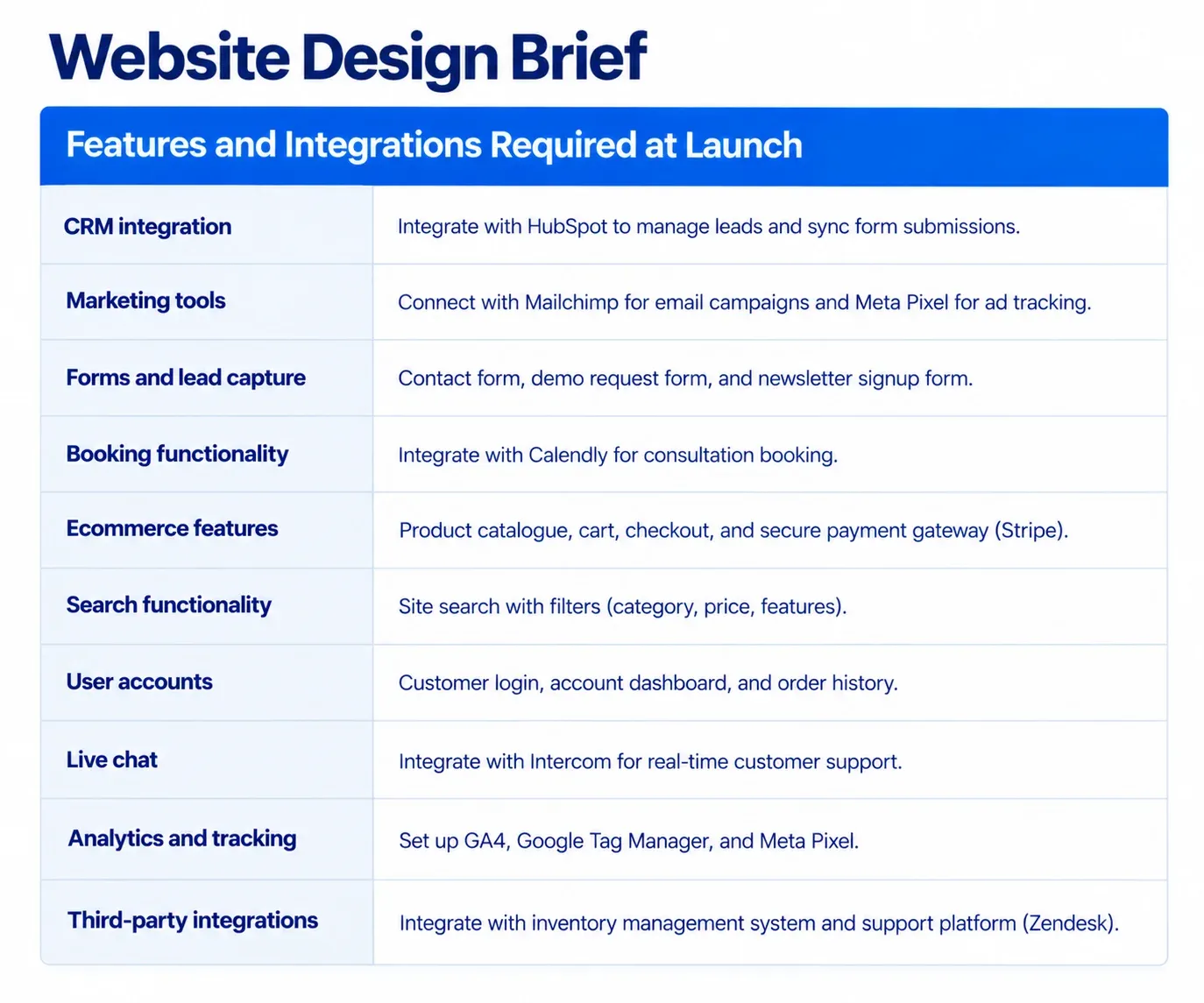
Functionality often has a bigger impact on project complexity than the number of pages. A website may look simple on the front end but rely on multiple integrations, workflows, and third-party tools behind the scenes.
Documenting these requirements early helps agencies understand the technical scope of the project and identify any dependencies before planning begins.
Here is an example of how technical requirements, integrations, third-party tools, and launch-related functionality can be documented in a web design brief.
6. Existing assets available for the project
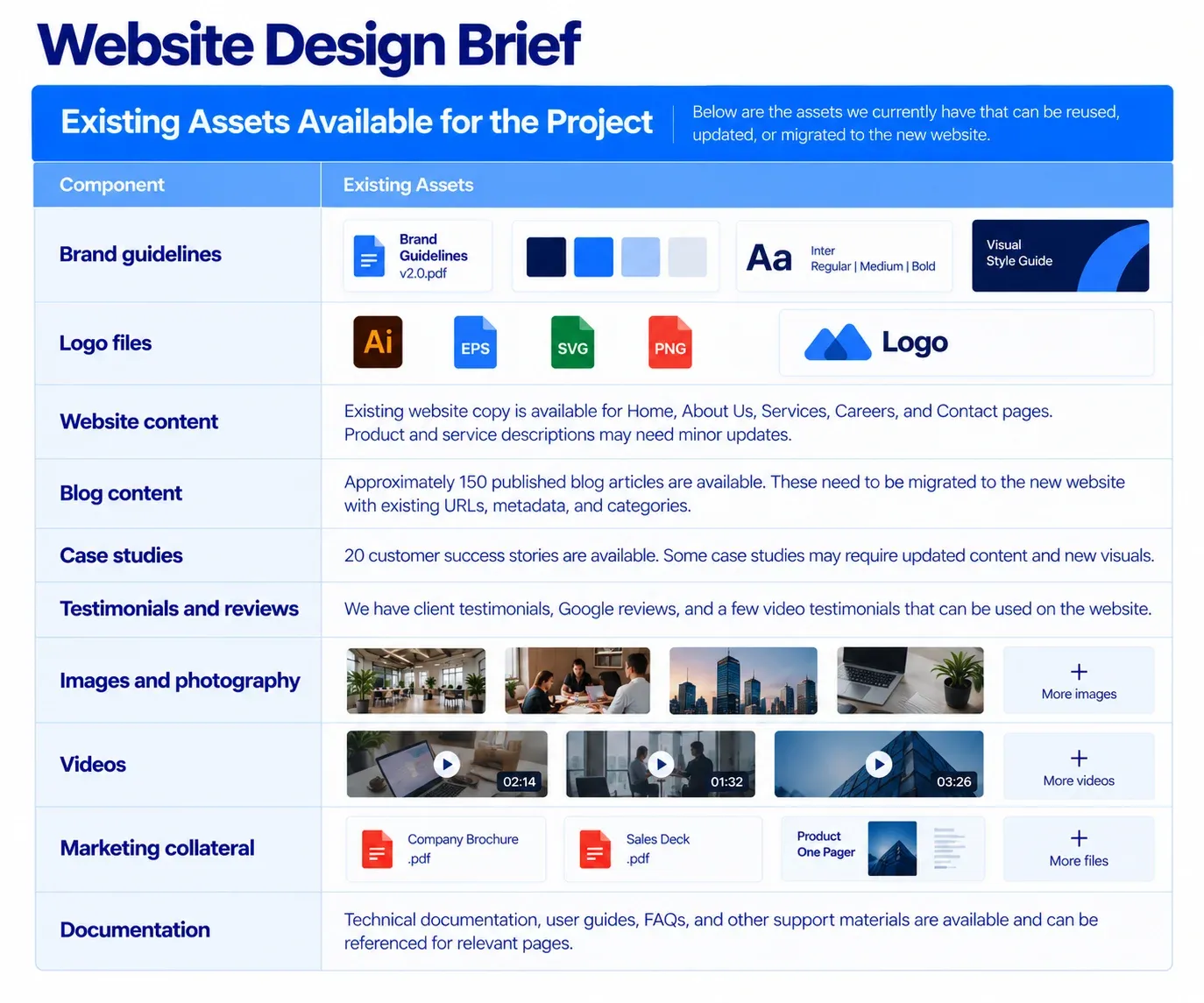
Not every website project starts from scratch. Many businesses already have assets that can be reused, updated, or migrated to the new website.
Documenting these assets helps agencies understand what is already available, what needs to be created, and where additional support may be required. It can also have a significant impact on project timelines, content planning, and overall costs.
Here is an example of how existing brand assets, website content, case studies, media files, and supporting documentation can be documented before the project begins.
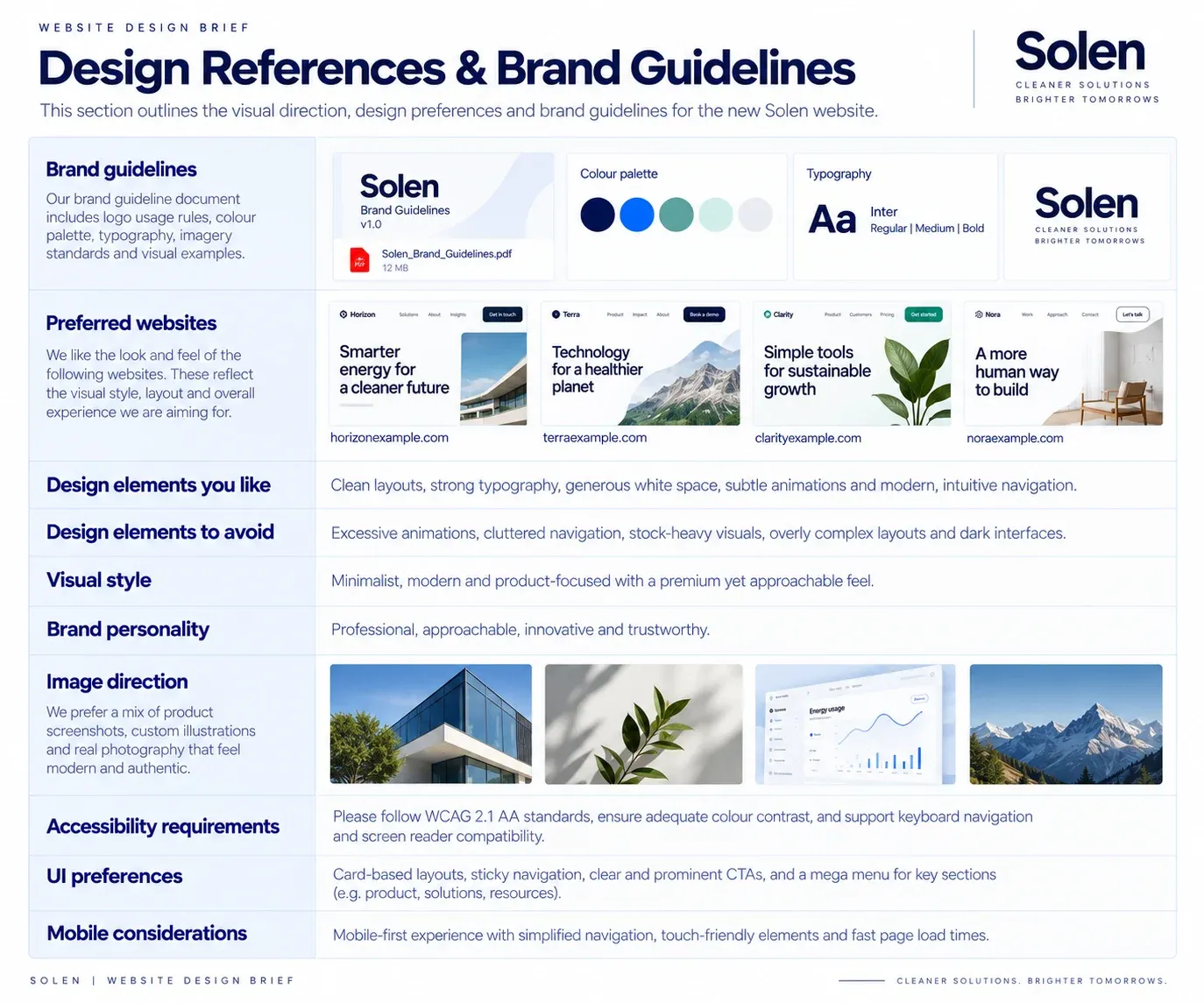
7. Design references and brand guidelines
Design preferences are often easier to communicate through examples than descriptions. Instead of stating that the website should look "modern," "premium," or "professional," provide references that demonstrate the visual style, layouts, interactions, and user experience you're looking for. This helps agencies understand expectations early and reduces subjective feedback during the design phase.
If brand guidelines already exist, they should also be included in the brief. Elements such as colors, typography, imagery, iconography, and visual rules help ensure the new website remains consistent with the brand's identity.
This example shows how design references, brand guidelines, visual preferences, and website examples can be included to communicate the desired design direction more clearly.
8. SEO, analytics, and tracking requirements
If the website already receives traffic from search engines, SEO requirements should be considered before design and development begin. Decisions related to site structure, URLs, content migration, redirects, metadata, and internal linking can all affect organic visibility after launch. The same applies to analytics and tracking, which are needed to measure performance and understand whether the website is achieving its goals.
Including these requirements in the brief helps ensure they are planned from the start rather than added shortly before launch.
Here is an example of how SEO requirements, analytics setup, content migration considerations, and conversion tracking needs can be documented within the brief.

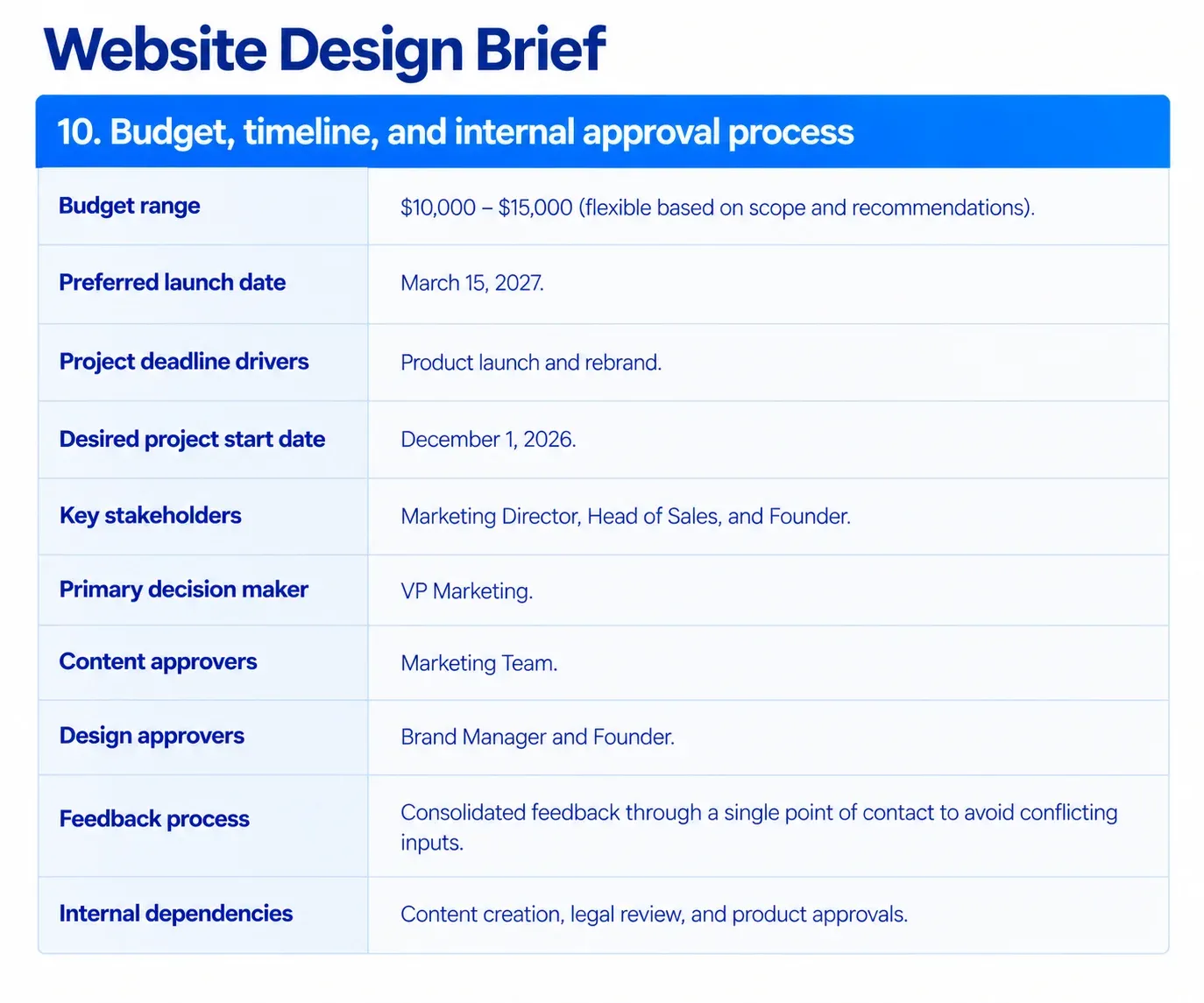
9. Budget, timeline, and internal approval process
Budget and timeline expectations help agencies determine what can realistically be delivered within the project's constraints. They also help shape recommendations around scope, priorities, functionality, and delivery approach. Being transparent about these parameters early in the process often leads to more relevant proposals and fewer surprises during planning.
It's equally important to document how decisions will be made internally. Many website projects involve multiple stakeholders reviewing content, designs, and functionality. Understanding who needs to approve key deliverables helps agencies plan review cycles and avoid delays caused by unclear ownership.
Here is an example of how project budgets, timelines, stakeholder responsibilities, approval workflows, and key deadlines can be documented before agency discussions begin.
Download website design brief template
If you'd like a starting point, we've created a free Website Design Brief Template that you can copy and customize for your project.
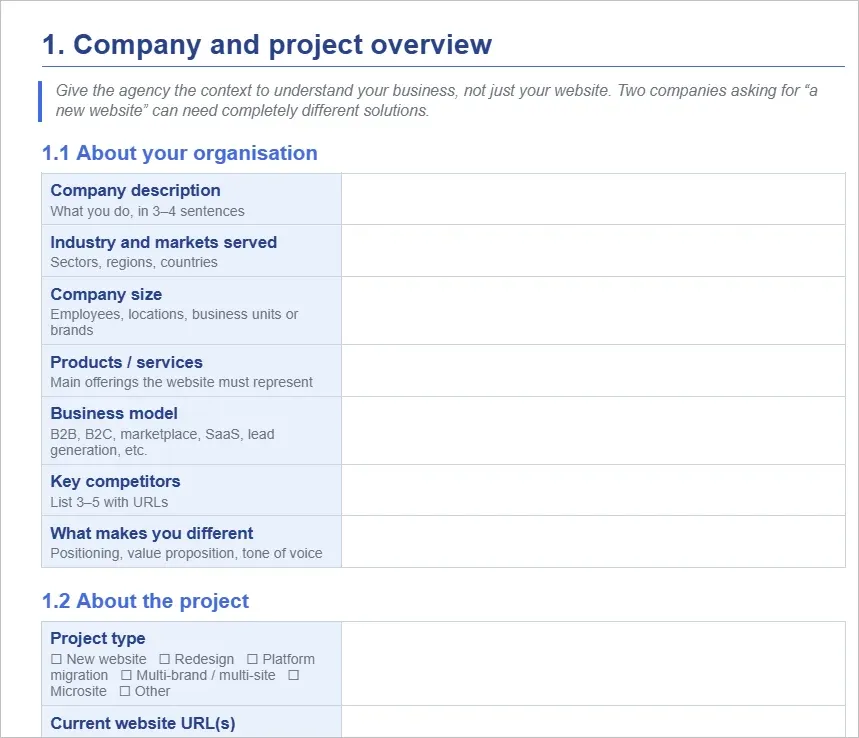
👉 Download the Website Design Brief Template (Word Document)
What happens after you send the brief to a web design agency?
Once an agency receives your web design brief, it will typically review the document, validate requirements, and identify any information needed before planning can begin.
Explore all website development case studies by Tenet
The process usually follows these steps:
- Brief Review – The agency reviews your goals, requirements, timeline, budget, and technical considerations.
- Questions & Clarifications – Any gaps, assumptions, or missing requirements are discussed before moving forward.
- Discovery Call – A deeper discussion focused on business objectives, users, website challenges, and project priorities.
- Proposal & Recommended Approach – The agency outlines the proposed scope, deliverables, timelines, and project approach.
- Quote & Agreement – Commercial terms are finalized and the project is formally approved.
- Sitemap & UX Planning – Information architecture, user journeys, and website structure are planned.
- Design – Wireframes and visual designs are created and reviewed.
- Development – Approved designs are translated into a functional website.
- Testing & QA – Functionality, responsiveness, performance, and content are reviewed before launch.
- Launch – The website goes live, and post-launch checks are completed.
At Tenet, we've worked on 450+ digital projects across SaaS, healthcare, fintech, ecommerce, and enterprise businesses. If you'd like feedback on your website requirements, project scope, or UX strategy before approaching agencies, our team can help.
👉 Request a free website design proposal
Need help turning your website requirements into a clear project plan? Talk to our web design experts today.
Need help turning your website requirements into a clear project plan? Talk to our web design experts today.




















Got an idea on your mind?
We’d love to hear about your brand, your visions, current challenges, even if you’re not sure what your next step is.
Let’s talk


